Furiosa: A Mad Max Saga

In 2015, Mad Max: Fury Road won six out of ten Oscar nominations, and, maybe more impressively, won the acclaim of fans and critics alike who respected the film’s craftsmanship, stunt work, acting, and moving storyline. Charlize Theron was universally picked as a highlight for her performance as Furiosa, a warrior who teams up with Max to free Immortan Joe’s harem of wives. 

Now, nearly ten years later, director George Miller gives us a prequel to Fury Road centered on Furiosa, although recast with Anya Taylor-Joy. The film follows Furiosa as a young girl (played impressively by Alyla Browne) as she is kidnapped by the crazed warlord, Dementus (Chris Hemsworth). Years later, once free from Dementus, Furiosa sets out on an epic journey to enact her revenge, and to find her way back home. 

Miller specializes in spectacle, and like Fury Road, this is a spectacle through and through. The action sequences are inventive (they never run out of interesting ways to use a car!) and the worldbuilding remains detailed and unique. The costumes and production design keep you immersed in this grotesque, bizarre world. The movie plays out in five chapters, adding to its grandiose feel, and the cinematography has a certain sheen to it that reminded me of a video game or comic book art style. It all succeeds in making you feel like you’ve been on a fantastical, if vile, journey. 

But is this a journey worth taking? While Furiosa certainly has pizzaz, I overall found it to be a letdown, an unrelentingly bleak exercise that doesn’t succeed in the same ways Fury Road does. Here is why:

First, in screenwriting, the conventional wisdom is that every scene should start with one emotion, and then end with another emotion. The conflict(s) within the scene should shift the character’s emotions, or the atmospheric mood. Stories and character arcs are built through this series of conflicts and turns. There should also be a use of contrast, where scenes of brevity, joy, or success are followed by more dramatic turns in the story. The moments of relief make the moments of suffering (and vice versa) all the more powerful.

In Furiosa, except for maybe two scenes where Furiosa is shown some bit of kindness, every scene is a deluge of bleak violence where everyone is trying to kill each other and no one expresses an emotion outside of stoic rage or deranged rage. There is no relief, and therefore, no contrast. I assume the intended effect is to get us into the despairing, survivalist mindset of Furiosa, but instead, it numbs us, and makes the story beats blend together without momentum. 

Second, there are no character arcs. No one changes in the film. Furiosa goes from a resourceful, brave child to a resourceful, brave adult. Her goal remains the same throughout the movie, and so do her methods. As a heroine, she is archetypal, but not individualized. That’s fine as an artistic choice, but it means this isn’t the insightful character drama one might hope for. Likewise, Dementus never changes. Joe never changes. No other character gets enough time to make a deep impression, and none of the characters interact long enough to have a real dynamic. Dementus and Furiosa interact when she is a child, but then they are separated for most of the movie until the very end. Furiosa’s love interest, Praetorian Jack (Tom Burke), is on screen for maybe 40 minutes, but then he’s gone and we don’t see the impact he has made on Furiosa.

Meanwhile, in Fury Road, Max and Furiosa learn to work together and trust one another. We see Furiosa mourn the loss of The Green Place. We see the wives and Nux interact. The characters interact in interesting ways and they change, which in turn makes the action more interesting to the audience because there are emotional stakes behind it. This is why I think Fury Road ultimately works better.

Despite all of these shortcomings in the script, I do think Furiosa is worth seeing if you really enjoy the Mad Max films and/or love action movies. The setpieces truly are impressive, and George Miller continues to take big creative swings. The film also lets Anya Taylor-Joy show more of her range, and it features a great Chris Hemsworth performance, allowing him to display a menacing bravado that may give his career a new life outside of being Thor. It wasn’t my cup of tea, and I think it doesn’t live up to Fury Road, but for some, there may be life in this wasteland.

Landscape with Invisible Hand

Landscape with Invisible Hand, based on the novel by the same name by M.T Anderson, is a small indie sci-fi film out in theaters now. I’ve been describing the film to people as “Nope meets Eighth Grade meets Sorry to Bother You,” for its alien invasion meets teenage deadpan coming-of-age angst meets an absurdist satire of capitalism. The story takes place in an America that, five years ago, was invaded by an alien species called the Vuvv, who brought with them advanced technology and medicine that has placed nearly all humans out of a job. Two teenagers, Adam and Chloe (Asante Blackk and Kylie Rogers, both terrific), decide to turn their budding romance into live-streamed content– a “courtship broadcast”– for the Vuvv, who do not experience love, and are so fascinated by human romance they are willing to pay for it. But as Adam and Chloe try to keep up their scheme, things get more and more complicated between them and their families, and they suddenly find more than just their livestream at the mercy of the Vuvv.

I have not read the book, so I can’t speak to this film as a work of adaptation. However, after seeing the film and looking up the book, it did not surprise me to discover the book is made up of a series of vignettes. While an attempt is made, the movie is unable to translate the book into a three-act structure and retains the vignette feel. Therefore the film feels disjointed, with each individual vignette having an isolated theme or critique. 

For example, there’s the first section, which explores the dehumanizing effect of romance being monetized. There’s another section where one of the Vuvv pretends to be Adam’s dad and, after watching old sitcoms, adapts sexist views towards Adam’s mother and tries to enforce a patriarchal structure within the home. There’s another section where Adam creates a piece of art in protest of the Vuvv, and the Vuvv then takes it and transforms it into pro-Vuvv propaganda, showing how those in power co-opt and silence dissident artistic movements. There’s a section where a homeless white man, living in the basement of a black woman, watches Fox News-esque TV and complains of how much more privilege she has than him and how things used to be better and different. These vignettes differ in the level of how compelling or well-realized they are, and because each section changes which character it is centered on, some characters disappear for long periods of time, meaning only Adam gets any real semblance of a character arc. 

That being said, as a thought experiment, I truly enjoyed Landscape With Invisible Hand. I love seeing an alien invasion movie where there are no world-ending stakes. It’s a slice-of-life drama about two families, in a world that is familiar but off-kilter. This is speculative fiction at its best, when it presents an alternative reality that we could still imagine and see ourselves in. 

There are other things to like about this film. The Vuvv are amazingly well-realized, from their design (these aren’t Roswell aliens! They’re incredibly unique) to the visual effects to how the actors interact with them. Tiffany Haddish, while I’m still not fully convinced is a great dramatic actor, continues a pretty solid run with this, Haunted Mansion, and The Card Counter. Props to her and her agent! Similarly, Josh Hamilton is quickly becoming one of my favorite actors, after his turn in Eighth Grade and this year’s excellent Reality. The production design makes this world feel lived-in and real while maintaining a stylized edge. And even with the vignette feel, the movie never drags, and there was also never a point in the story where I could predict what was coming next. 

If you enjoy science fiction, coming-of-age stories, satire, or just have already seen Barbie or Oppenheimer, I think this is certainly worth checking out. Like Adam and Chloe’s broadcast, the film is often more evocative of deeper feelings and thoughts than it is able to deliver on, but it’s entertaining nonetheless.

-Madeleine D.

A Man and His Silent Little Girl: The Midnight Sky and News of the World

*Spoilers for The Midnight Sky

During every awards cycle, there are what I like to call the “A-list” and the “B-list” of awards movies. The A-list award movies are the movies which are most certainly going to get nominated. This year, some of those films will probably include the likes of Nomadland, Minari, One Night in Miami, Judas and the Black Messiah, and others. Then there is the B-list, which are movies that have all the makings of award films and were clearly made with an eye towards awards, but are not going to get any major recognition. 

I believe The Midnight Sky and News of the World to be B-list award films. Neither has gotten quite the traction or critical reception they need to be top award contenders and while they may get nominated in smaller categories, I don’t see either as having a chance as top contenders. This is not to say they aren’t good, they’re just not quite as good as they think they are.

Along with being both B-list award films, they also have something else in common which I’d like to explore a little deeper. Both films feature older men who are accompanied on a journey by a young girl, who is either completely mute or speaks very little (or speaks a different language). This setup has become a trope, and one I think has fascinating implications. We’ll flesh that out further, but for now, let’s look at each film individually.

The Midnight Sky was released on Netflix in December. It is directed by and stars George Clooney, who plays Augustine, the last man on Earth. Augustine is trying to make contact with a group of astronauts on their way home who have no idea of the catastrophe that has wiped out civilization. Augustine discovers a mute young girl (Caoilinn Springall) to be left on Earth with him, and she joins him on the journey to warn the astronauts.  

The Midnight Sky looks beautiful, and Netflix obviously spared no expense in making it compete with the technical achievements of other recent space films, of which there have been many (Gravity, First Man, The Martian, Interstellar…). The setup of the film is intriguing as well, and there are a couple of exciting setpieces with Clooney and Springall fighting against the arctic wilderness. However, The Midnight Sky promises a meditation on grief and loneliness which never really lands. There are too many characters and none of them get their due, and there is too much vagueness about the catastrophes of Earth to feel real or unnerving. The cinematography is the most beautiful and interesting thing about it. 

Meanwhile, News of the World reunites director Paul Greengrass and Tom Hanks after they worked together on Captain Phillips. Here, Hanks plays another captain, Captain Kidd, a man who makes his living going from town to town reading newspapers. When he comes across an orphaned young girl (Helena Zengel), he decides to take her on an arduous journey to get her to her relatives. The use of the immediate post-Civil War setting and its atmosphere of paranoia and distrust, along with the film’s emphasis on stories and the role of journalism (which brings to mind Hank’s role in 2017’s The Post) make News of the World feel timely without being too preachy (save for a few scenes). However, the relationship between Kidd and the kid is clearly the film’s emotional core, and most of that comes from Hanks. The screenplay does very little to establish why Kidd makes the sacrifices he does for the girl. Instead, the film relies on Hank’s casting. Why does Kidd drop everything to go on this journey for the girl’s sake? Because he’s Tom Hanks! Do you think Tom Hanks is going to let anything happen to a child? No! Because he’s Tom Hanks, and Tom Hanks always does the right thing, and that is that. From this foundation, Hanks and Zengel are able to build a more fleshed out, interesting relationship which carries the film. 

Both films are fine, with News of the World edging out as the better one. Yet what I find interesting is how they embody this emerging trope of a gruff older man + near-silent young girl. I first noticed this dynamic in 2017’s Logan, with Hugh Jackman as Logan/Wolverine and Dafne Keen as Laura/X23, but other examples can be seen in War For the Planet of the Apes, Eleven in Stranger Things, Boo from Monsters Inc, along with many other variations. Vulture, upon the release of Logan, published an article about this phenomenon (with a focus on violent little girl characters), which includes the key observation that the girls in these roles “[exist] to be observed as an object of contemplation.” No matter how much agency she has in the story, her presence is something that causes the leading man to reflect upon himself, usually about his failings as a father, or what could have been. This is most explicit in The Midnight Sky, where it is revealed the little girl is not even real, but is George Clooney’s character imagining his daughter, who is actually Felicity Jones’s astronaut character. 

Now I am actually quite fond of this trope, and it’s easy to see its appeal. What is the similarity between the apocalypse of The Midnight Sky and the wild frontier of News of the World, or the world of the X-Men, or a science-fiction dystopia? Parenthood! Men embracing their paternal instinct! Drama is created through differences and contrasts, and since an older man and a young girl are seen as opposites, characters with this dynamic automatically have great cinematic potential.  

Yet, while emotionally this is an engaging trope, it comes at a cost. It is great to see these movies and genres- science fiction, western, superhero, etc.- that have traditionally been unwelcoming to women, now include them and allow young girls to see themselves in the picture through this trope. But the silence of these young girls, and how they rarely have personalities beyond being objects of observation, means they are not really characters. They could be replaced with a dog the male characters loves, and nothing would change. I wonder what it would be like to replace many of these little girls with grown women who come alongside the protagonist and join them as equals (maybe even without an obligatory romance!). Or, at least, if these young girls are allowed to speak, and take action in these stories. 

Consider that there is no equivalent trope for young boy characters. You don’t see many movies where older women are taking young boys under their wing. Firstly, because older women don’t exist in film. Secondly, if a young boy is in a film, they’re usually going on their own adventure. They’re not there as prompts for other characters to discover more about themselves. These boys are active agents of their own adventure. They are being prepped to be the next Tom Hanks or George Clooney, and maybe one day will be old enough to have their own silent surrogate daughter. 

– Madeleine D

Demonic Eden: Vivarium

vivarium__2.301.1.t_8a3677e8-5b3e-ea11-a9a6-0edcbcd33718

*Spoilers

Can you imagine being trapped inside of your home for days on end, only being able to be with your housemates, unable to leave your house because nothing is open and there’s nothing to do and there is a looming threat of death?

Well most of us by now actually do know what that is like, thanks to shelter-in-place and quarantine orders. But in case you want to relive the claustrophobia, Vivarium, a small horror movie that got lost in the COVID shutdown of theaters, is here to give you just that, except this time with a lot more metaphor and existential wandering!

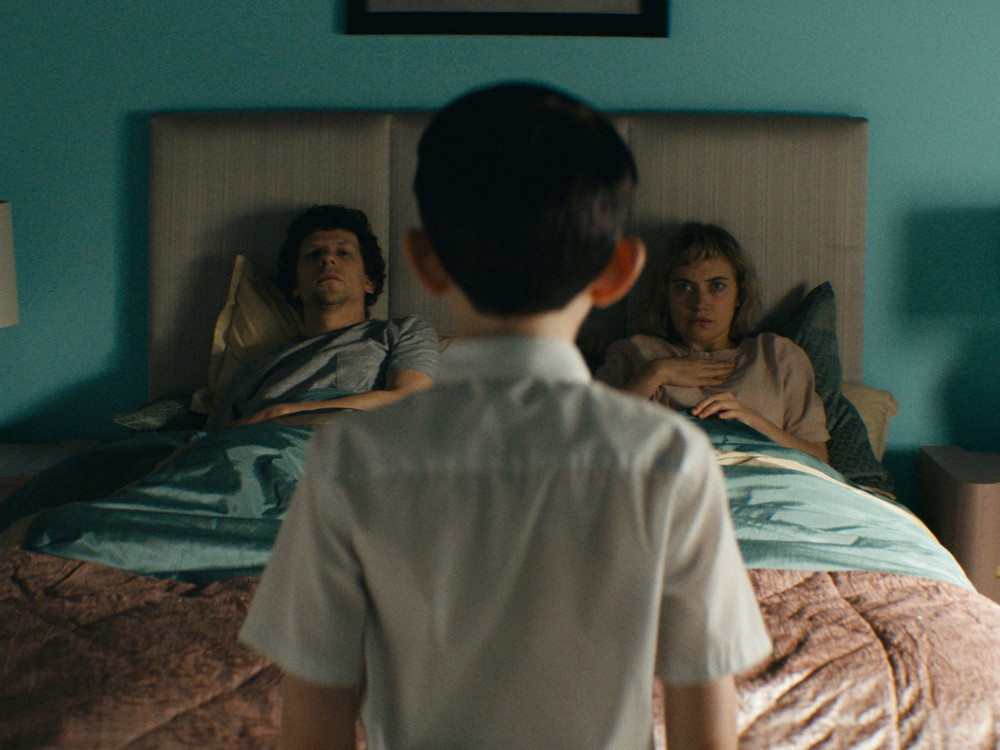
The movie tells the story of Tom (Jesse Eisenberg) and Gemma (Imogen Poots), a young couple who go to look at houses in a suburb called Yonder. When they try to leave the neighborhood, they find themselves driving in circles. There is no exit in the empty, lifeless maze. Gemma and Tom return to the house to find a box of supplies at their doorstep and a baby boy, with only a note saying that they must raise the baby, and only then will they be released. 

Vivarium is full of interesting horror imagery and promising ideas, but is devoid of emotion. This is primarily because of our two leads. The film spends little time setting up the characters and their relationship. We only get the vaguest sense of how deep their bond is, or their individual personalities, and the moment the kid comes into their lives, they become stripped of all individual identity. This is because Tom and Gemma are not characters so much as they are archetypes.

They are archetypes for Man and Woman, Father and Mother, Husband and Wife, even Adam and Eve. Vivarium turns out to be a long extended metaphor for parenting, and, specifically, gender roles in parenting. And it’s a pretty bleak one, considering that the characters are stripped of individuality once they become parents and in what the movie shows their roles to be.

First, there is Tom. Tom never bonds with the boy. He goes through the motions of taking care of him, but he won’t even call the child “him;” he calls the child “it.” When he discovers that the grass outside can be dug into, he begins digging day in and day out, hoping it will lead to some kind of escape. It brings Tom a sense of purpose and is initially out of a noble desire to help him and Gemma, but soon it’s clear that nothing will come of it, and the work quickly devolves into an act of selfishness and avoidance. And this big hole he digs? Well, it turns out that Tom is literally digging his own grave. It brings to mind the curse given to Adam in the Garden of Eden: 

“‘Cursed is the ground because of you;  in pain you shall eat of it all the days of your life; thorns and thistles it shall bring forth for you; and you shall eat the plants of the field. By the sweat of your face you shall eat bread, till you return to the ground, for out of it you were taken; for you are dust,  and to dust you shall return” (Genesis 3:17-19). 

Tom works the ground relentlessly for nothing, and he returns to the ground in death. Tom’s actions speak to the difficulties men struggled with for years- what it really means to be a provider for a family, and the temptations to use work as a self-centered escape from the stresses of family and domestic life. Tom’s desire to protect Gemma is twisted and beaten down until he’s a hollowed-out shell, and he bears the shame of not being able to defend his family from external forces. 

Then there is Gemma. While she refuses to call herself the boy’s mother, she quickly reveals a reluctant maternal instinct towards the boy. She protects the boy from Tom and tries to engage and teach him, but she is punished harshly for her efforts. This too echoes the curse upon Eve:

“I will surely multiply your pain in childbearing; in pain you shall bring forth children. Your desire shall be contrary to your husband, but he shall rule over you” (Genesis 3:16). 

Like many women, Gemma’s relationship with the boy, her appointed child, is full of strife and suffering. Her well-being becomes codependent on his. She and Tom struggle for power and leadership in their relationship, and Gemma even suffers violence from Tom. The fractured relationship between the two allows for some Freudian implications for Gemma and the boy. At one point the boy spies on Tom and Gemma having sex and later, when Gemma lies down beside the boy one evening, he puts his arm around her in a suggestive manner, while Tom is asleep outside in the hole in the ground. Oedipus much? Again, representing womankind, Gemma carries the weight of the home’s brokenness. 

At the end of the film, Tom works himself to death, and Gemma is left alone. When the boy is completely raised, the boy kills her, her usefulness finished. While this is obviously extreme, it isn’t too far from what many women feel as they age and when their children leave the nest- older women are routinely rendered invisible, hit with the double whammy of ageism and sexism in the larger society. They are not seen as being sexually attractive, are no longer marriageable or able to bear and raise children, and are often professionally stunted. So in other words, they have none of the things that our society sees as making a woman worthwhile. 

All of this leaves the question that must come with stories that function primarily as allegories or metaphors: what’s the point? Vivarium says that life sucks, we’re stuck with generational sins, the genders will struggle forever for power and domination, you’ll either die from capitalism or social marginalization, and child-rearing is a trial. Oh, and the suburbs are evil. So what?

Simon Abrams expresses this frustration well in his review for the film, saying, “Understood, but who cares? If all you can show me is what you think isn’t genuine, you leave me with zero idea about what you think authenticity looks like, or why I should care.” Vivarium is an interesting watch, to be sure, but because the film doesn’t have any substance outside of its metaphor or anything to root for or offer up as an authentic alternative, then it accomplishes nothing but to reinforce despair. Like we need more of that. 

-Madeleine D. 

Movie Minute: Alita, Isn’t It Romantic, and How To Train Your Dragon 3

College is hard, but not as hard as finding good movies to watch between January and April! Here are some that I’ve seen during the beginning-of-the-year movie desert.

Alita: Battle Angel

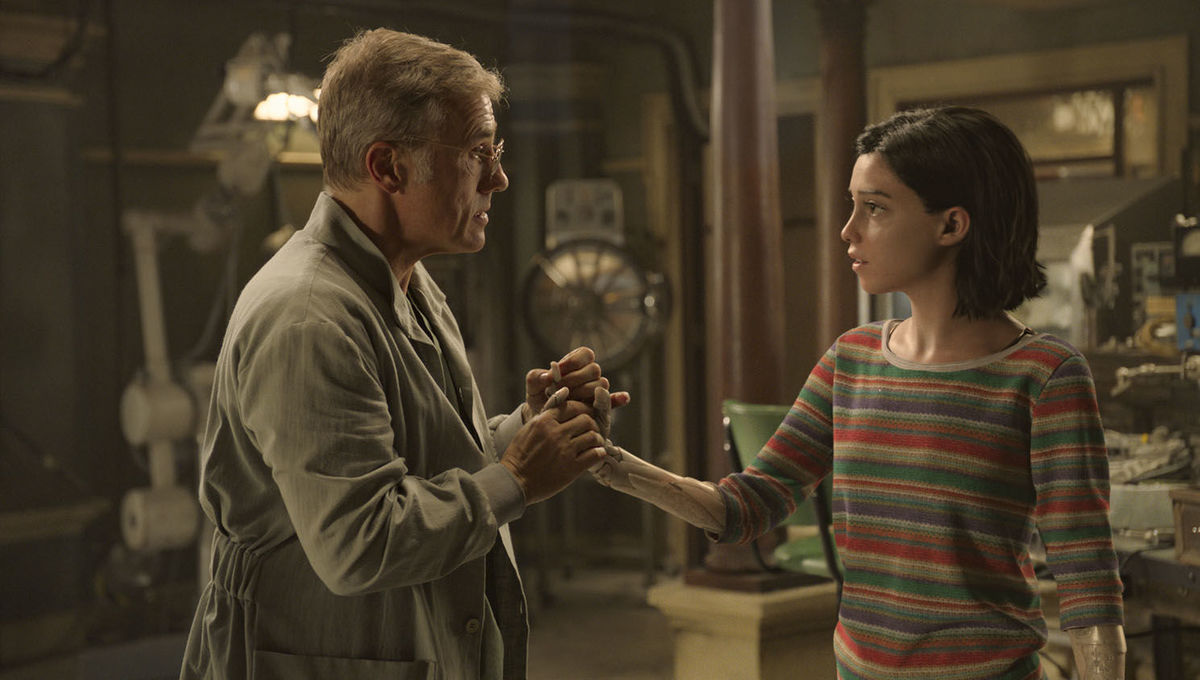
Related image      Wow, I didn’t know Christoph Waltz was making a second Big Eyes movie!

If anyone was excited for Alita: Battle Angel, it was me. Sure, I’ve never read the comic, and I’m not into anime or manga. But as far as general audiences go, I was ready to love it, because I’m a sucker for a bunch of things promised in this film. A teenage heroine in a dystopian future? Check. Oscar-winning actors in crazy costumes saying hilarious sci-fi jargon? I admit it. Trope of a scientist who goes too far in playing God? Sign me up.

But now I’ve seen it, and now I’m grumpy.

Alita: Battle Angel takes place in a dystopian future where Dr. “father figure at the ready” Ido (Christoph Waltz), a doctor/scientist/scavenger/”hunter-warrior”/Sad Man with a Sad Past™ finds the still-alive brain of a cyborg girl. He puts that brain into the conveniently pre-made cyber body he has, and when the girl, Alita (Rosa Salazar), comes to, she has no memory of her previous life and goes on a series of adventures to discover who she is.

To put it delicately: the script is bad. Real bad. There are too many characters whose arcs go nowhere, the plot is mangled and disjointed, and there is no sense of time in this film. In the first twenty minutes, we know a day has passed, and then after that, there is no sense of a timeline. How long as Alita been with Ido? How long did it take her to become a Hunter-Warrior? Has she really been with romantic interest Hugo for only two days by the time she’s literally ripping out her heart for him? It’s the halfway point of the movie, and I still have no clue the direction of the film or what it is going to be focused on. We’ve been introduced to father/daughter drama, boyfriend drama, big bad guy in the sky drama, hunter-warrior bully drama, gotta find my new sexier body drama, and motorball drama. Which direction are we going in? Oh wait, all six? All six storylines are going to be treated with equal focus so that the main storyline is super unclear and without any sense of urgency?

Well okay then.

If I was to try and find a theme or coherent storyline in this mess, I would say that the film is about all of the characters trying to force identities upon Alita. Ido wants Alita to be his replacement daughter. Hugo wants her to be his girlfriend who he may eventually scrap for parts. Gina Rodriguez wants her to be a soldier. Mahershala Ali wants her to be dead. Jennifer Conelly wants her to be dead. Edward Norton wants her to be dead (seriously, this cast is insane.) 21st Century Fox wants her to be a massive box office hit. But Alita decides to become none of those things.

Yet while all of that is in the movie, it’s not presented as I just presented it, because I don’t think writer/producer James Cameron and director Robert Rodriguez actually see anything wrong with the way the other characters treat Alita. I see the empowerment coming from her asserting her own identity and redefining her relationships with people on her own terms. They see the “empowerment” angle as coming from her beating people up. 

But hey, maybe this whole movie was worth it for the sheer spectacle of watching a scene where, and I’m not kidding, Christoph Waltz is cradling the decapitated, talking head of Alita, and walks past his character’s ex-wife, played Jennifer Connelly, who smirks and says, “you can’t bring our daughter back.” End of scene. I can never unsee it.

Isn’t It Romantic

Image result for isn't it romantic

Aspiring to be the Deadpool of romcoms, Isn’t It Romantic suffers from being very ill-timed. A film about a cynical, modern woman trapped in a romantic comedy, it delivers a meta-commentary of the genre as it was twenty-five years ago. The film’s loving critique comes only from films that were made between the 1990s and early 2000s. That would have been fine a few years ago, but we’re currently in a new, more diverse and inclusive romcom renaissance with the likes of The Big Sick, To All the Boys I’ve Loved Before, and Crazy Rich Asians. So while the throwbacks are fun, they don’t feel relevant, putting the entire movie’s premise on a bit of an outdated and uninspired note.

But for what this movie is, it is unabashedly fun. The musical numbers are delightful, the message is easy but sweet, and Rebel Wilson is a capable leading lady with this perfect supporting cast. It’s a rental, but I’d be lying if I didn’t say it put a smile on my face… and made me want to go watch my favorite romcom.*

How To Train Your Dragon: The Hidden World

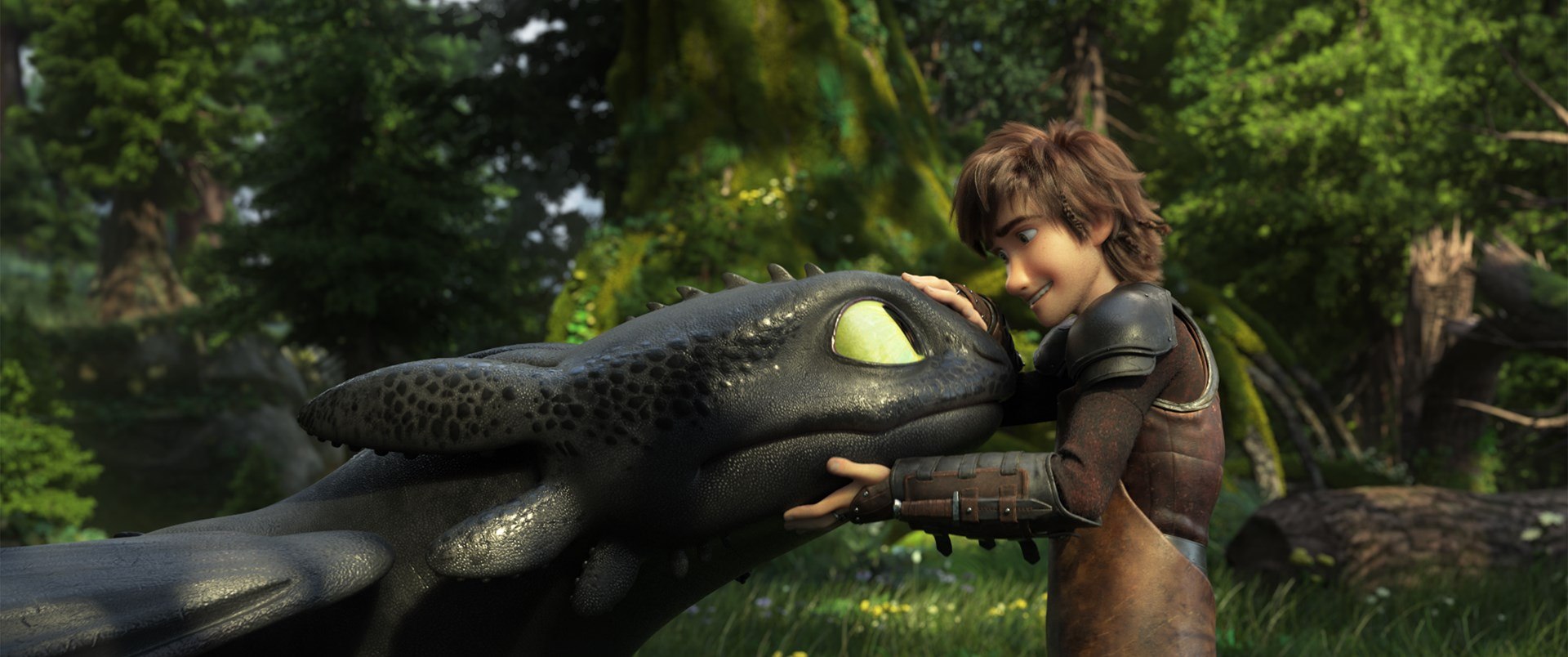
Related image

The How To Train Your Dragon movies weren’t a pivot part of my childhood like some fans of the series. I saw the first one in theaters and liked it, but didn’t like the second one as much. I’ve always had great respect for the franchise and how revolutionary it was in the animation world, but never truly got why it is so beloved. 

But when I went to go see this film on a whim, with zero expectations, I suddenly understood why people were such hardcore fans of these films. Because they’re awesome.

The animation, score, action sequences, and the characters? Breathtaking, detailed, and compelling. This movie is able to have an epic scale but an intimate narrative. I was particularly surprised that the message of HTTYD3 basically boils down to: part of becoming a man means committing to your loved ones and settling down. I know the audience for this franchise has grown up alongside it, but there is a lot of nuanced (and funny) conversations about responsibility, marriage, and family here that are not only rare for a movie aimed at families but especially for a movie starring a male lead. Hiccup has always been a wonderful role model, but I was reminded just how revolutionary and inspiring his brand of compassionate and empathetic heroism is. He’s a true leader in a way that I think is still rare to find in blockbusters.

Even if you haven’t seen these movies in a while, or only saw the first one, I think you can still go into this movie cold and enjoy it, and I highly recommend you do.


*13 Going on 30. And if you disagree with me, a friendly reminder that this film stars Elektra, the Hulk, Captain Marvel, Ulysses Klaw, Ant-Man’s ex-wife Maggie, and Silver Fox from X-Men. It’s an MCU movie, confirmed.

Triple Feature: Crazy Rich Asians, The Meg, and The Fundamentals of Caring

I emerge from the abyss of college, with darker rings under my eyes and a smaller bank account, to bring you hot takes on a couple films that have been in theaters for a while now.

Crazy Rich Asians

Image result for crazy rich asians

Overall? It’s charming, but forgettable. However, this is only the second film with an all-Asian cast ever made in Hollywood, and to hold it to a ridiculous standard of perfection in order to justify its existence is…ridiculous. If you like romantic movies that make you believe in love again, then go see it. It’s a visually stunning film with a talented cast. It’s not particularly funny, even though it was billed as a rom-com, but it’s very sweet. If you had plans to see it, see it, but otherwise, I recommend a rental.  

On a side note, a personal shout-out to director Jon Chu, who is only mediocre here, but directed one of my favorite bad-movies of all time, Now You See Me 2. Keep having a wildly varied career, Jon.

The Meg

Related image

It’s like the last twenty minutes of Jaws, but without any of the good directing, writing, or constraint. But if you just want to enjoy the thrill, The Meg delivers. It tries very hard to make you care about every one of its 10+ character cast, but so much happens that you forget which characters are alive and which are dead. While I appreciate trying to put human emotions into this film, none of it comes across as very genuine or earned. Truly, the movie’s best parts are Jason Statham being used as live shark bait, and if it had stuck to its strengths, the movie wouldn’t feel as long as it does, and have as many fake-out endings as Return of the King.

The Fundamentals of Caring

Image result for the fundamentals of caring

This is actually a 2016 Netflix movie, but I’m reviewing it anyway. This is what happens when Moviepass fails me.

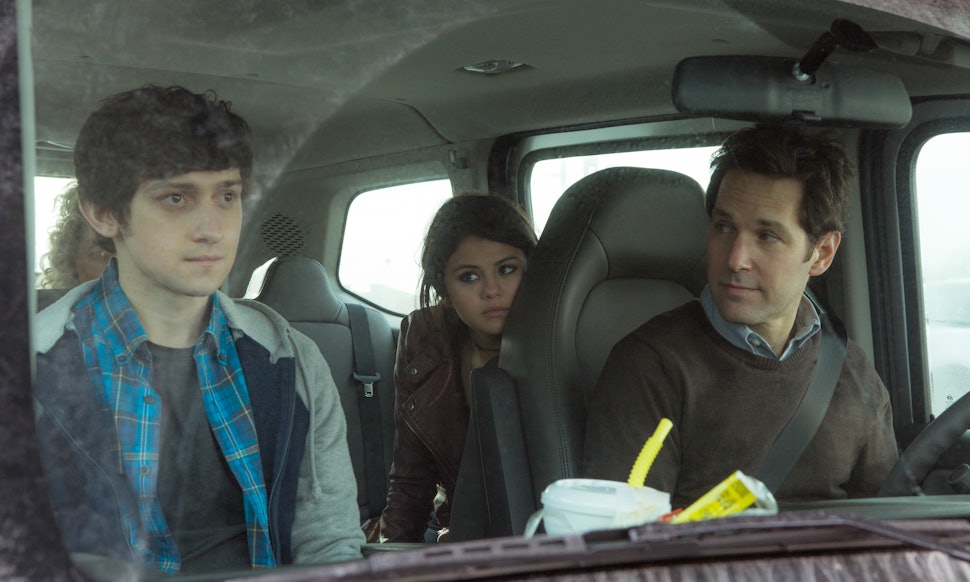
The Fundamentals of Caring, based on the book The Revised Fundamentals of Caring by Jonathan Evison, tells the story of Ben (Paul Rudd), a new caregiver, who is assigned to Trevor (Craig Roberts) a teen with Duchenne Muscular Dystrophy. The film falls into the likes of other cutsie road-trip indies (which I adore but can constructively criticize) such as Little Miss Sunshine. It has quite a few indie-movie pitfalls, most notably characters defined by one or two extreme quirks (She curses and smokes but has a heart of gold! So edgy! The other woman is super pregnant and… not much else! The disabled kid makes crass jokes and pulls mean pranks! Wow! No stereotypes here. The other guy literally runs away from lawyers! This is three-dimensional). Paul Rudd is precious though, and makes the more hamfisted moments feel light and natural.

It’s a message movie, one that is two-fold. One of these messages is questionable, and the other works quite well. The first: Ben is struggling with the loss of his son, and, though he denies it, it is clear Trevor becomes a son-like figure to him. Trevor calls him out on this, but the movie does not, ultimately saying that while Ben and Trevor eventually can move from one-sided father/son to friends, that Ben needs this to come to terms with the loss of his son, and Trevor wouldn’t have left his house if Ben hadn’t pushed him paternally.  

The problem is, that Ben’s son was a toddler. And so having Trevor, an 18-year-old, replace a toddler in Ben’s mind, is problematic. This dynamic becomes more complicated when you consider that these bonding moments are often framed around Ben and Trevor interactions while Ben is helping Trevor use the toilet (and if you haven’t seen the movie, then believe me. It isn’t just a one-off scene. This is a continuous thread throughout the film. It is the climax.)

Now I appreciate that the movie doesn’t shy away from the more squeamish parts of caretaking (unlike, say, Me Before You). But Trevor’s need for help here is not because he is a toddler, but simply because of his disease. He is still an adult. By using these interactions, which, when put through this parental lens, have an obvious connection to taking care of a toddler, the film infantilizes Trevor, for the sole purpose of giving Ben an emotional arc. Trevor’s character development is over halfway through the film, which means he spends at least half of the film only contributing to an abled-persons growth. For a story that tries very hard to keep its disabled character from being the stereotypical “inspirational” figure, it’s an uneasy commentary.

However, the film gets the other theme right. Ben is told at the beginning of the film that there must be a distance between caretaker and patient. But Ben can’t keep that distance. He can’t just take care of Trevor’s physical needs; after he learns about Trevor’s emotional ones, he seeks to help fulfill those too. Caretaking, the film argues, must be holistic. You can’t care for someone without entering into their pain; body, mind, and soul.

But the film also has a nice touch at the end by saying that Ben resigned as Trevor’s caretaker but kept being his friend. Because it’s true that real-life professional caretakers, not movie characters, must keep some professional distance. In fact, I watched this film with my roommate, who is a certified nurse’s aide. Throughout the film, I occasionally turned to her and asked, “would you be allowed to do this?” She regularly said no.

So despite the cliches, the heart of the story- that we should take responsibility for the people around us- shines through.

-Madeleine D

Netflix’s Sci-Fi Duds: Extinction and How It Ends

Image result for extinction netflix movieImage result for how it ends netflix movie

Netflix has become not only our entertainment overlord, but also a relentless content factory. Their business model has become “throw it to the wall and see what sticks.” So while it takes more time to sift through the bad content to get to the good, an unexpected side-effect is that the company has been leaning hard into sci-fi, and has been turning out an impressive number of films. Altered Carbon, Mute, Lost in Space, Annihilation, Okja, The Cloverfield Paradox, Bright, and What Happened to Monday have all come out within the last year, and are a very mixed bag (Okja and Annihilation are the best of the bunch). I love the idea of Netflix becoming a patron of sci-fi, supporting smaller productions with up-and-coming talent. But with Netflix becoming the dumping ground for films that studios don’t think can make it on the big screen, I have to wonder if this is actually improving the genre. Unfortunately, Extinction and How It Ends, both newly-released Netflix fare, are not helping Netflix’s case.

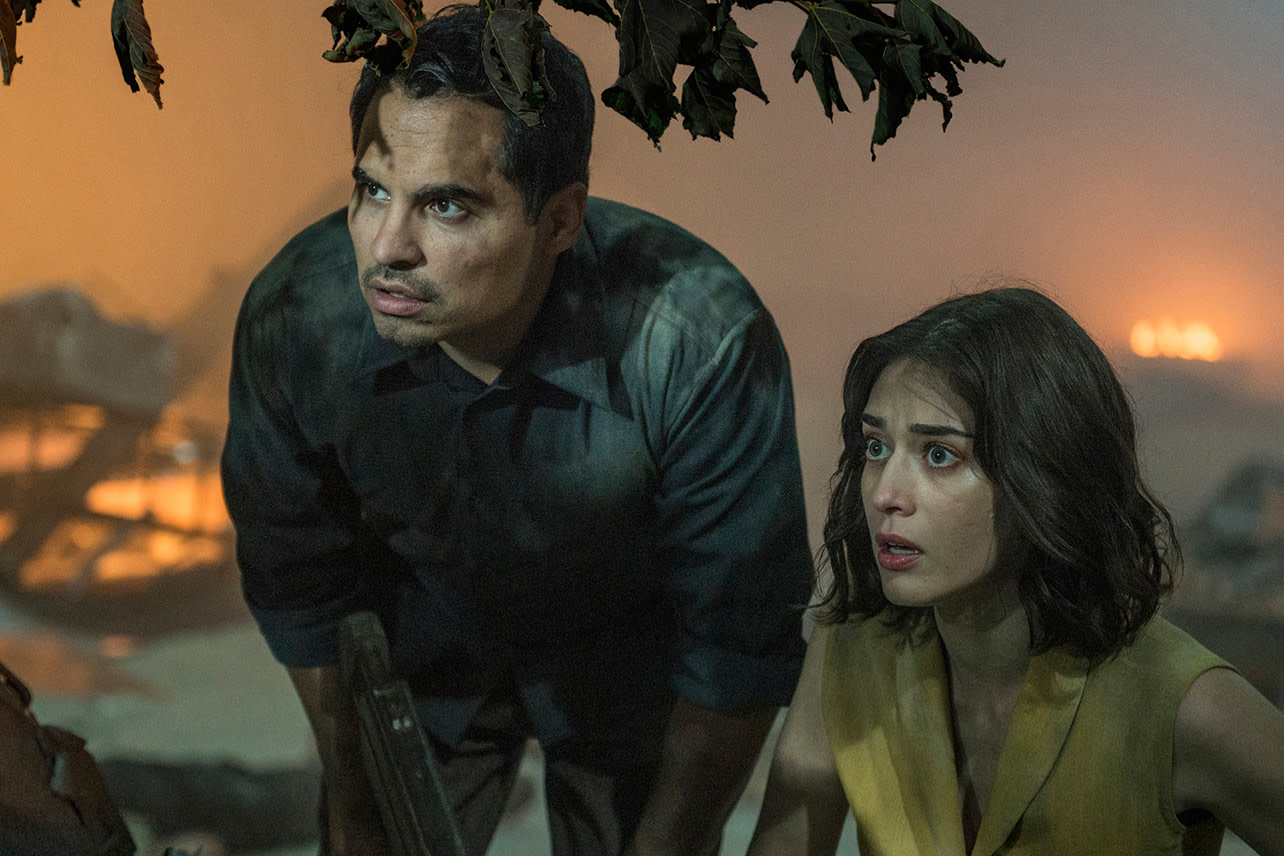
Extinction was a movie I was very excited about. I like stars Michael Pena and Lizzy Caplan, and the story of a dad who has visions about an apocalypse he will soon have to save his family from is familiar territory, but could be taken in a unique direction.

Alas, this film only has one goal in mind: get to the plot twist, which comes about thirty minutes from the end. So for at least an hour, we get a blasé, dull, and standard sci-fi alien invasion film. The twist doesn’t get enough time to fully develop, and it doesn’t impact the first hour of the film enough to make it worth watching. The lead-up to the twist is more filler than a compelling narrative.

Extinction tries to have a political undercurrent. For example, there’s a sign that says, “A Cyborg Took My Job.” But if you try to read the groups in the film as an allegory, the implications become a little concerning. Don’t think too hard about it. But if you take it for what it is in the film, the twist does attempt to add a different dimension to the are-robots-people question. It just comes so late in the film that it is kept from reaching its full potential.

So while I can see why Extinction was pulled from the Universal movie slate, it is still a passable two hours if you have Netflix. But with so much to see right now, passable isn’t enough. You’re worth more than that.

But Extinction is a Hitchcockian masterpiece compared to How it Ends, which is my new worst movie of the year. Congratulations! You took my favorite subgenre- the road trip- and made it a contender for the dullest two hours of my life.

Here’s why road trips paired with disaster films should work: road trips are an inevitable part of most of our lives. Pair it with something abnormal, and suddenly you’ve created the perfect dynamic in your movie. The macro-conflict can come from the disaster, zombies, robots, whatever. The micro-conflict that drives characters come from the road trip aspect. How we react in a disaster becomes framed by the normality of driving.

So what this film about a guy named Will (Theo James) and his prickly future father-in-law Tom (Forest Whitaker) driving across the country after something bad takes out all the power to get to his fiance should have had was Will and Tom arguing about where to take bathroom breaks, what kind of music to play, and exchanging stories about their daughter/fiance. It could be tense at times, sure, but not the lifeless sludge it ends up being. An endless repetition of being attacked by people on the road does not an exciting movie make.

I have no idea who these people are by the end of the film, and the “in-law road trip from hell” pitch is completely wasted in favor of the blandest War of the Worlds rip-off ever. There is no originality anywhere in this film. No clever solutions, no interesting dialogue, no real emotions, nothing of substance or that will be remembered. Theo James stares blankly at everyone he encounters and has the personality of a video-game shooter. Forest Whitaker solves every problem in the film by looking characters in the eyes and saying, “Trust me,” and if that doesn’t work, killing them.

I can’t recommend not seeing this film enough. It has the worst ending I’ve ever seen, a non-ending. Not to be too picky, but I feel pretty strongly that a movie called How It Ends should have an ending. My only explanation is that screenwriter Brook McLaren fell asleep before writing the ending, somehow hit his head, got amnesia, and forgot his idea for the ending. I too wish I could forget this film.

I’m not giving up on Netflix as a patron of science fiction. It has still given us good sci-fi films (again, Annihilation and Okja, people). But quality is better than quantity, and I don’t want flops like these to dilute and drag down such an exciting genre.

Off The Deep-End Fun: Jurassic World: Fallen Kingdom

Related image*Massive spoilers!
Jurassic World: Fallen Kingdom is the second installment in the reboot of the Jurassic Park franchise. I found the first Jurassic World (2015) dumb and boring. This movie is a major improvement in that it is dumb and off its rocker, which if your movie isn’t good, is the second-best-thing.

Fallen Kingdom takes the franchise out of the park, finally justifying the “Jurassic World” title and taking the series in a different direction. Director J.A Bayona has a horror background and puts it to good use here. The lighting and cinematography, along with setups and suspense, flip-flop between being unique and almost shot-for-shot copies of the original Jurassic Park, but are all used well within the story. It’s a monster movie, with visual allusions to Godzilla, King Kong, and werewolves. While it doesn’t always succeed, Fallen Kingdom is an ambitious next step, and I find that very admirable for a franchise.

Of course, it doesn’t experiment with everything. We’ve still got our two leads from the first film. Chris Pratt is Owen, aka Chris Pratt, which I’m pretty tired of right now, but hey, he does leading man well. But it’s really Bryce Dallas Howard as Claire who really gets to shine here, taking her character development from the first film even further, and giving a terrific balanced performance of action-hero competence and raw emotion. The movie also tries to, like its predecessor, attempt some winking-topical “humor”. The first used its corporate focus and egregious brand-promotion to say… something meta. I don’t think it succeeded. Fallen Kingdom has a military character call a character a “nasty woman” and has the rich billionaire villain have a Trump-style hairdo. Oooh, back up everyone. This is a topical film, not here to mess around. These attempt at relevancy are shallow, meaningless, and fall flat. It’s okay Jurassic World, you don’t need to do anything like that. You know what you’re about.

The ultimate argument of the film is that since humans brought dinosaurs back to life, it’s our duty to give that life as much freedom as we give other living things. This is encapsulated by a child named Maisie, a human clone (yes, you’re reading that right) releasing the dinosaurs into the world  and saying they’re “alive like I am.” Which might be a more convincing argument if human clones were real, but… they aren’t. Yet. This film does not dive into human cloning and this revelation, which is probably just a set-up for the third movie, feels a little cheap. Furthermore, these dinosaurs were brought to life by a tiny group of powerful people who promised to keep the dinosaurs safely away from human civilization. Their malpractice should not mean a more dangerous world for everyone else. As my vegetarian sister counter-argued against the dinosaurs-should-be-free-despite-being-a-danger-to-humans argument: “I try not to eat chicken, but if a giant chicken was going to eat you, I would eat it.” In other words, unless we believe dinosaur life is of completely equal value to human life, then we should prioritize the safety of humanity.

To its credit though, the film does do an excellent job setting up its thesis. It shows how similar humans and these dinosaurs can be. Both kill each other and both are capable of love, protection, and emotion. The dinosaurs have emotional range! It sure sets up an interesting debate on the sanctity of dinosaur life and freedom. And having the “parents” of Jurassic World (as a character in the film labels Owen and Claire) make the mess, and then the new generation (represented by child Maisie) take on that responsibility, is surprisingly touching.  

All that doesn’t mean the film isn’t silly and derivative at times- it is- but I’d rather watch a film taking a running dive off the deep end than shrug in mediocracy.

(P.S, While I will not be reviewing them, I highly recommend the documentary Won’t You Be My Neighbor? and Incredibles 2, both in theaters now. Won’t You Be My Neighbor? is a touching tribute to Fred Rogers and a peaceful protest/plea against the anger and divisiveness that is depicted in our media and politics. It is also a positive (but also honest) view of a Christian who used media to teach everyone that they are loved and worthy of love and dignity as a creation of God. Meanwhile, Incredibles 2 is just as fun and smart as the first, with laugh-out-loud humor, sweet family lessons, and incredible action. It’s a truly deserving sequel worth waiting 14 years for.)

-Madeleine D

A No-Brained Adaptation That Should Have Been a No-Brainer: Cargo

Image result for cargo 2017 martin freeman

A new release from Netflix, Cargo is the story of a father (Martin Freeman) in a post-apocalyptic zombie wasteland, who, when his wife dies, becomes infected with a zombie virus and has 48 hours to get his infant daughter to a safe place. It’s the perfect high-concept pitch that became a short film in 2013, which then became a finalist in the Australian Tropfest festival and was a hit after it was uploaded onto Youtube (you can view it at the link down below).  

However, I am here to report that feature-length Cargo confirms that not everything can be well-adapted. This is a shame, not only because the source material is so good, and is adapted by the same directors as the short film (Yolanda Ramke and Ben Howling) but extending a short into a feature-length film can work, like in the case of 2014’s “Whiplash,” where the longer run time was used to highlight the music and escalating tensions of the film. Cargo has so much potential that it seems like it would be a no-brainer (zombie movie pun intended ) on how to translate it into a longer runtime. All you have to do is heighten the tension, flesh out the characters, examine the different moral conundrums, add some actions, and get a great emotional climax out of all of the buildup. Cargo stubbornly refuses to do any of that, and not to its benefit. 

Cargo and this year’s earlier A Quiet Place have a lot in common. The monster aspect, the parenting metaphor, the scruffy-bearded dads trying to lead their families to safety, and babies born at really inconvenient times. A Quiet Place though knows exactly what it wants to portray thematically, and it boils down to a fairly simple message. The film is then elevated by its perfect tension building and trim script.  Therefore, it is a wonderfully effective film. Cargo, on the other hand, doesn’t know what it wants to say thematically, and so it doesn’t use filmmaking techniques to say anything either. Instead, the film wanders and is as broad as the themes, doing a lot and yet not much at all. A Quiet Place is more simplistic, but it is better to say something effectively than say nothing.

Cargo wants to meditate on parenthood, survival, fixing this world for future generations, and something about the Australian Aboriginal people. It also wants to stubbornly reject any kind of cliche, so it refuses to raise the stakes in any Zombie-movie style, which results in no stakes and no tension. A better film could be able to avoid cliches and meditate on those themes, but Cargo is not that film.

The film’s only momentum (besides the basic setup) is its star.  Martin Freeman shines in his second role this year about a distressed British man in a previously-colonized country. He is the best in the biz at playing disgruntled characters thrown into unusual circumstances, and he does it here with gusto and commitment. It’s exciting to see an actor like him in a genre film like this, and if Cargo was a better movie, I’d hope this would be a catalyst for that change. 

I love Cargo in concept. There were so many aspects of it that seemed like it would be my kind of movie. But throughout, I kept waiting, anticipating investment and feelings. By darned Martin Freeman tries, but even he can’t overcome the stifling blandness and brainlessness surrounding him.

Cargo short film:

https://www.youtube.com/watch?v=gryenlQKTbE

-Madeleine

Annihilation for Kids: A Wrinkle in Time

null

I read A Wrinkle in Time by Madeleine L’Engle somewhere around third grade, after I had finished the Harry Potter series and a relative had said, “Hey, you should read this. You and the author have the same name!”

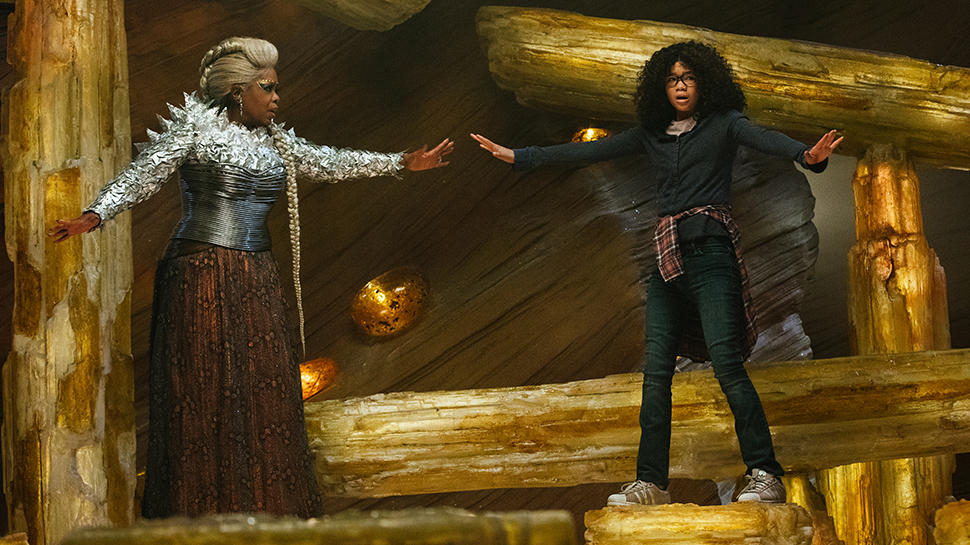
I don’t really remember anything about the book, except I found it too weird for my tastes. Anyone who knows the book well though will tell you it’s a difficult, near impossible story to translate to any other medium. It’s a strange mixture of L’Engle’s curiosity and imagination, religious inquiries and intellectual ponderings. It follows Meg Murry (in the film played by a formidable Storm Reid), a sullen, troubled thirteen year old, whose scientist father (Chris Pine, cementing his status as the best Chris in Hollywood) has been missing for four years. Three immortal beings- Mrs. Which (Oprah Winfrey), Mrs. Whatsit (Reese Witherspoon), and Mrs. Who (Mindy Kaling) come to Meg and her friend Calvin (Levi Miller) and little brother Charles Wallace (Deric McCabe) to travel dimensions to find Dr. Murry and bring him home.

What is most striking about A Wrinkle in Time is, even if you didn’t know there was a woman directing, you would likely still discern an intrinsically feminine quality to the film. To be clear, while there aren’t a lot of films directed by women, the majority I’ve seen do not play as obviously made by a woman, just like not every film made by a man is clearly so.

But it did feel like taking off blinders I didn’t even realize I had on to see a fantasy film from the female perspective. Sure, women are prolific in fantasy and science fiction literature, but this hasn’t translated to film yet. This is the first film I’ve seen with this “feminine fantasy” angle, and based on A Wrinkle in Time, I would characterize it as having a character-driven plot, the main arc coming from the protagonist finding inner strength (over, say, an external weapon or source of strength), emphasis on teamwork and collaboration, and women and people of color in leading, powerful roles.

Obviously these aren’t clear cut, and plenty of other fantasy stories driven by men do similar things, but here is what I see, and what I think will, as the genre hopefully grows, continue to develop.

See, A Wrinkle in Time is less concerned with adapting the novel and more concerned with giving the archetypal, mythological coming of age story to a young black girl. That is clearly the story Ava DuVernay is most interested in telling. That is the best story in the film, but unfortunately it is buried under the plot and visuals that have to be translated from the book. The best fantasy is always concerned with characters, but A Wrinkle in Time gives the hero’s journey to someone who doesn’t usually get it, and that’s an exciting development.

With that hero’s journey comes finding inner strength, which is usually a facet of fantasy. However, often the hero has to find an object that becomes his source of strength, or the strength within him is of a magical kind. Following in the steps of Moana and Frozen (also written by A Wrinkle in Time’s screenwriter Jennifer Lee) the climax is about Meg using the power of love for her brother to stop the It (the antagonist). She tells Charles Wallace about memories they have together, how much she loves him, and how he’s shown love to her.

I love this new alternative to the climactic battle. I hope other films starring guys will be able to start partaking in it too, because violence being the ending to all big blockbusters is… concerning. And particularly for a children’s movie, showing that compassion and love is stronger than violence is the message I would think we want to be taking away. So often good trumps evil is the theme of a story, but when that is only expressed through violence, then being good becomes aligned with being the better fighter. That’s not the message that creates compassionate, empathetic children.

Now with all of the praise for this film, I do need to say that despite all of the best intentions in the world, it is not a good film in the technical and story aspect. Thematically, it’s endearing. From a cohesive, well-paced and constructed filmmaking perspective? It’s a mess. The script seems like a rough draft, with character that say everything, never trusting the audience to understand its nuance. For example, in one of the opening scenes, a teacher character loudly tells another teacher something along the lines of: “Meg Murray’s father has been gone for four years. Meg is very troubled because of it. Her father was working on a science experiment to travel dimensions.”

And as kids around Meg say mean things, out pop Demi Lovato and DJ Khaled singing “Today I saw a rainbow in the rain, saying I could do anything, I believe in me” as if we didn’t get the message. I guess it was restraint that they didn’t along sing, “I better go save my father now, time to defeat some evil” in case someone didn’t understand what was about to happen. It’s a poorly made film, but can earnestness and good intentions save it?

I compare this film to Annihilation because both hit similar emotional beats. In both films, the protagonist is not particularly likeable, has lost a man close to her to the Science Thing, and goes on a mission to find him, discovering more about herself as she goes along. Both also have trippy visuals and an unusual climax that takes places in a cave with a clone.

Unlike Annihilation, though, this movie is not about self-destruction and its toll on people. It’s about our flaws, and how they can be our strengths, and the power of love. If personified, it would be a giant hug. In fact, I’ve never seen as much hugging in any movie as I’ve see in this one.

And that might cause some to scoff, or look down at the film for its childishness. And yes, it is childish in some sense. But its fascination with love is not, and I want more films like A Wrinkle in Time. Films that love unabashambly, have no cynicism or limits, and display feminine strength, something we still sorely lack, even in the age of #MeToo and girlpower. While more films are featuring women, rarely are those stories being told by women, and often those women are asked to be more masculine in order to be strong and worth the audience’s time. I want more protagonists like Meg, families like the Murrys, and the directors with the imagination and heart of Ava DuVernay.

And yes, I want films that are not terribly paced, oddly filmed and edited, sloppily scored, or badly written. I wish A Wrinkle in Time appealed to a broader audience, and showed the same deliberate, delicate filmmaking DuVernay has proven herself masterful of.

However, it is clear, and she has confirmed in interviews, that DuVernay made this film for children, and particularly girls of color. And I think this is the kind of film that should be supported. Hopefully movies like this will become better, but take your kids to see it, because this is a lot more hopeful, heartfelt, imaginative, and purposeful than 90% of kid entertainment available. And if you don’t want to sit through it yourself, sneak over to the next theater and watch Annihilation and get an adult-version of the experience.

Or, maybe not. Maybe A Wrinkle in Time will have a message and hug for you, too.

-Madeleine D