Unrest, Unfair, Unconvincing: Three Billboards Outside Ebbing, Missouri

3 billboards

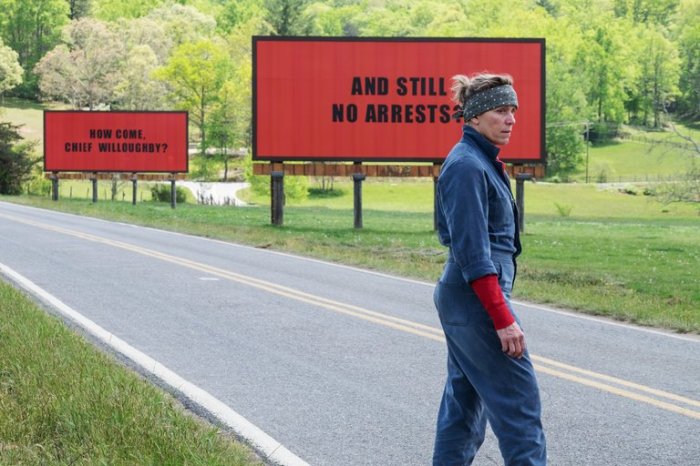
Martin McDonagh’s (In Bruges) Three Billboards Outside Ebbing, Missouri is a story about angry, grief-stricken Mildred Hayes (Frances McDormand). Her daughter Angela was murdered, and the police have seemingly dropped the case. The officers on the case are Chief Willoughby (Woody Harrelson) and Officer Dixon (Sam Rockwell). Willoughby is a well-meaning cop, dying of cancer, and Dixon is a dumb, racist, temperamental, corrupt cop. Mildred rents out three billboards that send a loud and clear message:

-Raped while dying

-And still no arrests?

-How come, Chief Willoughby?

This film has been getting critical acclaim and is leading the awards season, so I would like to raise three billboards of my own:

-7 Oscar Nominations.

-Best Screenplay and Picture?

-How come, Academy?

The biggest criticism of Three Billboards has been its treatment of race. Several people throughout the film explain that Dixon is racist and has a history of torturing the people of color in Ebbing. He uses the n-word, makes threats, and this is all used to establish him as a terrible man. Our (good?) police chief, Willoughby, explains not-so-helpfully why he keeps him on the force- “”You get rid of every cop with vaguely racist leanings, you’d have three cops left and all of them would hate the f-gs.”

Once Dixon needs to be redeemed through, his racism, which he never shows remorse for or makes efforts to change, is completely forgotten about. It’s treated, as Insider’s Jacob Shamsian notes, as “a character quirk.”

I don’t doubt that there are cops who feel this way, and it’s not that a movie that is supposedly about redemption and empathy and human complexity can’t redeem a despicable person. That’s what I believe we have to do in real life. But the redemptive arc for Dixon is shallow, unfulfilled, and he never seems remorseful. Discussing institutional racism in your movie is an admirable thing to do if you’re going to treat it with weight and actually have thoughts about it. But British director McDonagh is much more interested in throwing sensitive topics around as coloring to his black-and-white sketch of what he believes is middle-America, and it’s utterly unconvincing and disgustingly manipulative.

Another example- Mildred’s black friend, Denise (Amanda Warren), is arrested by Dixon to spite Mildred, and she isn’t released until the end of the film, and this is… cool with everyone? Not talked about? That’s not a commentary on racism, that’s terrible writing and using black characters for the advancement of white ones.

In my screenwriting class, my teacher tells us to make sure every scene has conflict, but that doesn’t mean “every scene has to have a screaming match.” Three Billboards is very much ready to have a screaming match, or an explosion, torture, domestic abuse, burning someone alive, or horrific beating in every scene. Almost every single scene escalates to 100, leaving no room to breathe or think. Frances McDormand and Sam Rockwell and Woody Harrelson do a fine job with their roles, but all of the things they are asked to do are so actor-y, so unnatural, and so over-the-top that I honestly don’t think they should have been nominated at all. I never had to read Frances McDormand’s face to figure out what she was feeling, she was either saying it or destroying something.

I recently watched Spike Lee’s Do the Right Thing. It’s a masterpiece, and it also deals with the escalation of anger. It and Three Billboards are very different films, but what Do the Right Thing does that Three Billboards doesn’t do is spend the majority of the film building characters and setting up the tension, before making the violence climax and thus actually hurt. Watching the riot in that film feels like a gut punch. Three Billboards is constantly pummeling me, so nothing feels like anything after a while.

I never felt like any of the characters were real. I could not imagine any of the characters in situations beyond the ones they were in. I suppose that this could be interpreted as a hyper-reality, like the film is becoming what grief and anger feels like. But it’s not presented that way. This is portrayed as a story where someone really does all of these things.

It’s a film being billed as a movie for our divided times. But as I see it, it’s a harmful one. It tells you your anger is justified. And true, a lot of anger is, and Mildred’s certainly is. But there are no repercussions for the actions she or Dixon takes because of their anger. They suffer indirectly- Mildred is still miserable and Dixon gets burned because of Mildred’s attack on the police station, but they are never punished for their actions. They never see repercussions. They are the only ones that affect each other, even though their villainous acts affect everyone else.

Anger isn’t the problem, it’s what you do with it, and all the characters in the film act in an evil way with it, and those actions are excused. Telling people they can be angry and do whatever they want with that anger is a dangerous message. Three Billboards isn’t just a movie about mean people. It’s a mean movie, one that wants to say a lot of important things but doesn’t have the heart to actually finish the job.

-Madeleine D

Meeting Laura Linney

Laura Linney

On Friday, February 2nd, I had the opportunity and privilege to help moderate a panel for a student discussion with actress Laura Linney, who was in Tulsa to speak at the Performing Arts Center for Tulsa Town Hall. Laura Linney has done it all- theater, film, and television. She’s been nominated for three Academy Awards, four Tonys, and she has won four Primetime Emmys, two Golden Globes, and a Screen Actors Guild Award. She studied at Julliard and began her film career in the early 1990s. Her most recent work is her role on Netflix’s Ozark, opposite Jason Bateman. She is currently filming season two of that show.

When she first entered the room before the panel began, she greeted each of us moderators individually, took a selfie with my class, and talked to my teacher. She was engaging and thoughtful. When my fellow moderator and classmate Charlotte asked her at the end of the panel, “Would you be my adopted mom?” Ms. Linney said yes.

Laura Linney selfie

During the panel she was asked questions about being a woman in Hollywood, the #MeToo/#TimesUp movement, how she’s kept a long and steady career, the differences between working in theater, film, and television, and what attracts her to different roles.

She spoke honestly about the difficulties of Hollywood, and advised all the young women in the room to bond together, as working together makes you stronger. She explained her criteria for picking roles- good writing, a director she could learn from, and a story she felt was necessary to tell. She told us about working with Clint Eastwood three times and things she had learned from him about letting scenes act themselves out. She spoke about the different demands of different mediums, and how she balances being an introvert with her work.

Laura Linney panel

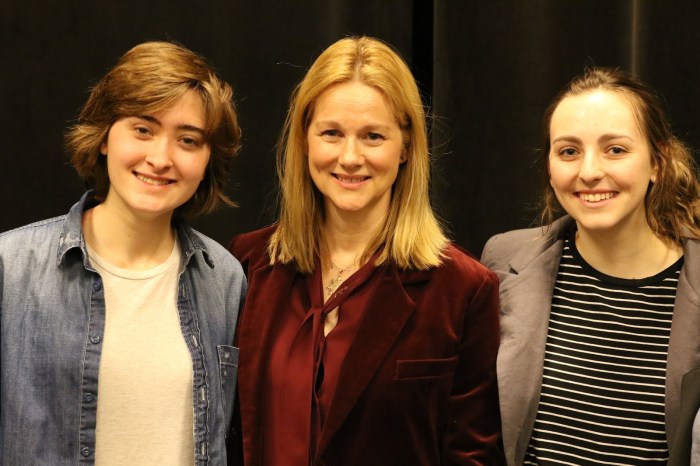
Moderating the panel. Left to right: C.S., Me, O.H., Laura Linney


After the student panel, we got to see her give her Town Hall speech to a full crowd in the main PAC auditorium. Her speech was about how to infuse creativity into every part of your life. My favorite thing she discussed was the need for an “Art Doctor,” someone who could prescribe to you a piece of art for every emotion or dilemma you may have. Feeling blue? Listen to this. Need some philosophical ponderings? Read this. Happy? Rejoice by watching this.

I would say, after needing some artistic inspiration, speaking to Laura Linney was just what the doctor ordered.

-Madeleine D

Laura Linney & me


I Would Probably Invest in a Ponzi Scheme If Jack Black Sang To Me: The Polka King

the-polka-king-jack-black

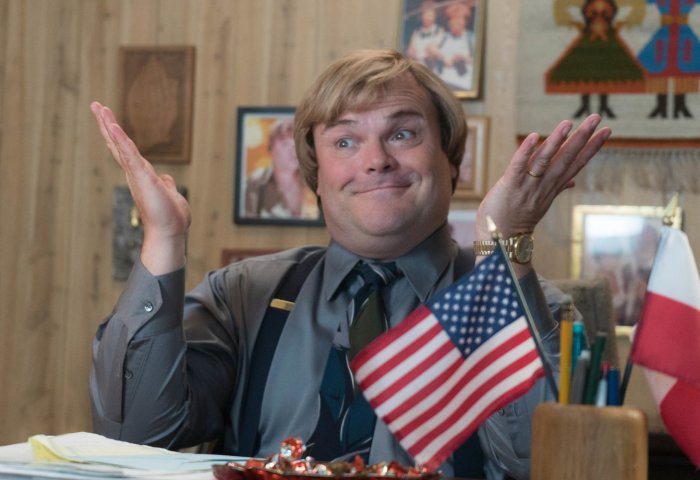
Netflix’s new movie The Polka King is a biopic of the real life Polka King of Pennsylvania, Jan Lewan. In 2004 he was arrested for running a Ponzi scheme to finance his various polka enterprises. The film is based off the documentary The Man Who Would be Polka King and notes the real Jan Lewan wrote about his life while in jail.

I knew this movie was about this scheme before I went in. The trailers and film summary tell you the movie is going to be about the scheme. Yet it wasn’t until halfway through the film I realized, with a start, Hold on, Lewan is scheming people out of their money!

Why did it take me so long to realize the film was portraying Lewan’s Ponzi scheme, when I knew that was what the film was about? How was I so surprised by what I knew before I pushed play?

What I saw while watching was a kind, hard-working family man who was just so… so genuine. Sure, part of it was that he was played by Jack Black, but his dreams and unabashed hope for America and love for his family and unyielding work ethic made me forget that what he was doing was technically illegal. People were giving him the money willingly! He was giving people generous interest on their money (at least for a while). What’s so wrong with that?

So in a way, Jan Lewan, and The Polka King, schemed me. I was duped in a film about people being duped. So what you should take away from this is that if Lewan asked me to invest with him, I probably would. I would be a tremendous sucker. Please don’t call me up for (my little bit of babysitting) money. But that also means, at least to this particular viewer, that the film not only pulled me in and made me sympathetic for the criminal protagonist, but also made me into one of the characters. It put me in the place of the investor who fell for his charm and earnestness.  

Now the film doesn’t get high marks exactly for how they make Lewan likeable. Patriotism, love for family, hard working, lovable goofiness, and an accent is the easiest and most black and white way to make a protagonist likeable. But the film does get high marks for using this as a way to make the morality of the situation grey. How can such a good man get punished so harshly? Should he even be imprisoned- did he really understand what he was doing? But he did, and now I’m angry that I’m defending him.

Ultimately, the film is able to stay pretty unbiased towards the material. It presents Lewan as a well-intentioned man who did wrong, which is how he was described in real life. The audience is the one that is left frustrated on how to respond.

Jack Black grounds the film with his Lewan being a wily, whimsical man with dreams and a dark ambition. He does most of the heavy lifting as his supporting cast get to ramble free with their own kooky stories. Jenny Slate and Jason Schwartzman are fun to watch, but are really there just to give stakes to the greater story. Their individual side plots do not have any thematic resonance on their own. Most of their contributions are true though, and the entire film is fairly accurate, which just goes to show how finding the right story is all you need for a compelling real-life movie. This movie is the true The Greatest Showman.

However, it’s the job of a film, a piece of art, to take a real-life story and find the thematic, universal message within it, and the failure of The Polka King to tie everything together and make each thread of the movie count, not just let it be filler distraction, makes it a weaker film.

This is director Maya Forbes’ second feature film, her directorial debut being 2015’s incredible Infinitely Polar Bear, a tender semi-autobiographical story about her own childhood. The Polka King is a less precise film, maybe because it is more of a comedy and doesn’t have Forbe’s own life and personal stakes in it. With a little more care, every scene and storyline in Polka King could have hit home perfectly. With a little more thought, the film could have relied less on Jack Black to pull the storylines of the other characters into his own.

That being said, The Polka King is a satisfying, whimsical real-life fable and cautionary tale that tells a story too crazy to be true. Just be warned- you might find yourself sympathizing with someone who would try to take all your money. Bleeding hearts (and get-rich-quick suckers) be warned.

-Madeleine D

Madeleine’s Official Top Seventeen List™

Coinciding with the release of the 2018 Oscar nominations, I thought I would weigh in with my favorite 17 movies of 2017. With my top films of the year, I chose them based on three things:

  1. How much I enjoyed them and/or how much they stuck with me.
  2. How “good” of a film they were, in terms of their craft.
  3. Cultural significance and relevance.

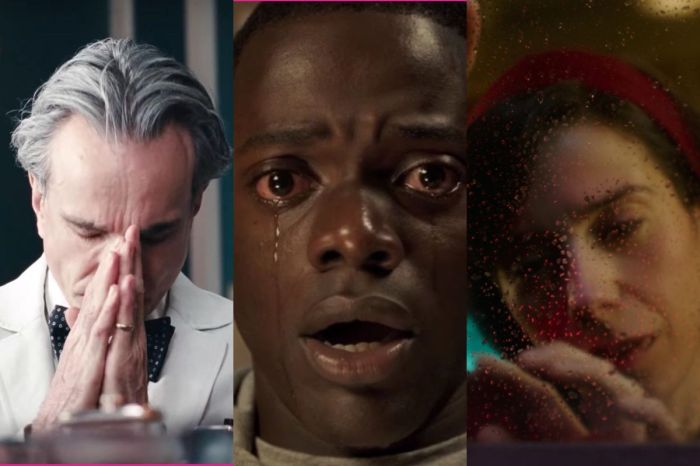
2018 oscars

17. Beauty and the Beast

16. Dunkirk

15. Lego Batman

14. Spider-Man: Homecoming

13. To the Bone

12. Wonder Woman

11. All the Money in the World

10. Battle of the Sexes

9. It

8. Okja

7. Get Out

6. The Big Sick

5. Lady Bird

4. Logan

3. War for the Planet of the Apes

2. Baby Driver

1. The Unknown Girl

the unknown girl

I have not yet seen Three Billboards Outside of Ebbing Missouri, Molly’s Game, The Florida Project, Phantom Thread, or I, Tonya.

My favorite scenes of the year:

“We’re all to blame” – Wonder Woman

Mall Chase Scene- Baby Driver

“Gaston” Musical Number- Beauty and the Beast

Kumail’s Comedy Show with Beth and Roy- The Big Sick

“The Sunken Place” – Get Out

Worst Film of the Year: The Emoji Movie

-Madeleine D

Drama In Front Of and Behind the Camera: All the Money in the World

all-the-money-in-the-world

“That’s why they call it the American Dream, because you have to be asleep to believe it.” George Carlin

J. Paul Getty was not just the richest man who walked the earth in 1973, he was one of the richest man who had ever walked it. He found oil in Saudi Arabia and was an infamous penny pincher. He achieved the success we all dream of in one way or another.

But Getty, no matter how smart or savvy or wary he was, lacked the humanity we all hope we have. On July 10th of 1973, Getty’s grandson, Paul Getty Jr., was kidnapped in Rome by Italian gangsters. They asked for $17 million as ransom. Getty refused, and in the end, only paid $2 million, because that was what he could get as a tax credit.

It makes you wonder, was it the money that turned Getty Sr. into stone? Or was it in him all along? Or do you have to stay asleep to some things to keep the American dream? To believe it’s worth it?

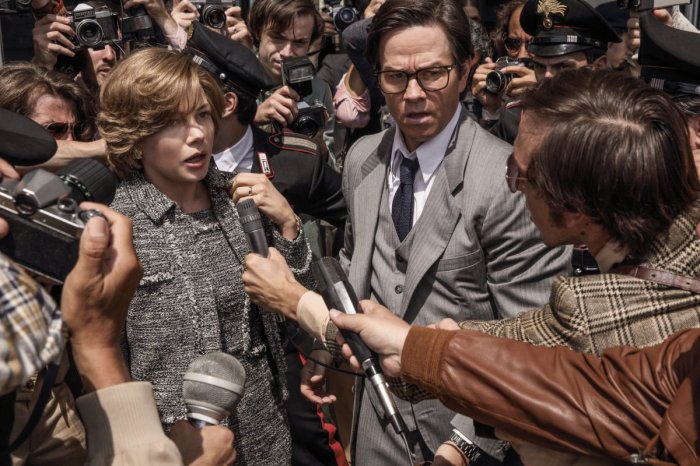
With Getty Sr.  as an immovable force, it’s up to Getty Jr.’s mother Gail (Michelle Williams) to fight for her son’s life, and Fletcher Chase (Mark Wahlberg) to help negotiate Getty Jr.’s release. As they suffer loss after loss, with Getty Jr. slipping from their grip, they’ll wake up to some realities of their own.

To me, All the Money in the World  is as intense as Christopher Nolan’s Dunkirk. While Dunkirk relies on the cold hand of time, All the Money in the World relies on the anticipation that something is going to happen, I was just not sure what. This might be because I didn’t know anything about the Getty story going in. I’m sure it will be different for everyone, but for me, watching a boy my age being kidnapped, tortured, with my own mother sitting beside me, watching the mother on screen do everything in her power, well, it got to me. I even nearly threw up during one scene (you’ll know it when you see it), and I had my eyes closed. The film leaves every scene with a cliffhanger, keeping the audience as frustrated as the characters, pulling us along and then making us lose hope over and over again, until the final scene where we can breathe a sigh of relief. It’s the kind of engrossing experience that only film can provide.

Christopher Plummer has been getting all the publicity for replacing Kevin Spacey mere weeks before the film’s release date, but this truly is an ensemble film. Plummer, though, does deserve all the credit he is getting. He makes nuance out of a role that would have just been stitched together with thematic lines. His and director Ridley Scott’s professionalism and talent are the real takeaway from the reshoots.

Michelle Williams gives a nomination-worthy performance as Abigail Getty Harris. She infuses grit and determination into the character, and she rejects every normal “hysterical mother” trope given to her, holding the screen in a fierce grip that puts her among the best female performances of the year.

Mark Wahlberg makes no impression here. I suppose his character is necessary, but… you know. Meh Wahlberg. Not a performance that, I dare say, is worth eight times more than Michelle Williams’. (http://www.vulture.com/2018/01/michelle-williams-paid-8-times-less-than-mark-wahlberg-for-all-the-money-in-the-world.html).

On the other side of the story, Romain Duris as Cinquanta, aka, “the nice kidnapper,” is incredibly charismatic and gives a tender performance. He and Charlie Plummer have the chemistry it takes to make the scenes of Paul’s imprisonment more compelling than they are written to be, and it’s a shame he is being overlooked in coverage of the film.

I like to say that a movie needs to justify its existence. Why is it a film I should spend money and time on? Particularly for live-action dramas.For example, I didn’t think last year’s Loving or this year’s Darkest Hour elevated their respective material to a cinematic level. Both of those films were high quality, but I didn’t gain something from watching them I couldn’t have gained from reading a Wikipedia article about their subjects.

All the Money in the World gives the audience multiple reasons for why it is a movie. The film is thrilling, and the adrenaline from watching it is not something you’ll get from a detached experience of reading it. And the film, no matter how bluntly, tries to say something about wealth, and create themes out of the historical events. Most of the time, it succeeds. And it’s an exciting ride nevertheless. It kept me engaged and left me with things to think about.

Ironically enough, a film that explores the selfishness and corruption of Paul Getty Sr., and his refusal to awaken to his family’s needs, has been a film that through behind-the-scenes drama has been a part of Hollywood’s own awakening to its corruption. Kevin Spacey’s sexual assault allegations were punished, and the revelations about the pay disparity between Williams and Wahlberg have pushed home the persistent gender pay gap. Let’s just hope Hollywood, unlike Getty, doesn’t try to fix things cheaply.

-Madeleine D

Take a Cue From Your Own Movie: Downsizing

downsizing

*Spoiler Alert

Alexander Payne (The Descendants, Nebraska) is a director who is known for “small” (small being basically synonymous with independent) movies with big stars (Jack Nicholson, Reese Witherspoon, George Clooney, Matt Damon, Bruce Dern). His latest film, Downsizing, continues in that same vein, but with more studio marketing than for any of his previous films. Unfortunately, the best thing about an Alexander Payne film, a consistently quirky tone, gets abandoned this time around.

Downsizing explores a differen genres in each of its major acts. While in better movies, this might be rightly labeled “quirky” or “original” and might work for the premise, in Downsizing it does not.

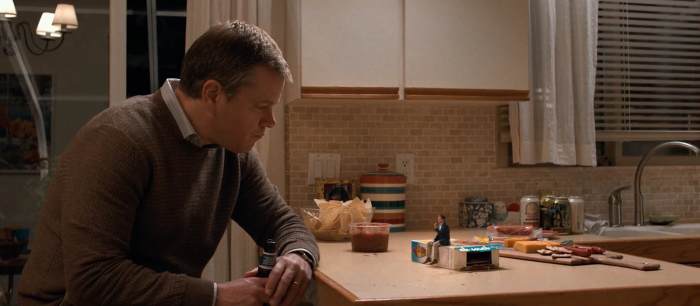
The first act is a pretty by-the-numbers dramedy about the premise. Paul Safranek (Matt Damon) and his wife Audrey (Kristen Wiig) learn about downsizing, a new process that shrinks you down to five inches tall. Once downsized, they get to live in a tiny community built for luxury and wealth. It’s supposed to be more sustainable and help the rapidly dying earth, not to mention increase your buying power exponentially, but it’s not without its problems. Here, the film is presented as a smart social commentary.

Then it takes a nosedive into a meandering second act where a newly downsized Paul wanders around, feels sorry for himself in his lonely new land, goes to his neighbor Dusan’s (Christoph Waltz playing Christoph Waltz, so I’m just going to call him that from here on out) European party, and meets Ngoc Lan, a former political activist whose government downsized her against her will and shipped her to America in a TV box. Ngoc Lan and Paul, through a series of adorable circumstances, find themselves working together to care for the people of the slum Ngoc Lan lives in. A commentary on immigration and poverty in the United States? Maybe?

In the third act, Ngoc Lan, Christoph Waltz, and Paul are invited to come to Norway to meet the original inventor of downsizing. Once there, they learn that the world is actually dying and that a group of small people are going into a vault to repopulate and continue the human race as the outside world dies. Life must find a way, and Paul can’t think of a better use of his life than to join them. But he loves Ngoc Lan and at the last minute joins her instead of going with the others. The end.

If that defied all of your expectations for the film, then you’re not alone. But is this the genius kind of crazy, or crazy kind of crazy?

Downsizing could be seen as a cautionary fable, and some critics, like Todd McCarthy of the Hollywood Reporter who named the film the best of the year, interpreted it as such. But unlike movies that are clear fables, like say, Joel and Ethan Coen’s Raising Arizona, Downsizing does not present itself as one. It plays as an SNL skit that goes on too long, feels like it needs a political message, and invents an ending that is just an excuse to go hang out in the fjords of Norway. It begins to give a social critique, or make an interesting statement, but can’t complete a single thought. It’s a rollercoaster of different stories crammed into one.

Ultimately, I think Downsizing would work much better as a short film. The main parts of the film- man learns about downsizing, downsizes, is unhappy, meets woman, finds purpose in helping others- would be more coherent without hours of filler in between. It’s the filler in Downsizing that bogs down the film and makes it unclear. The second and third act don’t even need to be in a downsized world!

Another problem is with the character development. Paul is a nice guy the whole movie. He doesn’t have a character arc, so there is no real change in his character that reflects the change to “downsize” his life decision.

If I were to find a message in Downsizing, I think the end says something whole. Paul has the opportunity to go with the group of small people to keep the human race alive. Paul finds it all important and sacrificial, but Ngoc Lan wants him to stay with her, primarily for love. He is about to go into the vault when he decides to go back to Ngoc Lan and spend the rest of his days helping her in the slums of LeisureLand.

It seems that director Payne is saying Paul needs to think smaller. He doesn’t need to join some humanity-saving experiment. That big picture thinking is what made him small and unhappy in the first place. He needs to think small like Ngoc Lan, and care for the people around him. He needs to “downsize” his vision and purpose. This is actually a compelling message, except the film doesn’t quite set it up to be that. The film treats the small people going into the vault as doing a necessary and important thing, so why isn’t Paul supposed to be a part of it? And he goes back to Ngoc Lan for love- that’s why she wants him to stay, too.

This problem is representative of the whole film: it has a handful of messages it wants to say, but either doesn’t complete a thought or say something seemingly unintentionally. And because I crave meaning, I have had to dissect it from a film that might not have meant to say that at all. To see such a great premise, with a prolific team behind the scenes, is disappointing.

So if you do see Downsizing, which I can’t recommend, please-

keep your expectations small.

-Madeleine D

You Can’t Please Everyone: The Last Jedi

The Last Jedi

I’d just like to take this moment to say I liked The Force Awakens.

Look, I understand why some people don’t. Does it follow all the beats of A New Hope? Yes. Is A New Hope based on the archetypal Hero’s Journey? Yes. Were people going to be mad if the new Star Wars trilogy was wildly different from the original trilogy, like, say, the hated prequels? Yes. And do I have a bunch of nostalgia and fierce opinions about a movie made twenty two years before I was born? Actually, no.

This is a spoiler review, because you’ve probably already seen The Last Jedi and/or been on the internet.

One of the best things about this new trilogy are the characters, who have certain characteristics of the classic characters, but also have their differences. This movie defines these differences even more.

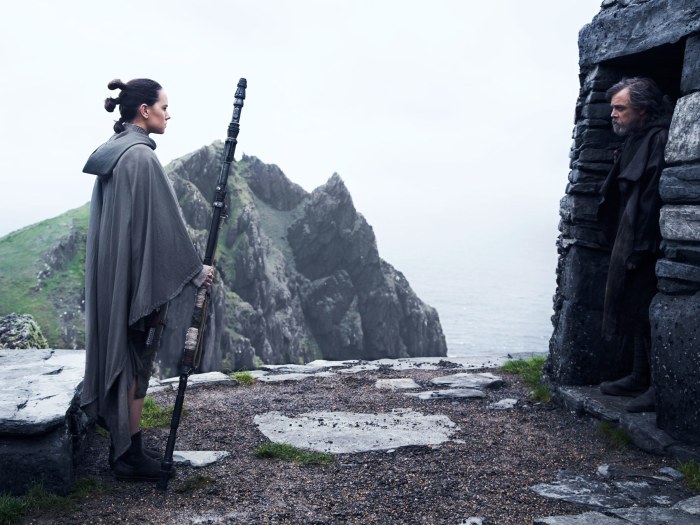
Rey is closest to Luke, but doesn’t have a royal legacy to live up to. She’s a nobody, and she has to grapple with that and what it means for The Force to have chosen her as the response to Kylo Ren.

Kylo Ren wants to be like Darth Vader, but for wildly different reasons. And he’s not going to get the redemption arc many thought he was. He has to pay for his actions.

Poe is a blend of Han Solo and Leia, and Finn is not Lando Calrissian. I think The Force Awakens needed to be like A New Hope in order to establish these characters so they could work in this film.

The problem is that new characters are added, and as interesting as they are, they are spread too thin, making it so no one gets a fair shake, and people disappear for large chunks of the film. With three somewhat equal plots and a handful of mini-ones, The Last Jedi takes pains to expand the world of Star Wars. It is clear director Rian Johnson was bursting with ideas. However, I think there are also some weak parts. He tries to take on three plots, along with small mini-ones, and I think all he needed was an editor with a strong pen saying, “This is great, Rian, but let’s leave some of this for the next movie or the deleted scenes. This film is two and a half hours, and we really don’t need to see Luke milk a beached loch-ness monster just for a blue-milk callback.”

As for the plots, though, I like the messages of Rose and Finn’s Canto Bright casino adventure. Star Wars is clearly making a small effort to say something nuanced about politics- people profiteering off both sides of the war and animal cruelty is wrong- but I don’t know if taking away so much time from the rest of the characters was worth it. Rose and Finn are legitimate characters (not tokenism) but their plot could be eliminated. Same for Holdo and Poe. I love that Holdo is such an antithesis to what we would expect, middle-aged woman in a ballgown as a military leader, who gets an amazing payoff, but again, not sure if it was worth taking away attention from the film at large. Some consolidating could be made to keep the film from spreading itself so thin and having multiple endings.

The most interesting plot to me was the Kylo and Rey plot. Not only is The Force-head-texting thing new, but it seemed like Johnson read all the fan theories online about the characters and said, Nope! Yet it doesn’t feel like he’s checking boxes. It seems like he’s trying to set the characters on course for a continuation of their arcs, and with the characters literally struggling against each other, gives a visual metaphor to the thematic struggle presented here.

Things people have disliked about the film that I didn’t mind- I was fine with changes to Luke’s character, and I think the parallels to the original trilogy are needed to remind you it’s the same series, and the Star Wars movies have always been based in archetypes. These aren’t new.

For all that is packed into The Last Jedi, the film doesn’t actually end very far from where it started. The resistance fighters are still scrappy and in bad shape, Rey is still figuring out her powers, and another mentor figure is gone. This shows how the Star Wars movies are never going to die, though- if they can do so much while moving forward so little, they will live on for eternity.

You’re always going to have people who are unhappy with change, want complete change, or are unhappy with the particular way you brought change. That isn’t to say criticism isn’t good (that’s kind of my whole thing). But personally, I’m not a Star Wars baby. I have no nostalgia for the original or prequels. I’m just here for the ride and the cultural conversation. I like the new Stars Wars. I like how it has made an effort towards diversity and representation, giving women a bigger role in sci-fi then they’ve ever been allowed, changed franchise filmmaking, and the themes and ideas that are being presented. I also respect the original foundations, but I don’t think that means they are the golden standard.

I think the best path for Star Wars is to do the same. You can’t please everyone, so do what you want. The Last Jedi does what it wants, and I think with a little fine tuning, this is what makes it a strong film and a steady path for the future.

-Madeleine D

“Dancing Through (A) Life”: The Greatest Showman

Dancing through life/ skimming the surface/ gliding where turf is smooth/ Life’s more painless/ for the brainless – “Dancing Through Life” from the musical “Wicked.”

The Greatest Show

The Ringling Brothers and Barnum & Bailey Circus are closed down. Fact.

A lot of people enjoy the circus. Fact.

The circus has a long and troubled history of animal abuse allegations and other ethical violations. Fact.

P.T. Barnum was not the inventor of the circus but widely developed it and was a “self-made man.” Fact.

Barnum was a charming man who advocated for the rights of the downtrodden and outcast and was a progressive social thinker. Fa-hmmmmmmm. Time for a musical number! And a one, two, three, four-

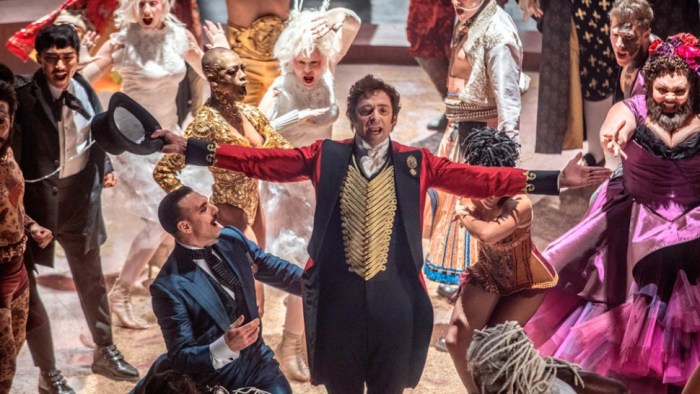
The Greatest Showman is from first-time director Michael Gracey and the passion project of Hugh Jackman. It’s a full swing original pop-musical, so get with it or get out. It’s full of clever choreography, likeable actors with earnest performances, beautiful sets and costumes, and a story that hits all the beats of a tidy rags-to-riches. It’s here to entrance you with magic and wonder. If you want the real P.T. Barnum, you’ll get a glimpse of him, but some of his rougher edges are mysteriously scrubbed away. Here, Barnum is carried by the earnest Jackman, whose Barnum is a business-minded, occasionally dishonest but gold-hearted, family man who identifies with all the outcasts he’s using in his show.

But, even if you don’t know anything about Barnum, there is still a sense in the movie that a lot is being left out, which it is. For example, you aren’t going to see the story of P.T. Barnum’s first real act, which was to buy Joice Heth, an elderly slave, advertise her as the 161 year old nurse of George Washington, and perform a public autopsy on her. I guess Hugh Jackman wasn’t down for that?

The Greatest Showman says it’s telling the story of P.T. Barnum, but it really wants to tell the story of how the circus is a haven for outcasts and misfits, a place for them to find a family. It’s not historically accurate, but you probably knew that you aren’t here for a history lesson, you’re here for musical numbers with Zac Efron and Zendaya! And that is legitimate and a fine indicator of a good time.

The music, penned by Justin Paul and Benj Pasek from La La Land, is fun and light. The choreography is enchanting and creative, with the cast using the settings around them as musical instruments and props during the performances, and it is an unapologetic musical. People just pop into songs. Director Gracey has a background in music videos, and it shows.

If you want a musical, you’re going to get a fun musical. But if you’d like a musical with a bit of thematic depth, I don’t think you’ll get it.

The selling point of the movie, the big theme and the subject of its many anthems, is being an outcast and being yourself. Ignoring, probably, the real P.T. Barnum’s motives, here, everyone is an outcast in some way, trying to fit in. Barnum gives them the chance to be seen and loved. The film really wants to say interesting things and hit on tough subjects- racism, marital infidelity, the dangers of show business on families- but it only does that in a very shallow way. That includes its own theme.

The problem with saying that everyone faces adversity is that yes, the central problem is the sin that all humans have of categorizing people and hurting each other. But some oppression is systemic and institutional. So, Barnum’s desire to be respected by his wife’s wealthy parents can’t really be equated with the struggle of the black characters in the film. Barnum can escape the adversary facing him. They cannot.

Furthermore, you don’t get to know the “freaks” very well. Some of them are given little introductions, but the majority are not. Because we don’t get to know these “freaks,” they don’t get any humanity outside of, “they are rejected by society.” This reduces them to what the movie wants to say the circus freed them from being- nameless freaks.

I went in wanting an entertaining musical, and I got one. I had a blast watching it. I’ve been listening to the soundtrack. I’d probably see it again. If you want to see an original musical, this is the only one being offered up this year, so go have a great time!

But I really don’t think it is too much to ask for some themes in a movie, or at least a message or interesting thought to chew on. Especially with a story like this, that has multiple routes to take. But The Greatest Showman is not willing to give me something beyond what I can find from Katy Perry’s Roar.

And that’s the real shame, because this movie tries to encourage people to be honest and fearless, but can’t find any strength to do that itself.

-Madeleine D

V for Victory: Darkest Hours

darkest hour

“We shall fight on the beaches, we shall fight on the landing grounds, we shall fight in the fields and in the streets, we shall fight in the hills; we shall never surrender.” – Winston Churchill, speech given to the House of Commons, June 4th, 1940.

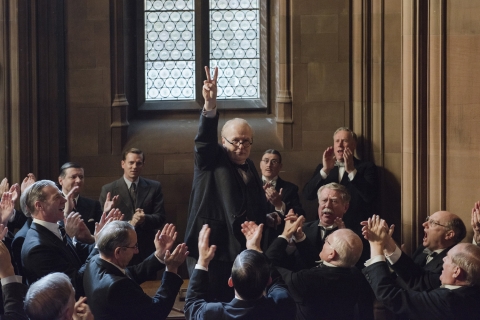
Great speech, huh? One of the best the world has ever heard. While you may assume you know about Winston Churchill, the prime minister of England during WWII, the man who guided the country through its “darkest hours,” Director Joe Wright and actor Gary Oldman want to take you through the first month of his term and try to reveal more about the man.

When I review a movie, I try to either put aside or state my personal preferences. There is no true objectivity in art, and so I try to judge both the technical achievement of a film and the thematic.

So, before I give my verdict on Darkest Hour, I should say that I have seen two other WWII films this year in Dunkirk and Their Finest. And within the last six months I have watched multiple WWI and WWII films (Empire of the Sun, The Wind Rises, Saving Private Ryan, Joyeux Noel, Lawrence of Arabia, Wonder Woman, Sophie’s Choice) and frankly, I’m just tuckered out. Also, British period dramas are not my cup of tea. Sorry. I can appreciate them, but there are only so many I can take. I would not make a good Academy member.

So Darkest Hour to me felt much longer than two hours. I was alert and engaged, but I was also not opposed to an abrupt exit.

Part of the reason is that I think films, to some degree, need to validate why they are films. If you are going to ask someone to pay money to see your film in a theater, there needs to be a compelling reason why. Darkest Hour is a lead-up to one of the most famous speeches in the world. That’s great, but besides “come see Gary Oldman’s great performance,” there isn’t anything here that I either haven’t experienced before, seen before, or could not have found out from a Wikipedia skim.

Moreso, 2017 has been a year characterized by out-of-the-box filmmaking. There have been the Justice Leagues and The Circle’s of course, but there have also been the Get Outs, Wonder Womans, Okjas and Logans and Lady Birds. Films that, even if they are not technically perfect, are ambitious and different. Films that spotlight new voices and talent.

Darkest Hours is classical. That’s not at all a bad thing. It is top-quality filmmaking. Cinematographer Bruno Delbonnel (Amelie, Inside Llewyn Davis) makes each frame of the film mean something. Whether it is framing Churchill alone in a claustrophobic space as he tries to make a decision, or showing the ‘God’s eye view’ of the battlefield, nothing is wasted or unintentional. The script is tight. The score is haunting. All of the actors do a fine job, with Gary Oldman completely disappearing into his role. His makeup and prosthetics aren’t obvious or distracting. The entire film ticks like an intricate machine, and hits every beat.

I think, though, what makes filmmaking such a powerful medium, what keeps it culturally relevant, are the messy films that have something to say and push our expectations. My tastes are leaning towards those films, and they stay with me longer.

If you want to see a fantastic lead performance, and if you love history and admire perfect filmmaking, see Darkest Hour. Appreciate it. But I don’t think that if you miss it, you’ll be missing out on one of the best films of the year.

-Madeleine D

A “Fun” Movie: Justice League

justice league

Why do I keep seeing superhero movies?

This year alone I saw six (including Justice League). That’s a lot of money going into the Hollywood machine! And yes, I liked three of them a lot. Two, I probably could have skipped. This one? Well…

Why am I not boycotting them? After all, a lot of them are just rehashes of other ones. Am I getting desensitized to the action blow-’em-up violence? Am I becoming more satisfied with the loose plots and broad, undefined characters?

My act of resistance was not seeing Justice League on its opening weekend. I didn’t really want to see it. It got blasted by critics, mixed reception from fans, and the most hopeful thing anyone could say to me about it was that it “was fun.”

Being “fun.” Hmmm. That can’t be a bad thing. I think “fun” can be an acceptable thing for a movie to be. So I went, and decided to gauge the film by if I had a “fun” time.

I did not have a fun time.

Justice League takes place where Batman v. Superman leaves off, but has amnesia about half of that film. Batman v. Superman was all about the world rejecting Superman, and Batman fighting him. Then Superman dies. Justice League begins with a mopey montage about the world and Batman suddenly loving Superman and mourning his death.

The film has a “plot,” but it goes through the obligatory motions with as much enthusiasm as I have about explaining it, so let’s just say that the plot’s main purpose is to get the team together and fight a CGI monster-dude. There’s Batman (Ben Affleck), Wonder Woman (Gal Gadot), a newly-resurrected Superman (not a spoiler- Henry Cavill’s name was on the poster), and three new characters- the Flash (Ezra Miller), Cyborg (Ray Fisher), and Aquaman (Jason Momoa). Flash is the energetic comic relief, Cyborg is the moody anti-hero, and Aquaman is just there to have a good time and speak to fish. All of the actors here try their best, but Fisher seems lost within all the CGI, and Miller and Momoa both seem like they are in a much more exciting movie in their heads.

Before I continue, I  know there was a lot of drama and tragedy behind the scenes of the film, and I sympathize. However, that doesn’t mean I can’t criticize it when I’ve been asked to pay to watch it. What was put in theaters is what Warner Brothers decided was a film, and a finished product.

Justice League comes across as a deeply uncomfortable movie. Not for the audience- it requires so little audience engagement that I wrote up the majority of this review in my head during it- but a movie uncomfortable within itself. The actors don’t seem like they fit with the world, the story doesn’t seem like it fits within the previous films, and each scene seems like a patchwork of lackluster efforts and organizational chaos. No scene sits and breathes easily.

For example, I rarely mention CGI and editing in my reviews. Not because they aren’t important, but because most films have professionals working on them and these are areas that are usually competently done. But Justice League can’t even do those things competently. Shots jump awkwardly from one to another, some shots are headscratchers (why do you need a shot at eye level with Wonder Woman’s rear in leather pants? Oh wait…) and some of the CGI is on the level of a video-game.

There is no point in Justice League where there was something that made me think- that looks like a distinct creative decision made by a director with a vision. Which is interesting, because the film is made by the same team behind Batman V. Superman, a film people hated much more than this film, but I think is a better film by the sheer value of having direction. It’s not a great movie by any means, but at least there Zack Snyder tried something. He made interesting casting choices and tried to say something thematically. Justice League says some things about friendship and truth and justice, but… what it actually says beyond the idea that  “those things are good!” I couldn’t tell you.

This is a superhero casserole, stuffed with things people liked from other films- jokes, colors, team-ups, and is crammed in here without thought to what made them work in other films. It’s hollow, but supposedly fun. And I guess if you compare it to previous Snyder-fare it’s fun. There were a few times where a character said something on screen and a part of me went, “Oh, that was a joke.”

But have we really lowered our expectations of “fun” so low that this counts? Can’t a “fun” movie be a movie with direction and effort? Since when are metal things hitting other metal things and a stale script with a by-the-numbers villain “fun?” Why does fun have to be mindless?

So why do I keep seeing superhero movies? Because I believe in their potential. Comic book and superheros are our modern-day Greek mythology and fairy tales. They can be used as lenses in which to view our society’s fears and dreams. They can be easily paired with another genre. Just this year, Logan and Wonder Woman were landmark films and used the conventions of the genre in interesting ways.

Justice League does not push in any category. It stalls progress, and I hope that doesn’t make other movies as lazy- or “fun”- as this one.

-Madeleine D