
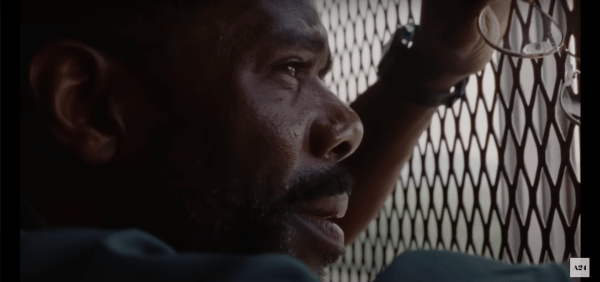

“Stories of the sort I am describing are like that visit to the deck. They cool us….Hence the uneasiness which they arouse in those who, for whatever reason, wish to keep us wholly imprisoned in the immediate conflict. That perhaps is why people are so ready with the charge of ‘escape.’ I never fully understood it till my friend Professor Tolkien asked me the very simple question, ‘What class of men would you expect to be most preoccupied with, and most hostile to, the idea of escape?’ and gave the obvious answer: jailers.” –C.S Lewis
“Why should a man be scorned if, finding himself in prison, he tries to get out and go home? Or if he cannot do so, he thinks and talks about other topics than jailers and prison-walls?” – J.R.R Tolkien
At Sing Sing maximum security prison, there is a theater program.
Initially created because of the psychological and social benefits of participation in the arts, the program grew from just a nice initiative to something much deeper and profound for the participating inmates.
In their cells, they plead their case for clemency and parole and sweat in the summer heat. On stage, they fight battles and win noble wars. In the yard, they keep their heads low, avoiding the ire of guards. On stage, they recite soliloquies written for kings and wear robes and crowns. In Sing Sing, they are men defined by the past. On stage, they are whomever they want to be.
For Divine G (Colman Domingo), an innocent man who has been wrongly imprisoned, the program is a lifeline.
Sing Sing is a narrative film, but is based on the true Rehabilitation Through the Arts theater program that began at Sing Sing and is now in several New York prisons. The movie even centers on a real play that was written and put on in the program. Domingo plays a real man, John “Divine G” Whitfield, who cameos in the film. The majority of the ensemble cast are also formerly incarcerated actors, many of whom are alumni of this exact program.
The film has to walk a very thin tightrope. It would be easy for this to be an unholy mashup of Shawshank Redemption and Theater Camp and become saccharine and cliche. To the cynical viewer, there may be moments when the film misses the mark and becomes a bit cheesy or softens the edges of its characters and their circumstances. But I personally think Sing Sing earns its powerful moments of catharsis, primarily through restrained filmmaking and an extraordinary performance by Colman Domingo (let this be the rallying cry of his Oscar campaign!). This movie has moments that allude to the horrific injustices of our penal system. But it is not ultimately about the justice system or the details of life in prison. If that’s what you’re looking for, it’ll disappoint. Instead, the film’s main focus clearly is, first, showing the dignity and personhood of these men, and second, how art is a beautiful and necessary means for building hope, dignity, and imagination.
As a Christian, while watching the film and observing these themes, I couldn’t help but reflect on the concept of Redemptive Imagination. I don’t think I’ve seen a movie that illustrates the concept as perfectly as this one.
What is Redemptive Imagination? It is an imagination which is being redeemed through the work of the Holy Spirit. Whether you think of yourself as creative or not, everyone has an imagination that is constantly at work. We use our imaginations, yes, for artistic endeavors, like writing, creating visual art, making music, and much more. But we also use them to anticipate scenarios and situations we may encounter. Imagination feeds our anxieties, but also can stir in us bravery, passion, love, and action. Our imaginations and memories are entangled in a dance of fact and fiction. Our imaginations fill in the gaps created by the mysteries and uncertainties of our lives. Imagination is not a fleeting fancy, useless daydreaming that only the idle enjoy. Our imaginations have a serious, material impact on our day-to-day lives. Used well, our imagination builds greater realities. Used poorly, it destroys. But it is always being used. What takes up the most space in your imagination is the greatest indicator of what you love the most.
Being a Christian means I have signed my allegiance over to God, but that’s just the beginning. I call Christ my Savior, but my heart, mind, and body continually rebel against what I know God wants for me. I am a person divided– both sinner and saint. As Paul writes in Romans, “For I do not understand my own actions. For I do not do what I want, but I do the very thing I hate… For I have the desire to do what is right, but not the ability to carry it out” (7:15,18). I am forgiven and loved by God, justified by the blood of Christ. That can never be taken from me. But now the work of the Holy Spirit is sanctification, the process of forming me more and more into the likeness of Christ, restoring me to full personhood, where my soul and my flesh will not be divided and at war anymore.
If my imagination is the war room in which the deepest passions of my heart are created, revealed, and acted upon, is that not the best place for the Holy Spirit to invade? If He can influence my imagination, then so much of me– my creative urges, my ambitions and dreams, my worldview and interpretations of circumstances– will be brought under His power. My imagination is, after all, a beautiful gift from God, first used in Eden by Adam to name the animals. It is a gift that has been led astray, but now can be transformed back to its original glory.
So what does a redeemed imagination in action look like? Here are some examples.
The tension of living as a sinner-saint is often exhausting. I swing from feeling like I am God’s gift to humanity, to feeling inhuman and unworthy of anything. On my pharisaical days, my redeemed imagination reminds me of Jesus, and his example humbles me and reminds me of how I need Him so desperately. On days when I feel the crushing weight of my sin and weakness, my redemptive imagination reminds me that God is making me into a new creation (2 Corinthians 5:17), and even angels long to understand His love and redemptive plan for me (1 Peter 1:12).
When my fellow church member annoys me. My regular imagination decides there is ill will behind their awkwardness and eccentricities. My imagination makes excuses for me to avoid them, and see them as less than myself. But a redeemed imagination remembers they are also made in the image of God, an eternal being like myself. A redeemed imagination tries to picture what understandable, sympathetic reasons could make them act the way they do. A redeemed imagination makes me consider how I could treat them more tenderly and how I could picture us as members of the same family.
A redemptive imagination helps me anticipate heaven with joy and excitement. It also helps me see with more clarity the important work to be done on Earth. Imagining what God is doing on Earth to bring about the Kingdom of Heaven helps me live more intentionally, but not put my ultimate hope in this world.
Finally, a redemptive imagination helps me see God’s invisible work all around me. Those repeated run-ins with my neighbor no longer look like a coincidence: What kind of relationships might God be calling me to foster with her? How do I love her better? The messy period of my life where everything went wrong and I was at my worst? That is not the end. With a redemptive imagination, I can begin to try to understand and believe– although maybe not fully, maybe not in this lifetime– that there is a bigger story at work that is redeeming these failures and sufferings.
We participate in the work of crafting our imaginations every day. The media we consume dramatically informs our imagination. The stories we tell about ourselves and others reveal the narrative scripts we believe we are living out (Am I the hero here? Am I a victim? Is this a comedy? Is it a tragedy?). Our daily work, where we live, our cultural moment, our hobbies and interests, and so many more influences, are always informing our imagination.
In Sing Sing, the theater program is a place where the inmates cultivate a redemptive imagination for their lives. Some ways this happens in the film:
A character refers to Divine G as the n-word. Divine G stops him, telling him that here, they don’t use that word. Instead, they call each other “Beloved.” Throughout the movie, the men refer to each other as Beloved. Their imaginations have changed. They are beholding one another more deeply and profoundly. It is a world that uses the n-word that is out of touch with the truth. Their redeemed imaginations allow them to actually see reality: that every person is, indeed, Beloved.
Divine G allows another man, Divine Eye (played by Clarence “Divine Eye” Maclin, playing a version of himself) to join the theater program. Divine Eye is a rough character, coming in with a big attitude and aggression that threatens to hurt the hard-won sanctity of the program. But Divine G sees artistry in Divine Eye, the potential for tenderness and talent and beauty that Divine Eye can’t even see in himself yet. And over the course of the film, being a part of the program does bring that out of Divine Eye. What made Divine G take a chance on Divine Eye? A redeemed imagination.
When he joins the program, Divine Eye suggests the troupe perform, for the first time, a comedy. So they write a comedy– a time-jumping, hilariously idiosyncratic, imaginative play that includes Egyptian pharaohs, gladiators, cowboys, Freddie Kruger, Hamlet, and more. These men are in prison. Many will never be released or go home again. They will be forgotten. Their stories seem tragic. But in this exercise of imagination, they turn themselves into the heroes of a comedy. They act out, in essence, the idea that my life may look like a tragedy, but that’s not the whole story.
In church, when we sing hymns, I rarely feel all the words. When we sing “It is well with my soul,” in the moment, I almost never feel like it is well with my soul. But I sing those words not as some kind of lie, but to live into them. I am using my imagination to identify with something that is perhaps not yet true about me, but will be with the work of the Holy Spirit. My imagination clings to these words and my identity begins to take shape around them, because the passions of my heart now have something to be affixed to. When the inmates in Sing Sing play these roles, they are living into what is not yet true about themselves, but one day, will be. They are not heroic, victorious figures. And they are not free yet. But one day they will be. Maybe not on this side of heaven. But their story is ultimately a comedy, not a tragedy, because one day, we will all be free and home again.
Not everyone is made for community theater, but we are all artists. Whether your medium is the stage, the written word, the canvas, the home, the spreadsheet, the office building, the city, the church, the school, the hospital, the friendship, the family, the neighborhood, and everything and anywhere in-between, our imaginations are at work. Whether we are inmates at Sing Sing or live lives of freedom and comfort, we are all, with Creation, waiting to “be set free from its bondage to corruption and obtain the freedom of the glory of the children of God.” (Roman 8:21). As we await that ultimate emancipation, we use our imaginations to hold tightly to this deeper reality.
-Madeleine D.




















 madeleinelovesmoviesdotcom