Movie Minute

Because I haven’t seen a new release in a couple weeks, I’m presenting for your consideration short reviews for a few films I have seen recently. These are not new releases, and vary in how old they are. Maybe one of these could be the perfect film for a sweltering hot summer day!

As you like it

As You Like It (2006) dir. Kenneth Branagh

As You Like It, an HBO movie from Hollywood’s favorite drama nerd director, has three things going for it. One, a marvelous ensemble cast, the majority of which is grossly underused. Two, a setting that distracts you from the oddly-paced story. And three, Bryce Dallas Howard, who has an energetic charm that keeps you from thinking too much about how terrible her disguise as a man is and how much of her role has been cut.

Those positives are about it. The biggest problem with As You Like It is that it doesn’t feel whole. Howard’s Rosalind does not seem to have the starring role she should have, and David Oyelowo does not get near his due with his Orlando. Branagh seems to try and make the minor characters have equal roles with Rosalind and Orlando, and in doing so creates a play that has no central storyline to hold on to. It is spread thin. Even similar plays like it, such as A Midsummer’s Night Dream, still have major and minor characters. This adaptation of As You Like It does not seem to have this distinction. And while the aesthetics of Japan are a unique addition, it is simply one more task the film cannot take. It buckles under the weight of its underdeveloped ambition and does not leave any strong impressions in its wake.

Bridge-of-Spies

Bridge of Spies (2015) dir. Steven Spielberg

A Steven Spielberg, Tom Hanks, and Coen brothers collaboration is no joke, yet Bridge of Spies was relatively neglected when it came out. While this story of an American insurance lawyer negotiating the trade between two Americans and a Russian spy during the Cold War did win Mark Rylance an Academy Award for his supporting role, it is nowhere within anyone’s list of favorite Spielberg movies. That makes sense when you take into account Spielberg’s resume, but does not when you take in its fellow movies of that year. Bridge of Spies is small and mighty, and it succeeds not only because of the talent involved, but because of its message. It might be one of the most patriotic movies ever made, while also being incredibly sympathetic to our country’s enemies. The film’s message is about everyday men and women who work hard and do their jobs. While these jobs might not always be noble, human dignity and the work we do are inseparable to many, especially in the context of our western ideals. It shows that our justice system is dependent on the people who run it, and when those people fight for ideals, we become more of the nation we inspire to be. A well crafted story with thoughtful themes makes a film worth watching, and maybe makes it worth being on a favorite list of some kind.

yoko_out

The Wind Rises (2013) dir. Hayao Miyazaki

Set in the early beginnings of World War 2, The Wind Rises is the loosely biographical story of aerial engineer Jiro Horikoshi, who designed the Mitsubishi A6M Zero, a plane used by Imperial Japan during the war.

It goes without saying that the Studio Ghibli work, lead by animation legend Hayao Miyazaki, is stunning. The film could be watched on mute, and the visual experience would be on par with its greatest contemporaries.

But don’t turn off the sound, because the story is just as worthwhile. There is something very disarming about being an American, watching the story of Japan’s entrance into World War 2 through the eyes of a civilian who just wants to make the world a more beautiful place. Jiro sees airplanes as one of the greatest achievements of mankind, and only wants to make them better. This intrinsic desire to make beautiful things is a message that should resonate with everyone. As a Christian, this desire is near the core of my belief, because it reflects on the nature of the greatest creator of them all.

More than what Jiro does, though, is who he is. Jiro is one of the best heroes I have ever met, despite what he creates being used in horrific ways. The love story between him and his wife, Nahoko, is a touching story of sacrifice and care, one of the best I’ve ever seen on film. Jiro is who we should aspire to be, and his personal integrity and strength defies all politics, all sides, and all situations we find ourselves in. If we all carried ourselves like Jiro, the world would be a better place.

-Madeleine D

Everyday Poetry: Paterson

PATERSON_D26_0049.ARW

(spoilers ahead)

Every morning, Paterson (Adam Driver), who lives in the town of Paterson, NJ, gets up. He goes to work (he’s a bus driver). He writes poetry. He comes home to his wife, Laura (Golshifteh Farahani), who always has a new project to show him. He takes the dog out for a walk. He goes to the bar, gets one beer, and talks to the owner, Doc. Rinse, wash, repeat.

In Paterson, one week in the life of Paterson is shown. How could this possibly be any more interesting than watching paint dry? I go to the movies for escape, not to watch some dude’s daily routine. How could watching seven days in a fictional character’s life be worthwhile?

Paterson reminded me of another low-key, almost drama-less indie that came out last year: Loving. I said in my review of that film about the famous Loving vs Virginia case, “(Loving) reminds me why not a lot of movies are made about introverts. It doesn’t matter how powerful those closeups of intense expressions are. It doesn’t matter how wonderful they are as role models… Quiet people simply do not have the onscreen charisma we are used to to entertain us. And I say this all as an introvert. A movie about me would not be entertaining in the least.”

Paterson is very Loving-like on the surface, minus the historical importance. It’s about Paterson, a quiet, kind, dutiful man, and his slightly more eccentric but equally as kind and lovable wife. They lead an unremarkable life, and are content. They’re even inter-racial like the Lovings, although this film does not treat that as anything but normal.

Loving doesn’t succeed as a movie because it takes what people see on the surface when it comes to quiet, calm, introverted people: silence and boredom. And that becomes the movie. (Not to say Loving doesn’t have good elements, it’s just underwhelming)

However, Paterson succeeds because it takes what goes on below the surface of quiet, calm, introverted people: observation, introspect, and a rich inner life. And that becomes the movie instead.

The cinematography of Paterson, richly done by Frederick Elmes, is Paterson’s inner monologue and observations. The shots of the shoes of people on the bus. The details of people’s knees touching. The layers of waterfalls and beers and faces and notebooks, are all  visual representations of Paterson’s brain. The brain of an artist works like that, and the film is able to capture a rich inner life visually with both simplicity and bravo.

The other thing that compels the character of Paterson to be beyond what is on the surface is Adam Driver’s performance. None of his moves seem calculated. He is simply inhabiting the body of Paterson, and exploring the world around him. It is beautiful to behold. He and Farahani are so lovable in the roles, that at the slightest bit of tension I was afraid something bigger would happen and I didn’t want them to get hurt.

Luckily for me, nothing did happen to them. Well, it seems like nothing bad happens to them. The climax of the film involves (spoiler) Paterson’s notebook of poetry being torn up by a dog. Nobody except his wife even knows about his poetry. Is that really climax-worthy?

While watching the scene, my mind rushed to the other writer’s-notebook-gets-destroyed scene from one of my favorite films, Little Women (1994). Little sister Amy rips up Jo’s notebook, and Jo (understandably, from a fellow writer’s perspective) viciously attacks her.

I held my breath as Paterson and Laura walked in to see the notebook. I waited for Paterson to explode into anger, or cry, or chase after the dog. Or at least Laura to do something.

But instead they just react. Paterson doesn’t get visibly upset, because it’s nobody’s fault. Laura tries to make him feel better, but there is nothing she can do.

So I let out my breath and relaxed. Nothing bad happened to them. It’s all okay. Until you start thinking about the whole movie, and realize that it’s not okay. This really is a climax. This really is a dramatic moment for the film. Just because it’s quiet and not overblown or even truly expressed, I just spent an hour and a half watching a week in Paterson’s life, just to to feel the pain of this moment, which in any other movie would not be felt at all.

Paterson is an ode to our own beautiful lives. No matter how ordinary, or routine, or small, what we do and how we act and how we interact with people around us matter. The more you observe it, the more poetic- whether sad or hopeful- it becomes. Our lives fuel our art and passions, so that itself gives it worth.

Paterson, like its lead, has more going on under the surface, and it’s dazzling in its own peculiar way.

-Madeleine D

Let’s Not Make This Complicated: Gifted

Gifted

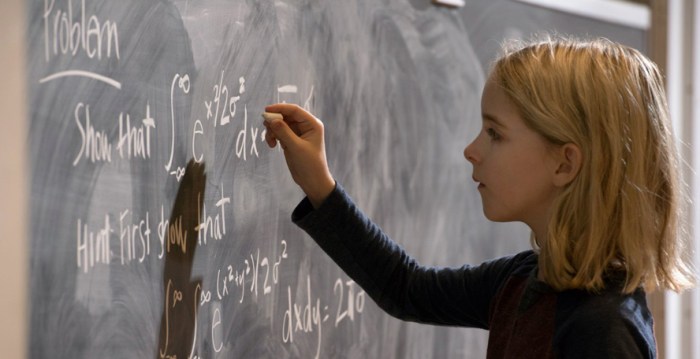
First-grader Mary is gifted. Now, aren’t we all gifted in something? Some of us are great athletes. Some of us win every spelling bee. Some of us are natural artists. And some of us are really good at getting participation awards.

But Mary (Mckenna Grace) is a different kind of gifted. She’s Stephen Hawking, Albert Einstein, Katherine Johnson level genius. She’s far beyond what any elementary school could teach her, and who would want such a gifted child to be stuck with kids still learning basic addition?

Her Uncle Frank (Chris Evans), that’s who. He wants to raise his niece right, after her mother took her own life. And right means normal and happy and not-weird. Too bad Frank’s mother Evelyn (Lindsay Duncan) doesn’t see it that way.

Director Marc Webb is back from directing the two totally not controversial or hated Amazing Spider-Man films, and is ready to go back to telling small, stand alone stories. He made a name for himself with 500 Days of Summer, and now, armed with a script from the Blacklist and star power, he’s ready to go.

Speaking of star power, the real tragedy of this film, beside suicide, neglect, abandonment, and disabled cats, is Octavia Spencer getting another underused role. She gets maybe fifteen minutes of screen time. Give her the deep acting role! I know she was busy getting Oscar nominations and literally playing God, but come on! You had Octavia Spencer!

Meanwhile, Chris Evans gives this movie his all. He’s going for gold. When he’s in the courtroom, you can see Jack Nicholson from A Few Good Men playing behind his eyes. When he’s staring off into the sunset, you can tell he watched at least two Daniel Day-Lewis movies. He portrays Frank’s insecurities about his abilities, and his devoted love, with sincerity, charm, and ease. He does his darndest, and for the most part, it works.

It’s screenwriter Tom Flynn (Watch It (1993)) that is the biggest problem. Just like Frank in this movie, I think Flynn has some self-doubt to work through. His script is good. There are quite a few moments, particularly in the familial drama department, that got me. As things were revealed throughout the film, I was excited about how it would impact the rest of the story.

Then, Flynn loses his nerve. He seems to get worried the nuances of his script and the threads he had laid won’t be enough. So he adds things. Sure, a child being ripped away from her guardian is tough, but you know what is tougher? A one-eyed cat about to be put down. Sure, Frank is shown to be a good guardian throughout all the scenes, but you know what will really make him a hero? If he storms into a shelter, rescues/steals three cats, then trespasses to take back his niece with some questionable legal skills. Sure, the teacher and Frank have a connection, and Frank wants a life and fellow adult connections, but you know what will really show that? Besides a drinking scene where they literally tell each other their greatest fears? An unnecessary bedroom scene, then a basic disregard of the teacher later.

Stories about gifted kids aren’t particularly new. There have been numerous other films that have explored the idea of adults trying to make the right decisions for children, especially gifted ones. The ethical problems presented in the film are interesting though. It’s not that this sort of story shouldn’t be told again. It’s that this kind of story has more depth to explore, and I don’t think Gifted quite takes the leap from by-the-books family drama to a more thoughtful exploration of its topic.

For example, it could take a chance and make the audience feel more uncomfortable with both options. What if Frank wasn’t a lovable guy, but just a solid guardian? What if Evelyn was more likeable? What if Mary was more troubled than just being precocious? Instead, Gifted, for all of its twists, still puts people in boxes.

At one point in the film, Frank reveals to Evelyn something along the lines of somebody wanted her to die. People in my audience cheered. Yeah! Take that Evelyn! You deserve it, you monster!

Really? What if the audience couldn’t react with a cheer when the “Bad Guy” is beaten? What if it was more difficult to see who was right? What if it was more like real life, where there are no clear heroes and villains in cases like these?

So, Gifted doesn’t take the plunge. It plays it safe. While Gifted is a film with promise and talent, and is disappointing when it doesn’t go the extra mile to be better, all that doesn’t make the film bad. If you don’t go in with high expectations, it will be very enjoyable. I was engaged the entire time, and so was the rest of the audience.

Maybe, if anything, it’ll remind you of how important good role models are. Go thank your teachers and parents and anyone else in your life who has made a big impact on you. Even the people who were in a grey zone, most of them tried their best. That is one message of Gifted that is okay with exploring complexity.

-Madeleine D

“I’ve Been Standing With You”: Fences

fences

Troy Maxson can’t accept who he is and where he is in life.

After overcoming a troubled childhood and young adulthood and a stint in prison, he’s a settled family man in Pittsburgh. It’s the 1950s, and he’s a black man, but he’s doing his best. He gets a promotion at his sanitation job. He has his wonderful wife, Rose (Viola Davis), of eighteen years.

But he can’t be satisfied.

His 17 year old son is wanting to go into sports, something he could never pursue himself because he was black. Sports will let his son down like they let him down, Troy rationalizes. So he puts a stop to it. Like a good father would.

His wife isn’t giving him everything that he wants, either. You can’t fault a man for wanting to feel full, Troy rationalizes. So he finds another woman. Rose should be able to understand.

Life hasn’t given Troy what he wants, and it keeps giving him things he can’t accept. Things that remind him of his past failures. Things that leave him bitter.

So what do you do with things you can’t accept? You lock them out. You lock the things you want in. Maybe you build a fence around them.

Accepting circumstances and people is one of the many themes reflected on in Fences, directed by and starring Denzel Washington, based on the Pulitzer Prize winning play by August Wilson. Going into the film, I only knew that Fences was a famous play, and both Viola Davis and Denzel Washington had played the parts on Broadway. I didn’t know the story, and that made the experience much better. I wasn’t focused on how the play translates to screen. I was completely engaged in the tumultuous story playing out before me.

Fences is one of the deepest character studies I have ever seen. Troy and Rose Maxson became as real to me as my family beside me. The slow reveal of Troy’s conflicted personality and motivations made me jump from sympathy to rage to sadness- sometimes all in the same scene. Rose’s sentiments were real and her journey was one that is universal for so many, yet equally as complex and conflicting. Confronting her husband and his selfishness- “I’ve been standing with you. I gave eighteen years of my life to stand in the same spot as you!… What about my life?” will stay with me more than any line I’ve heard from a film all year. All the side characters feel lived in and dynamic. That’s purely from the writing, not to mention the acting (which we’ll get to later).

Simply put, there is a reason this play won a Pulitzer. Don’t just take my word for it. See it yourself.

Denzel’s directing here is never flashy. The film, honestly, doesn’t take full advantage of its cinematic medium. This was a story made for the stage, and the film simply cannot shake that. Yes, the close-ups on the actors do make the story more intimate. But the film still takes place in no more than four locations, and if you aren’t prepared to basically watch a play when you sit down in the theater, it might surprise you how theatrical the film plays. So while there might not be a real justification for putting this story to screen, it does mean the story is being exposed to more people, which makes it worth it. I, for one, am grateful.

Saying Denzel Washington and Viola Davis are fine actors is kind of like saying the sun will rise today, but great work should be recognized, and they do great work here. They have both had the advantage of playing these characters before on the stage, so I’ll let the Academy decide if that is grounds for denying them Oscar nominations. If you only consider their performances, though, Oscars for both.

Watching their performances, each time a new revelation was made (and trust me, there are plenty), I waited in tense anticipation for what the character’s reactions would be. Each time, they were realistic, one I could imagine myself having, and yet astonishing to me at the same time. The sheer volume of their emotions carried me to the finale that is a poignant reflection on legacy.

I can’t say enough good things about Fences. I can’t stop thinking about it either. I urge everyone to see it. It is a tour de force on numerous levels, and one of the most human stories put to screen this year.

-Madeleine D