The Perfect Thanksgiving Movie: Coco

coco-pixar

Dia de los Muertos is a hard sell in America.

In general, all movies about other cultures and countries are. We’ve westernized the world through Hollywood, and we don’t really care for anyone else’s films.

On a deeper level, though, Dia de los Muertos is a Mexican holiday about death that coincides with our date for Halloween. It’s about celebrating and remembering those who have died. And here in America we prefer not to think or talk about death, thank you very much. We don’t die, we “pass on,” and to where? Who knows! But please don’t speak about it too loudly, lest the Grim Reaper come for me before my preferred time.

But, if there is any movie studio able to tackle this holiday and present it to an American audience, it is Pixar. There is nothing the studio behind Finding Nemo, Inside Out, Toy Story, and Up can’t do. Add a big-eyed boy with a guitar and some musical numbers, and maybe Coco will manage to sneak into your heart, and family viewing rotation, after all.

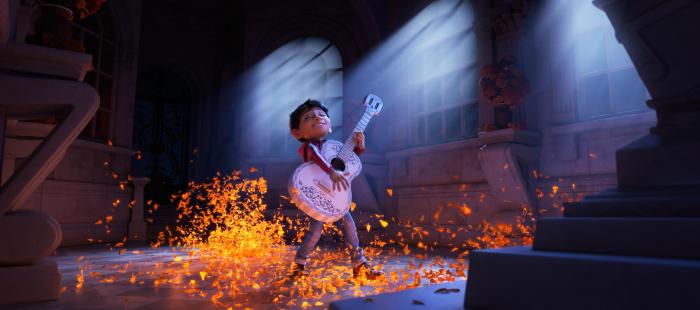
Coco tells the story of Miguel, the youngest of the Rivera family, who wants to be a musician. He wants to be like his idol, Ernesto de la Cruz. The only problem? The Rivera family does not do music. A guitar cannot even be in their line of sight. So on the Day of the Dead, Miguel skips his family’s celebration to compete in a talent competition to show off his skills, and through a series of mishaps, finds himself in the Land of the Dead.

The first act, and probably the weakest part, of Coco is the only area that isn’t highly original. The son-who-wants-to-be-a-musician-but-his-family-doesn’t-want-him-to is not only a trope, but was the plot of 2014’s The Book of Life, an animated movie also about the Day of the Dead.

On a side note, the 2014 animated film The Book of Life is an enjoyable film for kids, but if you have to choose between it and Coco, Coco is the Target brand, Book of Life is the Walmart brand (and Book of Life also includes a mariachi version of Mumford and Sons “I Will Wait,” so decipher from that what you will).

Once the “nobody understands my sensitive musician soul” storyline is established, everything else in Coco shines. It builds up to a well-earned, intense, emotional conclusion that I didn’t see coming. And while there are a few tear-jerker moments, the film doesn’t pry open your tear ducts in the way Pixar usually does. They’ve been accused of being emotionally manipulative, which I think is true in some cases, but here, it doesn’t feel pushed.

I don’t want to say much more about the story or characters, because I think the less you know the better for this film. But, I will say that the voice acting is top-notch, and the adventure the characters go on is full of twists and turns. There are some serious moments, but nothing truly scary, so consider looking at a content review of the film before taking a young child to see it. The toddler I took to see the film was fully engaged the whole time.

What struck me while watching the film is that Coco, even though it starts on October 31st and the skull motif fits for Halloween, is actually the perfect Thanksgiving movie, a genre that is severely lacking. Thanksgiving as a holiday is about family, being thankful, remembering your past, and appreciating your life and culture. Coco does all of that.

In America, we take two distinct views on death. Either we ignore it and don’t talk about it, or we say it’s natural and a part of life. As a Christian, I don’t think either of these are healthy. Ignoring death, not talking to children about it, and refusing to acknowledge or prepare for it is not only an act of fear, but simply unreasonable. We can’t protect anyone from death. Christianity is all about death- the death of Jesus, the death of our sins on a cross, death of our former selves when we come to Christ, and our eventual death so we can go to a new heavens and new earth.

As for saying it’s a natural part of life, ala the Lion King, that also doesn’t seem right either, because we weren’t made to die. In the Garden of Eden, Adam and Eve were made to be eternal with God forever. Sin is the unnatural thing brought to mankind. For those who are not Christians, death is something to be afraid of, and as Christians, we should mourn for them.

So Dia de los Muertos- a holiday that acknowledges death, believes that there is an afterlife, teaches children that death isn’t something to be afraid of, and celebrates family- is a great thing. It’s a very Christian thing, I believe.

The only thing that makes this particular Presbyterian pause is that Coco sometimes leans a little too close to ancestral worship. Also, the afterlife presented here isn’t really a heaven. In the film, it explains that if you aren’t remembered by people on earth, then you have a “final death,” where you are gone forever, which isn’t what Heaven is.  

I think these issues can be talked through with children if you go as a family to see Coco, which I highly recommend you do. It is not only a lovely film that shows off Pixar’s storytelling and artistry, but it also has another message that is ripe for discussion. Coco explains how we are responsible for each other. Miguel is responsible for his family members being remembered, and his family members are responsible for him and helping his future, and they all create a tight net that will never let the others fall. We are responsible for each other, whether in death or life, and through those loving bonds, nothing can really separate us, because one day, I hope, we will all be united together again.

-Madeleine D
My Best Self: Lady Bird

Lady-Bird

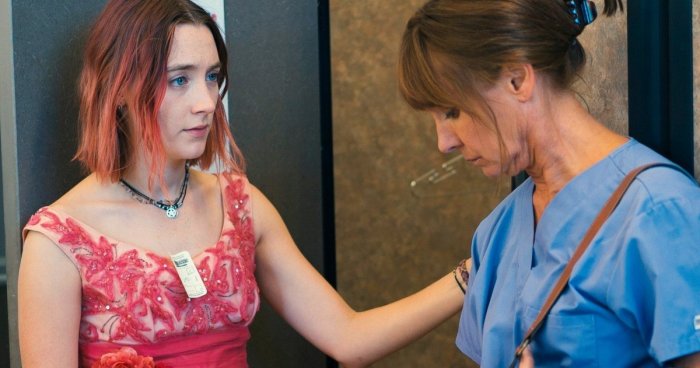
It’s 2002, Sacramento, and Christine “Lady Bird” McPherson (Saoirse Ronan) is up to trouble again.

She’s not a bad teen by any means. She tries very hard to be good. She just wants what… what she is supposed to have. This is her senior year of high school. Can’t she have a boyfriend, a job, a role in the school play, a little popularity, and a chance to get into the college of her dreams and escape California without her mother (Laurie MetCalf) giving her the silent treatment or commenting on every little thing?

Is that too much to ask?

Greta Gerwig’s directorial debut is a terrifically acted, charming meditation on the leap between teenagehood and adulthood. It’s about who and what shapes you, and loving where you come from. It’s a love letter to suburbia and awkward moments and mistakes and families.

It hits all the beats of a coming of age story, but in a way that doesn’t feel like it’s trying to be “quirky” and “cute.” It feels honest, and I think a lot of people will see shadows of their lives in this film, to a bigger degree than a lot of films that try so hard to be realistic and cool and end up missing the point.

Lady Bird is not a story where bad things rain down upon the protagonist. It’s not an endless parade of drama and despair. There are serious moments, but I think the life Lady Bird leads is common and unextraordinary. In other words, it’s not a movie where you describe the plot, because Lady Bird isn’t really interested in that. It’s interested in making you laugh, cringe, nod in understanding, and reflect.

A lot has been written about Lady Bird- the splendor of Ronan’s performance, Gerwig’s confident directing, the commentary on wealth and Bush-era America. Those are all important aspects of the film, but here is what I primarily took away.

Lady Bird is an optimistic movie in the way another one of my favorite films of the year, The Unknown Girl, is. Both are films about characters figuring out how to interact with the people around them. Lady Bird navigates strained relationships with her mother, father, boyfriend, siblings, friends, teachers, and strangers. Throughout the film, she messes up and tries again, each time getting better and better at empathizing, understanding, and supporting those people. She learns about how complex the lives of others are. She matures by deciding the world is not just about her.

That’s what coming of age is, yet the irony is that most films like this are about individuals becoming more selfish. They decide they deserve more, that life isn’t fair, and that they have a special place in the world to do something only they can fill.

But Lady Bird is about realizing that maybe you don’t contribute all that much, and maybe we need to treat each other with a little more kindness as we realize that sobering fact.

Lady Bird isn’t strikingly unique in many aspects, yet people love it (it has set a record on Rotten Tomatoes by having no negative reviews and just today was named Best Picture by The New York Film Critics Circle). I think that’s because it is difficult to convey such a nuanced message. That is what makes it one of the best films of the year.

-Madeleine D


So We Just Pretend Those Other Movies Don’t Exist, Right? Thor: Ragnarok

thor ragnarok

Every time I go in to see a Marvel movie, a voice whispers in the back of my mind: Don’t you dare give this a good review. You can’t give them all good reviews. Your five readers are going to think you’re basic. You’re becoming the enemy of cinema, a blockbuster, mouth-drooling, action-spectacular addict who likes quips and things that go boom. Don’t fall into the trap. Be better. Be the special snowflake who doesn’t like it.

But, I whisper back to the voice, professional critics have liked it. And I’ve been looking forward to this movie for two years.

They’ve already been mind-controlled. You are young, you can escape.

I just want to have a good time.

No, art only comes through pain and suffering.

That sounds fake, but okay.

Reveal this movie for what it truly is- a hollow technicolor sugar-rush!

And then I write the review.

Thor: Ragnarok takes place a little time after Avengers: Age of Ultron left off. Thor has been having dreams of an impending Ragnarok, the term denoting the apocalyptic-like end of his home planet of Asgard. As he tries to figure out what’s going on, his (evil? antihero?) brother Loki (Tom Hiddleston, giving a very earnest performance) has been masquerading as their father, Odin (Anthony Hopkins, definitely phoning it in), on the throne. A series of events occur, and Odin, being the Best Dad Ever, tells Thor and Loki they have an evil sister, Hela, goddess of death, (Cate Blanchett, having way too much fun) who is going to destroy Asgard. And then Odin promptly dies. Thor is subsequently sent to the planet of Sakaar, where he is forced to fight in a gladiatorial arena against fellow Avenger, Hulk (Mark Ruffalo, who deserves more respect for his MCU work at this point).

When I walked out of the theater, the first words out of my mouth were- “it felt sloppy, and I am conflicted.”

Whaaaatttt? 

Director Taika Waititi (of the fabulous Hunt for the Wilderpeople and What We Do In The Shadows) has said the dialogue of the film is “about 80%” improvised. And that’s where the problem lies.

The film is clearly split into three parts (not just because of the three-act film structure) and they are all very different. The first part is rushed and works to parody the rest of the Thor films and clear up any threads to the previous films in order to start with a clean slate. This part was obviously scripted, with only subtle details that point to Waititi.

Then there is act two, where Thor is on Sakaar, fights Hulk, and assembles the new team. This is clearly where the improvisation happens, and where Waititi is most in control. The action sequences are good, but it’s the character interactions that shine. Then the film remembers- oh wait, plot– and so act three is served up with a script and probably a dose of improv. The pacing is uneven and rushed.

The third act is where the attempt at an emotional core takes place. Heimdall and Thor repeat this mantra a few times: Asgard is not a place, it’s a people. And that’s nice, except….

You can’t spend the first part of this movie parodying and invalidating and killing off the only recognizable characters from the previous Thor films, then expect me to then use the supposed connection I have with the previous Thor films to make me believe this ending and care. Maybe this makes me a terrible human being, but seeing all those extras looking mildly distressed is not enough to make me care all that much about Asgard.

So without an emotional connection at all, Thor: Ragnarok does not feel like a Waititi film, because his films do have heart. Quirky and off-kilter maybe, but they feel genuine. The ending of Thor: Ragnarok does not.

Ultimately, this film exemplifies all the pros and cons of the Marvel Cinematic Universe. The good things? Well, there are jokes in this film that have been 5 years in the making, and as a fan, that is glorious. It makes it all worth it. The easter eggs in here are spectacular. I love seeing different Avengers pair off and watching their dynamic. I love that Marvel trusted an indie New Zealand comedic director to handle a big blockbuster! That only happens when you’re on your 17th film.

But the bad things? The first act having to deal with the previous movies. The overstuffed plot and characters that sacrifice a smoother story for fan service. The way Marvel is becoming too much of the same “funny.”

Yes, I said it. Marvel is too funny. If you watch the first Avengers film, while all the Avengers can be funny, each Avenger was a different kind of funny. Iron Man quipped. Captain America balked. Black Widow had the understatements. Bruce Banner/Hulk self-deprecated. Thor was a meathead.

But now, everyone has the same Marvel Humor. Doctor Strange, Ant Man, Star Lord and all the Guardians of the Galaxy, they all rip one-liners and can’t have an emotional moment without a joke attached. Thor may be more witty, and his jokes more physical, but when Waititi is gone and Thor is in the hands of another director, his jokes will probably lose their edge and become the same as everyone else. When everyone is the same kind of funny, it’s not as fun.  So I’m surprised this film has seemingly caught everyone off-guard by being a straight comedy. That’s really all the MCU is creating right now, and while a few films in the future may divert the path, Marvel needs to rethink their brand. Light does not have to mean sitcom.

I’m trying to keep my critic’s hat on for this, because believe me, my fan side has some very specific strong opinions. I had high expectations going in.

That all said, I’m critiquing this movie because it has so many things going for it. You’re harder on things you love. And while I am frustrated with Thor: Ragnarok, I do like it, and I think most people will love it. The acting, the humor, the character moments, the visuals, the music, are all spot-on. I can’t really say more for fear of giving stuff away, but this film is really best just seen and experienced. If you can get over the issues I had, which I’m sure I’ll be able to put aside for a repeated viewing, then Thor: Ragnarok is going to be a blast. I don’t think this is a game-changer, but it’s certainly a solid step.

-Madeleine D

Our Responsibility to Strangers: The Unknown Girl

the unknown girl

What responsibility do I have to a stranger?

If I see someone on the street crying, I don’t comfort them. Right? Keep to yourself. Don’t interfere.

But what if I see that person fall down? I don’t help them up, right? They can pull themselves up. Toughen up. They probably don’t want my help.

What if they walk in front of traffic? Are hit by a car? I interfere, right? But what makes that different from the other times?

Dr. Jenny Davins is a gentle, considerate, helpful, caring, practically perfect doctor to her patients. She makes house visits at weird hours of the night, sleeps in her office, and will drop everything to take care of you. She is far overdue for some time to herself, time to close her doors and get some rest.

But one fateful night, when she closes her doors and ignores a woman who knocks, the woman shows up dead the next morning. Who is to blame? Certainly not the good doctor. Nobody blames her.

Yet Dr. Davins can’t get the woman out of her head. The nameless woman no one can identify. The nameless woman who may die without a tombstone and a family. So Dr. Davins goes on a search to find her.

The Unknown Girl is a Belgian French foreign-language film from the respected Dardenne brothers. Please don’t let that scare you off! I’m a little hesitant about foreign language movies, too (a small piece of my father’s soul just died), but I am very, very thankful I saw this one. Trust me, the mystery is so gripping and the acting and story so powerful that the inconvenience of subtitles becomes nothing in their wake.

The Unknown Girl has on display some of the better qualities of European films compared to American films. Generally speaking, in American films, every character and shot is glossy. Even with those that aren’t trying to be, there are things that just make the reality of the movie out of reach. The characters never stumble with their words. Conversations always have a great pacing. The characters never wear the same clothes or hair twice, and they’re certainly never within my price range. No time is wasted on small details when there is the overwhelming push for action and plot.

The Unknown Girl kept surprising me by breaking all of those rules. The Dardennes are known for their documentary-like style. This film does not rush itself or its story. The quiet revelations and heartbreaking moments knock quietly, and the simplicity of each scene is so natural that I could see interactions I’ve had in my life reflected in the ones on the screen.

The greatest part of the film, though, is its star, Adele Haenel. She centers the film with an unexplainable intensity and quiet charisma. In her, I saw myself. Or rather, potential for me. Here was a character that I could look up to, because she was in my reach. I don’t look up to superheroes or Katniss Everdeen or Harry Potter. They are too good in too fantastical of worlds. I can’t match their heroics or even force of personality.

But maybe, just maybe, I could have the integrity of courage of Doctor Davins. Maybe I could be afraid like she was, but go on. Maybe I could care as much about people as she did.

I was moved by The Unknown Girl. Moved in a different way from other movies of the year. I was swept away by the grandeur of Beauty and the Beast and War for the Planet of the Apes and Dunkirk. I was startled and entranced by the uniqueness brought to Logan and Wonder Woman and Baby Driver. I cheered along with the victories of The Big Sick and Battle of the Sexes and To the Bone. A little piece of me died with Despicable Me 3 and The Emoji Movie.

None of these films, though, made me empathize and despise a character at once, or even grasp for a moment my ability to be like them. None of them made me rethink my own actions towards others, and none of them left me feeling as full and hopeful the way The Unknown Girl did.

-Madeleine D

“Putting the Show Back in Chauvinist” : Battle of the Sexes

Battle-of-the-Sexes

“You know, I remember when the actual match happened,” an older woman told me as we walked out of the theater together. I threw away my popcorn as she reminisced, “At the time, I just thought it was a big show.”

The famous 1973 match between women’s tennis champion Billie Jean King and retired champion Bobby Riggs was set up as an elaborate publicity stunt, with parades, dancers, costumes, and sponsorships. But Battle of the Sexes reveals the more sinister elements going on underneath. Infidelity, repressed sexuality, addiction, and, of course, sexism.

Battle of the Sexes’ main plot might be the lead up to the match, but the topic that obviously interests the filmmakers more is Billie Jean’s affair with hairdresser Marilyn, her sexual awakening. I think people should know what movie they are going to see, so just keep that in mind.

What I found most interesting about it was, while it’s tastefully done, the film hides the negative aspects of the relationships. We do see the toll the affair takes on Billie Jean emotionally, and her husband Larry is portrayed as a great guy. But the film leaves out of its ending credits what ended up happening to the relationship (Marilyn sued Billie for palimony, outed Billie through the lawsuits, and Billie lost her sponsorships).

Whether you agree with the choices Billie Jean King made or not, not telling the truth about something seems suspicious on the part of the filmmakers. However, it’s also Hollywood, and to be expected. It just sets up an odd tonal shift with Billie tearing herself up about it one minute, then the next throwing Larry out and seemingly confident with her decision in the next. It’s like the filmmakers wanted to realistically show what a situation like that is like, but not in a way that could be interpreted as negative or disheartening.

All that said, this is the best performance I’ve seen Emma Stone give. She’s always been talented, of course, but here her role just allows her to be even more transformative. She’s not the La La Land actress, fantasy girl. She’s a flesh and blood woman. Her Billie Jean King is driven, focused, conflicted, but when it comes to the tennis match, is always the bigger person. She faces her opposition with grace and humility, but doesn’t hesitate to speak out. She’s a role model to many for a reason.

Steve Carell plays Bobby Riggs with both over-the-top extravagance and subtle nuance. His Riggs is a showman, a con artist, and an actor. His brash and extremely sexist comments are almost laughable, and when you see how he really does seem to love his wife and family, he becomes likeable. His actions and comments are no longer as bad because he is so likable. He’s just doing publicity! Making headlines!

But that is what is just so sinister about it. When we like someone, we are less willing to critique them or call them out on something. Rigg’s sexism is so over-the-top and “playful” that it becomes normalized. It appears less harmful, although he’s preying on real attitudes. And the thing about sexism is that it isn’t just words. You don’t just hurt women’s feelings. Sexism is sinister because it is tangible. Words reflect thoughts, which is a person’s character, and eventual actions.

The things Riggs and some of the men in this movie say are scary because we almost don’t take them seriously. They are the “lovable misogynists,” and they validate men who want to do the same. There are many, many men in power who have used their lovableness and “cluelessness” to allow them to say, and then do, horrible things. It doesn’t matter that Bobby Riggs may not mean it, or his wife loves him or he’s a good dad or whatever. “Boys will be boys,” “It’s just locker room talk,” are excuses. It wasn’t appropriate then, and it doesn’t become less appropriate just because one representative woman “proved the worth” of all womankind.

There was one thing I felt missing as I walked away from Battle of the Sexes. I never got a strong establishment of the time period. Outside of tennis, what was sexism like in the wider American culture? How did people perceive the famous match? Did it really make any difference to women outside of sports? What did it mean to have one woman represent all women? Did Billie Jean King feel that burden going forwards? The film doesn’t answer any of those questions, leaving the impression that it isn’t nearly as interested in that subject as it is in its main protagonist and her love affair.

Making the main angle Billie Jean’s personal story is a good choice, though, because the typical sports story about overcoming adversity and winning has been done. That happens here, but it’s short and sweet at the end, and isn’t really the point. Winning the match for women is here, and it’s important, but by making the focus even narrower, a woman’s tumultuous time in her life, winning the match becomes bigger. It’s a matter of life and death for Billie Jean’s soul.

With those kind of stakes, it’s way more than just a show.

-Madeleine D

Behind the Meat Dress: Gaga: Five Foot Two

Gaga: Five Foot Two

If you don’t keep up with music news, then you might not have realized that last year was a pretty big deal for Lady Gaga.

The infamous singer, known for her elaborate costumes, makeup, songs, and persona, with her army of “little monsters,” underwent a huge brand change in 2016. She performed her nominated song at the Oscars (“Till It Happens To You”), won a Golden Globe for her role in American Horror Story, released her new soft rock/pop country album “Joanne” and played the Super Bowl halftime show this year. And this whole time, she’s apparently been being filmed by a documentary crew.

Right off the bat, it’s easy to write off Netflix and Chris Moukarbel’s Gaga: Five Foot Two (referring to her height) as a nice promotional piece. It is that, to some degree. I don’t personally know enough about Lady Gaga to say how die-hard fans will feel about the image she portrays here. We’ll never know how much of the footage was edited or left out. But what I saw, as someone who just had a public-mass view of Lady Gaga, was different from what I thought I knew about Lady Gaga. Suddenly, it’s not as easy to write off this film.

It is rare to see anyone, particularly a star, be able to show how complicated a person can be. Stefani Germanotta can be Lady Gaga. She can wear the meat dress and the white tee and shorts. She can be hunched over in excruciating pain and still incorporate it into a dance. She can be in a room of people and still seem alone. She can celebrate the LGBTQ community and be a part of a tight-knit Catholic family and love and be loved by them. We are walking contradictions in our own lives, but it seems unnatural to expect that from celebrities, who have to market a personal brand. It’s almost uncomfortable to see them demonstrate that they are like the rest of us, not because they mess up sometimes or are “super relatable,” but because they have as many contradictions and layers in their lives as we do. I don’t think I’ve ever seen that expressed as well as it was here.

The doc works because we have such an ingrained sense of who Lady Gaga is, we don’t have to see her “do” that persona. We see her behind-the-scenes personality, then contrast it with our own, and realize the complexity behind that.

And, helping us along the way as we try to figure out who this woman really is, is Gaga herself. She has moments of startling clarity and reflection. She talks about how her insecurities have kept her hiding behind the stage makeup and costumes and elaborate stunts. But in the same scene she gushes over her love of fashion and how she’s trying to find that balance between the high glamour she loves and the more natural image she’s trying to reveal. She voices the anxieties of women in the workplace, how the industry tried to change her, how she tried to rebel against it, and how she knows she’s more privileged than most and how her money helps her cope with her medical problems. She’s thoughtful, and she can say it while shirtless in one scene and backstage smoking in another. She’s many things at once, like we all are.

If you aren’t interested in music pop culture or don’t have any tolerance for celebrity gossip, then this might not be your film, no matter how good it is. But if you are interested in any of that stuff, even just a little, then this is well worth your time. This star-doc is well-directed and put together, but is different from others of its kind.

What makes Gaga: Five Foot Two different is Gaga herself. She has the entire doc on her shoulders, and as she proves, she can carry the whole show.

-Madeleine D

Even Keanu Reeves Can’t Save You: To The Bone

To The Bone

I initially wanted to watch Netflix’s To The Bone because I wanted to understand how to help my friends who have eating disorders. And I really like Lily Collins. We have similar eyebrows.

As news came out about the film, though, it became even more intriguing. Suddenly it was controversial. Should Collins, who struggled with anorexia as a teenager, have lost weight for the role? Didn’t that put her at risk? Is depicting eating disorders going to trigger those who struggle with them? Does it glamorize them? And should Netflix be making movies anyway? Aren’t movies only for theaters and big studios?

But once I actually pushed “play” on To The Bone all of the controversy melted away. I was instantly engrossed by the story of Ellen (played by Collins), a 20 year old with anorexia nervosa who has tried seemingly everything. Her last hope, a group home led by the unconventional Dr. Beckham (Keanu Reeves) may be what she needs, but Ellen isn’t even sure if she wants to get better.

The first thing that is striking about To The Bone is that it is very insider-baseball. The dialogue and details in the film could only have been made by someone who had close experience with eating disorders. And it turns out it was. Writer and director Marti Noxon has struggled with eating disorders. That means that with her and star Collins, the whole production was creatively led by women who had intimate insights into the psychology of eating disorders. They know what they’re talking about, and the film does, too.

But this made me feel misled. I thought I was going to watch a film about solutions. And while there are some suggested, it’s not what the film is about. It’s a message to fellow victims of eating disorders, not to the people around them. Noxon’s message is about choosing to change. Choosing to try, and choosing to live.

Because it’s such a life-affirming film, it is forced to  walk a tricky balance between being cheesy and being truthful. It mostly walks the line well, but sometimes it stumbles. Some critics have critiqued the film in the moments where it goes “inspirational,” and a character comments on it (like, “you’re trying to make us love life, Doctor”). These critics say the film uses bathos. Heck, I’ve criticized films for doing that. But I don’t think it is a problem here.

The difference is that To the Bone is making a statement. The inspirational, life-is-beautiful moments do not change the character. Therefore, when the character comments on it and has a snarky remark, it’s not the writer bailing out on a scene- it’s the movie saying to its audience, “We understand that people say this stuff to you and it isn’t working.” If this were a film that was just using bathos, the character would comment, but still be affected by the inspirational moment.

Ultimately, the message of the film is that no one person is able to make Ellen want to live. It’s a lot of things, but ultimately, it’s her decision.

That’s an idea I haven’t seen on screen recently, and it’s a lot better than the European-vacation-romance-makes-me-want-to-live story shown in book/movies like Me Before You and The Fault in Our Stars.

Noxon and Collins pull the curtain back on the mind of a person with an eating disorder. It’s not the sunset beaches or cool museums or kisses that are going to save them. They’ll probably call you out on it, as Ellen does to the well-intended characters in the film. It’s a personal choice, and it’s one that the film asks its intended audience to make.

As someone who doesn’t struggle with eating disorders, I can’t say whether To The Bone would be troubling for some. It is an unflinching look at what eating disorders do to the body, the soul, and the lives of loved ones. It’s also a well-acted and thoughtful film, with one of the coolest metaphorical baptism scenes I have ever seen.  If you watch it, watch it with discretion, but I think it is worth anyone’s time.

-Madeleine D

Thanks, Dad : The Glass Castle

TGC_D40-4817.raf

*Light spoilers ahead

I’m going to be honest. If there is one trope I don’t get tired of, it’s the crazy father trope. I love it in my books, I love it in my movies, and it’s nothing new in our culture. All the best villains and heroes have daddy issues (Luke, I am your father, anyone?). I’ve always found the trope fascinating. Maybe because of its insight into human psychology and how Freudian it can be. Maybe because it feels so removed from me personally, as I have a wonderful father who loves me enough to edit this review. Either way, it’s always been intriguing.

But this film with its eccentric father isn’t dealing with fiction. This is real life. Based on Jeannette Wall’s memoir of the same name about her tumultuous childhood under an alcoholic father and neglectful mother, The Glass Castle juggles tragedy wrapped up in childhood innocence. Hearing a story like that is a reminder that this archetype has roots in very real, dark places.

Something I admired when I read Wall’s memoir was the matter-of-factness the book had. When describing her childhood, Walls never indulged in sentimentality or despair. Instead, she told the events through the eyes of her childhood self. Traumatic events were sometimes viewed as exciting adventures when framed to her by her father. The realization of how abusive her situation was came later. Walls never diminished what happened, but instead put it into perspective. It was clear to me while reading that Walls never let her upbringing become excuses, which is very admirable.

There is that quality in this film, too, until the end. Up until then, the scenes of Walls’ childhood play out with a lack of exploitation. When her father Rex (Woody Harrelson) explains to Jeanette (played as a child by Ella Anderson and Chandler Head, played as an adult by Brie Larson) that sneaking out of a hospital is an exciting adventure, there is playful music because that is how child Jeanette is perceiving it. When an older Jeanette realizes her father stole her college money, the scene is darker and the music is gone, because Jeanette has matured enough to understand the true situation. Any reflections on the events take place in the adult-Jeanette scenes, which is how the memoir is written. I liked how the story, for the most part, let it speak for itself. It would be very tempting to do the opposite, especially in a story like this that deals with children.

All of this subtlety falters near the end, though, when director and co-screenwriter Destin Daniel Cretton gets antsy and decides the audience can’t figure out the metaphors for themselves. Brie Larson is saddled with having to explain the glass castle metaphor from the title, the similarities between Jeanette and Rex, the strengths of the family, the power of forgiveness, the complexities of fatherhood, and so on. It’s a shame, because I think the movie does such a good job letting the story find its own significance and importance, without having to assert it in a preachy manner.

The performances elevate the script, though, and Brie Larson and the rest of the cast are up to the task of the more heavy-handed moments. I haven’t seen Room, so I finally got to see Ms. Larson and how good of an actress she is. I’m definitely ready for her to play Captain Marvel.

Woody Harrelson is the other star, though, and he is phenomenal. There are a lot of times he could have chewed scenery and done very Woody Harrelson-y things, but he never does. He dances between manic and sober, enlightening and pessimistic in every scene, but it never rings false. His unpredictability keeps the film and the audience on their toes, making the story feel even more real. The child actors also are all fantastic.

The ending aside, whether you learn the story of the Walls family through the excellent memoir or the good film, it’s still a story worth taking to heart. It is a discussion of nature versus nurture, the importance of parents and their influence, the resilience of children, and the ultimate power of hope and forgiveness. It is also a reminder that earthly fathers may fail, but there is one who does not.

-Madeleine D

Do Not See The Emoji Movie

The-Emoji-Movie

Like all well-intentioned people, I didn’t mean to see The Emoji Movie. But life happened, and I saw it.

For all the parents out there, I understand. You just need to get the kids to be quiet for an hour and a half. Non-parents, I’m sympathetic. You think it can’t be that bad.

If you want to get the experience of The Emoji Movie without seeing it, go outside when it is 110 degrees. Sit in a metal dumpster, then set the dumpster on fire. Bring all of your favorite books, movies, and music with you. As all of that creativity and inventiveness (because no matter your tastes, I’m sure it will be better than this) burns around you, you will understand The Emoji Movie. The amount of effort put in the title of this Sony flick is how much effort was put into the film.

If you are a parent and are looking at Fandango anxiously, your fingers inching towards the “buy ticket” button, because it’s Summer and you just need a break, please bring your child over to my house. I will personally babysit them for an hour and a half, just to spare their innocence, and increase the brainpower of the future generation.

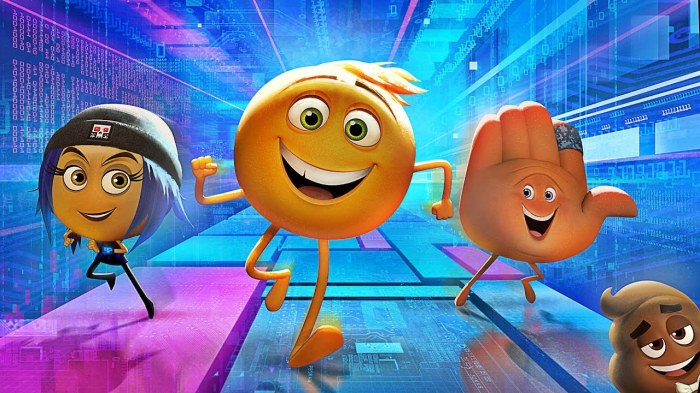
To say anymore about this piece of 💩 would be to give it more thought than it got during its entire two years of production.

-Madeleine D

Revealing Humanity Without Humans: War for the Planet of the Apes

war ftpota

*Spoilers ahead

“Then they said, ‘Come, let us build ourselves a city and a tower with its top in the heaven, and let us make a name for ourselves, let us be dispersed over the face of the whole earth. And the Lord came down to see the city and the tower, which the children of man had built. And the Lord said, ‘Behold, they are one people, and have all one language, and this is only the beginning of what they will do. And nothing that they propose to do will now be impossible for them. Come, let us go down and there confuse their language, so that they may not understand one another’s speech.’ So the Lord dispersed them from there over the face of the earth, and they left off building the city. Therefore its name was called Babel, because there the Lord confused the language of all the earth” (Genesis 11: 4-9).

“And Abraham went early in the morning to the place where he had stood before the Lord. And he looked down towards Sodom and Gomorrah and towards all the land of the valley, and he looked and, behold, the smoke of the land went up like the smoke of a furnace. So it was that, when God destroyed the cities of the valley” (Genesis 19: 27-29).

These verses are here not just because I think the makers of War For the Planet Of The Apes would appreciate them, but also because they perfectly set up the atmosphere and morality explored in this last entry of the Planet of the Apes trilogy.

War for the Planet of the Apes begins where the second film left off. Caesar (the phenomenal Andy Serkis) is the leader of his band of enhanced apes. He is forced to fight a war that a crazy ape named Koba started before he died. Caesar tries to make peace with the humans he’s fighting against, led by a zealot Colonel (Woody Harrelson) but when his own family is murdered, he drops everything to carry out a revenge mission against the Colonel.

War FTPOTA is not only a visual feast, but uses its effects to serve its science fiction premise to the fullest. It does what science fiction is supposed to do: make us think about our world. This apocalyptic story about apes overtaking humans is simply a vehicle to ask bigger questions. What is the primary difference between humans and animals? Is it language? If so, what about people who can’t talk? If animals achieve human language, then what determines it? If there were a plague that infected your loved ones but put others at risk, what would you do? Is revenge ever justified? What makes a leader?

War FTPOTA asks big questions, and expresses itself through poignant imagery. It isn’t always subtle. There are strong Apocalypse Now parallels, to the point where some graffiti is shown that says “Ape-pocalypse Now.” It is the second film of the year to feature animals re-enacting a kind of holocaust (the first being Netflix’s Okja) and it loves religious imagery, too. Caesar is hung up on a cross and is pierced in his side. The Colonel, in explaining his backstory, says, “I sacrificed my only son to save humanity.”

It might not be subtle, but it’s interesting. War FTPOTA uses intertextuality to make this story bring in stories we already know to increase the emotional impact. It no longer seems as foreign, because we recognize the archetypes, just re-enacted with apes.

The film goes big with imagery, and it goes big in messages. War FTPOTA is political. All art is to some degree, because every creator has a worldview that impacts their work. But this film has a villain that is trying to build a border wall (I know the film was made before Trump became big, but still). It combines warfare and religious imagery, muses on how the ability to speak and use language defines us as human beings (consider the verses about the Tower of Babel above), and gives a compelling story about failed leadership. Caesar has been the leader of the apes for two movies now, and in this movie, he falls. Great leaders are ones that put aside their personal desires for the cause of the group. Here, Caesar lets himself get personal with the humans. When his vendetta becomes his focus, the entire group falls, and everyone suffers the consequences. While he is able to do the right thing in the end, he still dies.

With that storyline, it’s impossible not to see similarities to this year’s Logan, a film I loved. Both feature the patriarchs of a franchise showing wear and tear. They become father figures to young girls who don’t speak, fight military men to get across a border, take their charges to a safe Eden-esque place, and die. I don’t know quite what that pattern says about today’s culture, except that a maybe a lot of filmmakers are becoming parents and are trying to make blockbusters more prestigious, but again, I’m interested. I’m intrigued.

In the end though, if this movie proves anything, it is, say it with me:

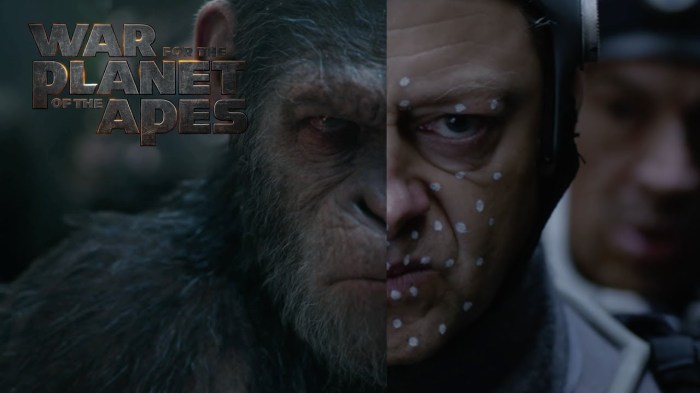
Give!      Andy!       Serkis!      An!       Oscar!

Motion capture acting is real acting, and it’s about time the Academy at least acknowledges it. His performance as Caesar is emotional and intimate, yet stoic. The entire cast takes the project seriously, and it shows.

War for the Planet of the Apes exceeded all of my expectations. In the two weeks before seeing the film, I watched five war-themed films (Saving Private Ryan, Joyeux Noel, Their Finest, Hunt for Red October, and Dunkirk). I would easily count this new Apes film among those. War films should reveal something about humankind at large, and War FTPOTA does that and more.

-Madeleine D