Everything Everywhere All at Once & The Unbearable Weight of Massive Talent

Two of the most talked about indie films of 2022 (so far) have hit streaming. Should you check them out?

Everything Everywhere All at Once

A24 has become the cinephile’s go-to studio, a studio with an impressive slate of films that reach critical, awards, and fan success. And now they have box office success, with Everything Everywhere becoming the studio’s highest-grossing film since Hereditary and nearing the 100 million dollar mark. Part of the film’s success has no doubt been how it has been marketed as a “multiverse” movie, even going up against Marvel’s Dr. Strange and the Multiverse of Madness. The film follows laundromat owner Evelyn (Michelle Yeoh) as she and her sweet and meek husband Waymond (Ke Huy Quan) go to the IRS to undergo an audit. It is there that Evelyn is found by a variant of Waymond from another universe who tells Evelyn she is the chosen one and must defeat an evil force that has taken over the body of Evelyn and Waymond’s daughter Joy (Stephanie Hsu). The film jumps through several multiverses as Evelyn has to fight to save Joy, and more importantly, save her relationships with her husband and daughter and discover more about herself. 

While multiverse fatigue has set in for some people, it hasn’t for me. I was excited by the idea of taking the multiverse premise and using it on a small scale, stripping the superhero-level scale and stakes and instead making it about one family, with mundane yet universal problems like taxes, familial strife, and personal dissatisfaction. And the movie is at its best when it sticks to this premise, using the multiverse to bring out the drama in the small-scale problems of the characters. 

But the movie then tries to go bigger than that and incorporate magic, huge existential forces, and a bigger intergalactic scale, and that’s when the movie, to me, loses its spark. The middle section of the film is incredibly chaotic, with directors Daniel Scheinert and Daniel Kwan (known as “The Daniels”) seemingly throwing every visual and joke they can at the wall and seeing what sticks. This is how you get a movie that has a scene of people trying to stick things up their butt (it’s just as painful to watch as it sounds) right beside a touching scene of a daughter pleading with her mother just to take a moment to listen to her. Or a scene of people with hot dogs for fingers next to a scene with a husband telling his wife that her cynicism and bitterness is poisoning their marriage and he wants her to see kindness as a strength. Brilliant, intimate moments next to slapstick, gross-out shenanigans. 

There is a thematic reason for all the absurdity: the characters in the movie come to see that the world is chaotic, absurd, even meaningless. However, we have the power then to create our own meaning, and that meaning should be being kind and loving to the people around us, letting go of resentment, and finding meaning in the mundane parts of life (like laundry and taxes). But I think this message gets lost in the chaos and absurdity, and I think the movie revels in just how gross it can be, which undercuts its better moments. 

You’ll have to find your mileage. Some people love the more absurd, gross-out, wilder elements of the film. It’s not my cup of tea, but I appreciate the creativity and originality and boldness to try a lot of stuff, and while I think this chaos hides the best parts of the movie, the best parts of the movie are still there. 

Maybe we don’t need more multiverse movies, but if we are going to keep getting them, I’d rather them be more in this vein, with the multiverse concept being used to focus on character drama and a smaller scope but with higher emotional stakes. I could do without the dildos, nihilism, and everything bagels, but you do you, Daniels. 

The Unbearable Weight of Massive Talent

In The Unbearable Weight of Massive Talent, actor Nick Cage (played by Nicolas Cage), needing some money, agrees to make an appearance at the birthday party of a billionaire superfan Javi (Pedro Pascal). Once Cage gets there and begins to bond with Javi, he learns Javi might be up to some criminal activity, the kind of activity only an accomplished actor like Nick Cage can thwart! 

Okay, you may be asking. So…. is this film just a big ego boost for Nicolas Cage? Or is it, like, a joke? Is it a fictionalized biopic? What is it?

Good question. It’s ultimately a celebration of actors like Nicolas Cage, actors who have ingrained themselves in the pop culture lexicon for their range of films, charisma, star power, likeability, and the sincere intensity and commitment they seem to bring to every role. Remember the scene of Keanu Reeves playing himself in Always Be My Maybe? It’s like a feature-length version of that, wrapped up in a buddy-comedy action movie. There’s talk of Nick’s real-life movies and career trajectory, but his personal life in the film is completely different from the real Cage. Cage himself says this movie-Cage is not much like him, but the film blurs the lines between Cage the real person, Cage the real actor, Cage the persona, and Cage the fictional actor in this movie, so much so that it’s hard to tell where each Cage stops and starts. And that’s kinda the point; you get to be swept up into this funny little fantasy about Nick Cage and the joy of making movies, while also watching an action flick. 

While it’s Nick Cage’s movie, Pedro Pascal steals the show. He matches Cage, even surpasses him, beat-for-beat in every scene, bringing a more-laid-back charm that matches Cage’s intensity in surprising and complementary ways. Without him, it wouldn’t work nearly as well as it does.

When the film begins to turn into Nicolas Cage: Action Star in the third act, like Everything Everything All at Once, I think it moves away from its best elements in order to be a bit more action-oriented and mainstream. But the chemistry between Cage and Pascal, beautiful locales, and laugh-out-loud funny moments make it a worthwhile watch. It’s a good-natured half meta spoof, half decent-but-generic action movie, all with a dose of heart. It may not live up to its hyperbolic title, but if you like Nick Cage at all, or like movies about movies, or already saw The Lost City and want something similar, then it’s worth checking out. 


– Madeleine D.  
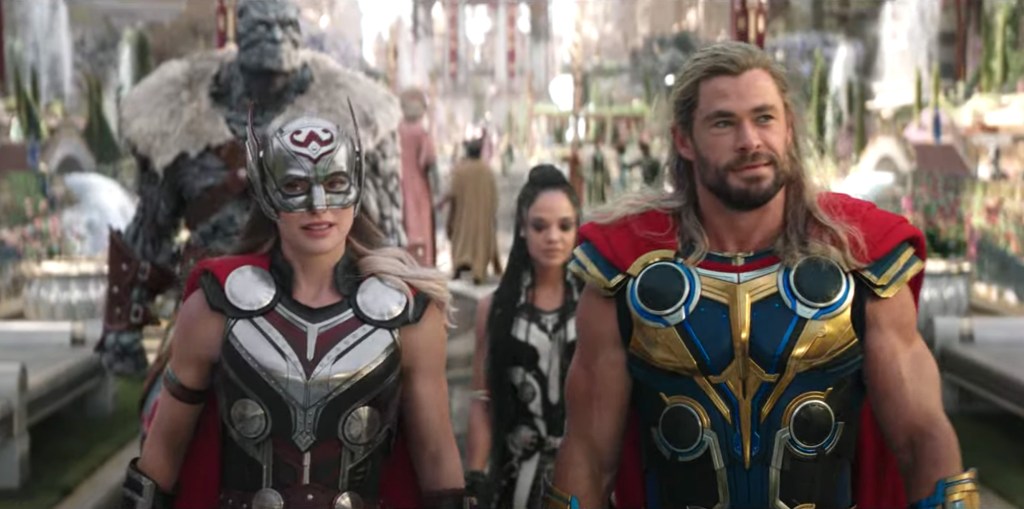
Thor: Love and Thunder

*Spoilers!

With Thor: Love and Thunder, the MCU breaks tradition. Of the original Avengers, Thor (Chris Hemsworth) is the only one getting a fourth solo film, instead of just a trilogy. The reason? The character was completely reinvented with 2017’s Thor: Ragnarok, helmed by director Taika Waititi. Thor went from a self-serious Shakespearian hero to a surfer bro with a band of eccentric new friends. But in Love and Thunder, Thor’s past comes to haunt him in the form of his ex-girlfriend Jane Foster who appears on the battlefield with his old hammer and his same powers. And if that’s not bad enough, there’s a new villain out there called Gorr the God Butcher who… well, his name is self-explanatory. 

What’s a god to do?

Love it or hate it, Thor: Ragnarok’s success came from its humor and breezy tone. I initially gave it a pretty tough review, complaining that the improv didn’t always translate well and made the film structure messy, and any attempts at sincerity in the film’s themes are undercut by the humorous tone. I’ve since softened on Ragnarok, and especially now, because compared to Love and Thunder, Ragnarok is a much tighter and neater film. I now look back at Ragnarok as the perfect balance of when Marvel lets an auteur director do their thing, with just enough oversight so things don’t go off the rails. With Ragnarok, Waititi was able to bring his signature style while still delivering a film that adds something to the MCU. But in Love and Thunder, I get the sense that Waititi is confident in his newfound mainstream success (which is very deserved!) but in a way that feels, frankly, a little phoned in, even self-indulgent. I imagine the on-set antics created an environment that was very fun for the cast, but again, that improv doesn’t always translate to the film. 

Not to say this movie isn’t funny–it is. But not funny enough to carry the whole thing. The movie swings very clearly from “this is a Marvel-mandated scene,” or even “this was a well-thought-out scripted scene,” to “this was clearly improved or only loosely scripted,” making the movie more disjointed than it should be. While not as tonally inconsistent as some other Marvel movies, Love and Thunder doesn’t have much sense of urgency, direction, or momentum. But this seems to be a phase 4 problem overall, with the lack of an overarching story or even a core group of Avengers moving us towards any goal. And while I don’t mind more stand-alone stories in theory, it does make various corners of the MCU seem like they’re spinning their wheels, waiting for something of consequence to happen.

Love and Thunder, despite its similarities to Ragnarok, isn’t a total retread. It has a few different elements, like Natalie Portman’s return as Jane and debut as The Mighty Thor (with the impressive biceps to show for it!). She has a few nice moments and brings weight to the dramatic scenes, and does her best with what she’s given. However, for much of the movie she feels like Mark Ruffalo did in Ragnarok: a decidedly not-comedic actor who seems out-of-place with the more freewheeling vibe of the rest of the cast. Maybe with another movie she would be able to grow more into the role, but for now, I don’t see much of a future with the character. 

The other big player here is Christian Bale as Gorr. People have been saying he is the best villain since Killmonger, who himself was the best villain since Ultron (from the best marvel movie of all time, Avengers: Age of Ultron!). And like Ultron, Gorr is the most spiritual/religious character we’ve gotten in a Marvel movie. After the death of his daughter and being mocked and rejected by his own god, Gorr takes up the task of confronting the gods of the MCU for their carelessness towards their followers, and killing them as justice/revenge. 

Because of this motivation, Love and Thunder finally lay out a somewhat-comprehensive look at what the MCU has been building towards when it comes to gods. This movie, and the MCU at large, basically says that in this universe, gods are like regional managers for certain groups of people. These gods can be good or bad, kind or cruel, powerful or incompetent, but they are in charge of the people who believe in them. Like the Greek pantheon, these gods are flawed and petty, and often use humans like pawns in their games (hence Gorr’s anger). Similarly, there is no one afterlife. Instead, people go to the afterlife based on their god or their cultural/ethnic background (Asgardians go to Valhalla, Wakandans go to the astral plane, in Moon Knight there’s the Egyptian afterlife of Aaru, the Field of Reeds, and so on). 

I think this is a fascinating picture of how religion is being more and more viewed in American pop culture, which Marvel is in many ways representative of. In an extremely individualized American culture, where there is no objective truth, it would make sense to say, “You can have your god based on your upbringing or your preferred cultural/ethnic group. Religion is a lifestyle choice or a cultural tradition.” It almost feels like saying that you’re religious is the equivalent of saying you’re vegan: people will be like “oh that’s great,” maybe even see you as being very noble or disciplined, but also, like, please don’t be so intense/serious about it that it makes us feel weird. Despite the seriousness Christian Bale brings to the role, I don’t think Taika Waititi brings much seriousness to this concept; it’s mostly played as a joke and a clever bit of worldbuilding. Thor never really challenges Gorr’s anger or is motivated to change himself, he just convinces Gorr to channel his desire for justice into resurrecting his daughter, not actually dealing justice to the gods. It’s the Kilmonger problem: the villain is right, he just goes too far in his mission.

I am not saying people should get up in arms about how gods and religion are treated in this film; this movie does not take that subject or itself seriously. I just think Love and Thunder provides an unexpectedly insightful picture of how a worldwide mega-conglomerate tries to depict religion: by not depicting any particular stance at all. 

Speaking of Gorr’s resurrected daughter, let’s talk about that ending. I think it’s interesting to see how in Phase 4 Marvel is quickly reorienting its demographic by bringing in younger and younger heroes (high school Peter Parker, higher schooler Kamala Khan, teenage America Chavez, young 20-something Kate Bishop, Wanda’s twins, Cassie Lang, Sprite from Eternals). Love and Thunder introduces Heimdall’s son and spends a lot of time with a group of Asgardian kids who bravely fight for their freedom from Gorr, and the film ends with Thor adopting Gorr’s daughter and becoming a single #girldad. While I thought this was an interesting twist at the end, to have the villain resurrect his daughter, just to die and give her into the custody of his enemy who he just tried to kill, I’m interested to see where this is going, as “protagonist man becomes father,” aka, the daddyfication of franchise characters, is becoming a go-to character arc, and is the most recent in a new trend of Marvel heroes getting some kind of family as a reward for finding themselves. This dynamic also falls into the trope of “man and a silent little girl.” Who knows? Maybe Gorr’s nameless daughter will talk one day. 

Alright, you may be saying at this point. Madeleine, you thought the humor and tone of this movie was underwhelming and didn’t always work, and it all feels too frivolous. Didn’t you also recently just praise Jurassic World Dominion for being lighthearted fun? How can you enjoy the frivolous fun of that movie and criticize Thor 4 for the same? 

Touché. Here is where I think the difference lies. Jurassic World Dominion had emotional payoffs for the older characters, and nicely wrapped up things for the newer characters. There was an equal emotional reward for the time invested in these characters (also, the Jurassic World movies are equal, if not more, about dinosaurs and spectacle than characters). But with Marvel, we get to know these characters for multiple movies for years. We’ve been seeing Chris Hemsworth’s Thor now for 11 years, in 8 films. The MCU, especially now with the Disney+ shows, requires such an extraordinary investment of time, yet I don’t feel like my time is being rewarded emotionally anymore.

 There’s enough in the MCU that still compels me that I stay invested (Moon Knight was an amazing surprise this year, and I loved Black Widow). But weaker projects like Love and Thunder dilute the whole franchise. After this much time and investment, I want to be having more personal, emotionally satisfying, compelling, and interesting content with these long-term characters, and I don’t think this movie does that with Thor. 

A repeated theme of this movie is that it’s better to love someone, even if you get hurt, than not to love at all. Real heroes don’t hold people at arm’s length to protect themselves. But for a movie about being emotionally vulnerable and not holding people at arm’s length, I still feel like I’m being held at an arm’s length by Thor, by Marvel, and by Taika (who is capable of making very sweet, sincerely emotional movies!). Despite me investing what feels like a third of my life in these films, Marvel continues to hold its characters at an arm’s length. But like Thor and Gorr, I want to choose love. But if you can’t give me love, then feel my thunder!

– Madeleine D. 

Elvis

Director Baz Luhrmann, known for his big, bombastic, highly stylized films like Moulin Rouge!, Romeo + Juliet, and 2013’s The Great Gatsby, was first announced to be helming an Elvis biopic in 2014. He’s since had 8 years to work on the film, a film Warner Brothers is betting their entire summer slate on and is launching former Disney and Nickelodeon actor Austin Butler’s career into the mainstream. And it’s the first big biopic of one of the most popular musicians and icons of all time. 

So, did Baz get it right?

Elvis is right in line with Luhrmann’s other work. It’s epic in scope, long, sprawling, unevenly paced, energetic, inventively visual, and has a stellar soundtrack. With a movie as ambitious and messy as this one, there are plenty of things to critique. But there are also many moments where everything comes together, and Luhrmann’s style marries with the material perfectly, so that, all in all, the film has really stuck with me. 

A musical biopic has the tough task of portraying several facets: the historical facts of the artist’s life, the inner life of the artist, how the artist was perceived by his or her contemporary audiences, and the artist’s place in history. Not all biopics can or try to do all these things. But Elvis does, and of these four categories, Elvis is best at conveying how Elvis was perceived at the time. The movie viscerally captures people’s reactions to Elvis’s dancing, his politics, and his sound, and these are the sections of the film that are a perfect match of Lurhman’s delirious styling and editing. Watching these scenes, I got it. I understood Elvis Presley: icon. I understood why he was seen as such a threat and a seductive figure, his sex appeal, his musical uniqueness, his potential, and his raw star power. I felt it. 

Much of it also just comes down to a truly mesmerizing performance by Austin Butler as Elvis. Butler is completely deserving of all the praise he’s been getting. He melts into the role, never feeling like an impersonator. His star power is blinding, yet there is a depth of humanity and sincerity he brings that transcends the script. I hope the Academy doesn’t dismiss the hype and does, in fact, nominate him for best actor. 

But while Butler gives it his all, the script steers away from giving Elvis introspective moments that allow us to get more into his head. He is reactive to other people and situations, but we don’t get to really know Elvis, especially once he becomes the figure of Elvis Presley. We don’t really get to know the man suffering under the weight of the role he’s playing. This is where the film’s breakneck pace, the heavy focus on his early life and career, and the lack of time spent on his final years, become a problem. While the decision not to dwell on Elvis’s final days probably comes from a place of respect and not wanting to sensationalize his downward spiral, I think it contributes to the movie’s overall problem of robbing The King of complexity.

Part of this also comes from the framing device. The film is narrated by Elvis’s manager, Colonel Tom Parker, played by Tom Hanks. Hank’s performance has been very polarizing. Unlike some critics, I don’t think Hanks is inherently miscast. In moments, it really works, such as scenes where the Colonel is trying to proposition himself as a pseudo-father figure for Elvis, because on a meta-level it’s playing against Hank’s persona as a good-natured “America’s dad.” But in other parts of the film, it doesn’t work at all, with his exaggerated accent and prosthetics making him cartoonish. The performance is off-putting, but not in the way I’m sure Hanks intended. To me, it doesn’t ruin the movie, but it is one of its most erratic elements. 

Besides Hanks, the other big criticism of the film has been how the film tries to pay tribute to the Black musicians Elvis was influenced by (or, depending on how you see it, stole from). Despite the effort, these musicians are still relegated to the sidelines, mostly just to say encouraging things to Elvis. The movie flattens the issue to basically: “Elvis was a well-meaning appreciator of Black music and had personal ties to it, and he helped open a lot of doors and break down the color barrier.” Which, while that may be somewhat true, is not the whole truth, and the priority is clearly preserving Elvis’s likeability over all else. But in the film’s defense, this isn’t an academic discussion. This is an emotional rendering of Elvis’s life, not an objective perspective on his place in music history, and one that is not even told from Elvis’s perspective. In the same vein, the movie also sidesteps looking too closely at the relationship between Elvis and his wife Priscila (Olivia DeJonge), instead placing her in a very stereotypical wife role, barely giving her any lines or significant screen time. 

Because of these elements of Elvis’s story that are sidestepped or rushed through, when I left the theater I immediately began googling all sorts of things to fill in the blanks:  Elvis Presley’s death. Tom Parker. Elvis Priscilla relationship. B.B King. Original Hound Dog. Going in, I was pretty unfamiliar with Elvis’s story. But the movie was so compelling, even with its flaws, that I wanted to know more. In the end, while Elvis stumbles in telling the darker tragedy of Elvis Presley, it succeeds as a spectacle that captures the enduring power of the Elvis myth. 

–  Madeleine D.