A Man and His Silent Little Girl: The Midnight Sky and News of the World

*Spoilers for The Midnight Sky

During every awards cycle, there are what I like to call the “A-list” and the “B-list” of awards movies. The A-list award movies are the movies which are most certainly going to get nominated. This year, some of those films will probably include the likes of Nomadland, Minari, One Night in Miami, Judas and the Black Messiah, and others. Then there is the B-list, which are movies that have all the makings of award films and were clearly made with an eye towards awards, but are not going to get any major recognition. 

I believe The Midnight Sky and News of the World to be B-list award films. Neither has gotten quite the traction or critical reception they need to be top award contenders and while they may get nominated in smaller categories, I don’t see either as having a chance as top contenders. This is not to say they aren’t good, they’re just not quite as good as they think they are.

Along with being both B-list award films, they also have something else in common which I’d like to explore a little deeper. Both films feature older men who are accompanied on a journey by a young girl, who is either completely mute or speaks very little (or speaks a different language). This setup has become a trope, and one I think has fascinating implications. We’ll flesh that out further, but for now, let’s look at each film individually.

The Midnight Sky was released on Netflix in December. It is directed by and stars George Clooney, who plays Augustine, the last man on Earth. Augustine is trying to make contact with a group of astronauts on their way home who have no idea of the catastrophe that has wiped out civilization. Augustine discovers a mute young girl (Caoilinn Springall) to be left on Earth with him, and she joins him on the journey to warn the astronauts.  

The Midnight Sky looks beautiful, and Netflix obviously spared no expense in making it compete with the technical achievements of other recent space films, of which there have been many (Gravity, First Man, The Martian, Interstellar…). The setup of the film is intriguing as well, and there are a couple of exciting setpieces with Clooney and Springall fighting against the arctic wilderness. However, The Midnight Sky promises a meditation on grief and loneliness which never really lands. There are too many characters and none of them get their due, and there is too much vagueness about the catastrophes of Earth to feel real or unnerving. The cinematography is the most beautiful and interesting thing about it. 

Meanwhile, News of the World reunites director Paul Greengrass and Tom Hanks after they worked together on Captain Phillips. Here, Hanks plays another captain, Captain Kidd, a man who makes his living going from town to town reading newspapers. When he comes across an orphaned young girl (Helena Zengel), he decides to take her on an arduous journey to get her to her relatives. The use of the immediate post-Civil War setting and its atmosphere of paranoia and distrust, along with the film’s emphasis on stories and the role of journalism (which brings to mind Hank’s role in 2017’s The Post) make News of the World feel timely without being too preachy (save for a few scenes). However, the relationship between Kidd and the kid is clearly the film’s emotional core, and most of that comes from Hanks. The screenplay does very little to establish why Kidd makes the sacrifices he does for the girl. Instead, the film relies on Hank’s casting. Why does Kidd drop everything to go on this journey for the girl’s sake? Because he’s Tom Hanks! Do you think Tom Hanks is going to let anything happen to a child? No! Because he’s Tom Hanks, and Tom Hanks always does the right thing, and that is that. From this foundation, Hanks and Zengel are able to build a more fleshed out, interesting relationship which carries the film. 

Both films are fine, with News of the World edging out as the better one. Yet what I find interesting is how they embody this emerging trope of a gruff older man + near-silent young girl. I first noticed this dynamic in 2017’s Logan, with Hugh Jackman as Logan/Wolverine and Dafne Keen as Laura/X23, but other examples can be seen in War For the Planet of the Apes, Eleven in Stranger Things, Boo from Monsters Inc, along with many other variations. Vulture, upon the release of Logan, published an article about this phenomenon (with a focus on violent little girl characters), which includes the key observation that the girls in these roles “[exist] to be observed as an object of contemplation.” No matter how much agency she has in the story, her presence is something that causes the leading man to reflect upon himself, usually about his failings as a father, or what could have been. This is most explicit in The Midnight Sky, where it is revealed the little girl is not even real, but is George Clooney’s character imagining his daughter, who is actually Felicity Jones’s astronaut character. 

Now I am actually quite fond of this trope, and it’s easy to see its appeal. What is the similarity between the apocalypse of The Midnight Sky and the wild frontier of News of the World, or the world of the X-Men, or a science-fiction dystopia? Parenthood! Men embracing their paternal instinct! Drama is created through differences and contrasts, and since an older man and a young girl are seen as opposites, characters with this dynamic automatically have great cinematic potential.  

Yet, while emotionally this is an engaging trope, it comes at a cost. It is great to see these movies and genres- science fiction, western, superhero, etc.- that have traditionally been unwelcoming to women, now include them and allow young girls to see themselves in the picture through this trope. But the silence of these young girls, and how they rarely have personalities beyond being objects of observation, means they are not really characters. They could be replaced with a dog the male characters loves, and nothing would change. I wonder what it would be like to replace many of these little girls with grown women who come alongside the protagonist and join them as equals (maybe even without an obligatory romance!). Or, at least, if these young girls are allowed to speak, and take action in these stories. 

Consider that there is no equivalent trope for young boy characters. You don’t see many movies where older women are taking young boys under their wing. Firstly, because older women don’t exist in film. Secondly, if a young boy is in a film, they’re usually going on their own adventure. They’re not there as prompts for other characters to discover more about themselves. These boys are active agents of their own adventure. They are being prepped to be the next Tom Hanks or George Clooney, and maybe one day will be old enough to have their own silent surrogate daughter. 

– Madeleine D
Could 2021 Be the Greatest Year in Movie History?

A guest post by Jonathan Dorst

This past December, many of us watched a rare occurrence in the night sky- the ‘great conjunction’ of Jupiter and Saturn that some called the Christmas Star. As I look ahead to this year in movies, coming on the heels of Netflix’s announcement of their planned weekly movie release, I am wondering if there will be a great conjunction of films. With the many films that were held over from their original 2020 release dates combined with the normal slate of 2021 releases, will 2021 become the greatest year in movie history? To answer that question, we first need to ask three other questions.

The obvious first question is, When will people go back to theaters? Many people might not return in mass until the fall, or even into 2022 (and some people, having spent thousands of dollars on home theaters during quarantine, may never return to a traditional theater at all). But, with the news of Warner Brothers pictures now being released on HBO Max the same day as they premiere in theaters, it would seem that the streamers are winning the release war and will pick up the slack of theater revenue. Nevertheless, it’s possible that some of the big releases this year might get pushed back to 2022 by nervous studio executives, like Damien Chazelle’s upcoming Brad Pitt/Margot Robbie-starring film Babylon has already been.

The second question: What is coming up this year, and why should we expect a great year? To start with, let’s talk about the directors who have films slated to come out this year (how spoiled are we?): Steven Spielberg, Wes Anderson, Edgar Wright, Guillermo Del Toro, Steven Soderbergh, Taika Waititi, Paul Schrader, Kenneth Branagh, Peter Jackson, Denis Villeneuve, Ridley Scott, Sam Levinson, Cary Fukunaga, Adam McKay, Jane Campion, Tom McCarthy, Ramin Bahrani, and more. 

You’ve got lots of potential blockbusters: Top Gun: Maverick, Black Widow, No Time to Die (the new Bond film), Dune, Sherlock Holmes 3, The Matrix 4, Ghostbusters: Afterlife, F9, Cruella, Mortal Combat, A Quiet Place II, Godzilla Vs. Kong, Uncharted, Jungle Cruise, The Suicide Squad (not to be confused with 2016’s Suicide Squad), and Death On the Nile

You’ve got auteur-driven films: The Card Counter (Schrader), Last Night in SoHo (Wright), The Northman (Eggars), The White Tiger (Bahrani), No Sudden Moves (Soderbergh), Next Goal Wins (Waititi), Pinocchio (del Toro), and possibly Killers of the Flower Moon (Scorsese). 

You’ve got your musicals and musical biopics: In the Heights, Respect, and The Beatles: Get Back. You’ve got Tom Hanks in Bios and the Untitled Elvis Presley Project. You’ve got Pixar (Luca), Disney (lots of stuff, including many of the aforementioned blockbusters), DC (Morbius), Marvel (Black Widow and a new Spider-Man), and a long-awaited Space Jam sequel. Get your popcorn ready, there’s a lot coming this year.

The third question is, What’s the competition? Which years in movie history are the best up to this point? This, of course, is a matter of great debate, and is probably hopelessly subjective (unless you just go by box office receipts, in which case 2018 would be the champ). But, it seems that there are three years that are regularly considered by critics and film buffs as the greatest year in movie history: 1939, 1962, and 1999. 

1939 has the distinction of having the highest-grossing film of all time when adjusted for inflation: Gone With the Wind (which also won Best Picture). It was a time when the studio system was at its height, with great directors, stars, and producers cranking out movies for an audience hungry for entertainment. It also saw this murderer’s row of classics and very good films: The Wizard of Oz, John Ford’s Stagecoach (some believe to be the greatest Western of all time), Mr. Smith Goes To Washington, Gunga Din, George Cukor’s The Women, William Wyler’s Wuthering Heights, Howard Hawk’s Only Angels Have Wings, Ninotchka, Destry Rides Again, Love Affair, Kenji Mizoguchi’s The Story of the Last Chrysanthemum, and Jean Renoir’s Rules of the Game

1962 benefited from a historical oddity: many international films that were released in 1960 and 1961 were released in 1962 when distributors realized they could make money on these films. As the book Cinema ’62 notes, 1962 was a time when the studio system was changing greatly, a slew of great international directors- including Kurosawa (Sanjuro), Ozu (An Autumn Afternoon), Bergman (Through a Glass Darkly), Truffaut (Jules and Jim), Resnais (Last Year At Marienbad), Antonioni (La Notte and L’eclisse), Bunuel (Viridiana), Tarkovsky (My Name Is Ivan)– were at their prime, and subject matter began to evolve to include more of the human experience. The slate of American and English-language films released in ’62 is pretty good, too: Lawrence of Arabia (that year’s Best Picture and box office champ), To Kill a Mockingbird, Dr. No, The Man Who Shot Liberty Valance, Whatever Happened to Baby Jane, The Manchurian Candidate, The Miracle Worker, The Music Man, The Longest Day, Gypsy, Sweet Bird of Youth, Cape Fear, Lolita (Kubrick), The Trial (Welles), How the West Was Won, Mutiny on the Bounty, and Days of Wine and Roses.

Economics played a part in 1999 being a great year: DVD sales were booming, which meant that studios could take a chance on films that could recoup box office losses in DVD revenue, and it was not yet the golden age of TV. ‘99’s box office champ and Best Picture winner are not very good: Star Wars: Episode 1- The Phantom Menace and American Beauty, respectively. The best films of that year, though, were made by a who’s who of the-newly-arrived great directors: Memento (Christopher Nolan’s best), Fight Club (David Fincher’s best), Hard Eight (Paul Thomas Anderson), Election (Alexander Payne), Titus (Julie Taymor), Three Kings (David O’Russell), and The Insider (Michael Mann), along with great and very good films like The Matrix, Being John Malkovich, The Iron Giant, Toy Story 2, Run Lola Run, Brokedown Palace, The Sixth Sense, Topsy-Turvy, 10 Things I Hate About You, Office Space, The Green Mile, The Hurricane, Man on the Moon, A Midsummer Night’s Dream, Boys Don’t Cry, Eyes Wide Shut, The Straight Story, Bringing Out the Dead, Any Given Sunday, All About My Mother, Notting Hill, and The Talented Mr. Ripley.

A couple of runner-up years: 1946 saw a number of great films get released on the heels of WWII, including It’s a Wonderful Life, Notorious (Hitchcock), The Best Years Of Our Lives, Shoeshine (de Sica), Great Expectations (Lean), My Darling Clementine (Ford), The Big Sleep, Gilda, The Killers, The Postman Always Rings Twice, The Stranger, Henry V (Olivier), A Matter of Life and Death, Paisan (Rosselini), Children of Paradise, and Beauty and the Beast (Cocteau). 1974 is a strong representative of ‘70’s cinema (which some see as the highest film genre yet invented!): The Godfather II, The Conversation, Chinatown, Scenes From a Marriage, Amarcord, Blazing Saddles, Ali: Fear Eats the Soul, Alice Doesn’t Live Here Anymore, Murder on the Orient Express, The Front Page, The Great Gatsby, Lenny, The Parallax View, Sugarland Express, and A Woman Under the Influence. 1994 was influential in many ways: The Shawshank Redemption (the highest rated IMDb movie ever), The Lion King (maybe the greatest animated movie ever), Pulp Fiction, Forrest Gump, Hoops Dreams, Ed Wood, Quiz Show, Crooklyn, Reality Bites, Natural Born Killers, Dumb and Dumber, Speed, Little Women, and Legends of the Fall.

One could make an argument for 2007 as the greatest year of this century so far (There Will Be Blood, No Country For Old Men, The Lives of Others, Pan’s Labyrinth, The Counterfeiters, The Departed, The Queen, Dreamgirls, The Diving Bell and the Butterfly, 4 Months 3 Weeks and 3 Days, Gone Baby Gone, La Vie en Rose, Away From Her, Juno, Into the Wild, Zodiac, Once, Ratatouille, Babel, I Am Legend, Michael Clayton, and Atonement). As to whether 2021 will become the greatest year in movies, if I were going by the one and only 2021 release I’ve seen so far, I would say: “Yes!” Amazon Studio’s Herself is an excellent indie from Ireland. Ultimately, however, my guess is that 2021 will not be the greatest movie year ever for the simple fact that so many productions were shut down in 2020 due to COVID. But, it’s easier now than ever to make a movie, and many productions have improvised and proceeded. We’ll just have to wait and see where the chips fall, and then argue about the merits of 2021 versus all the other great movie years for the next decade or so. Happy viewing!

You can read more of Jonathan’s reviews at:

https://www.patheos.com/blogs/chorusinthechaos/author/jonathandorst/

The 10 Best Things in the Second Half of 2020

Twice a year, I make a list of the best media of the year. This is my chance to recommend non-movie entertainment, such as books, music, and podcasts, to you. In a year without traditional theatrical releases or many of the movies we were promised, I relied more than ever on other types of art to get me through. 

TV:

  1. The Good Lord Bird on Showtime

First Reformed already showed us that Ethan Hawke was skilled at playing zealous religious figures burdened with righteous purpose and a melancholy temperament. The Good Lord Bird, which aired this fall on Showtime, based on James McBride’s book, just confirms that Ethan Hawke should play wild preachers for the rest of his life. In 2020, where we were constantly reminded just how stupid we as a country can be, we didn’t need a dignified, sanitized look at history. We needed something unorthodox and a bit scandalous. By exploring the life of abolitionist John Brown from the perspective of the Black people around him, McBride and Hawke pull off a series that never gives easy answers. Was Brown a madman? Was he the sanest person in the country? Was Brown a Christian hero? Did Brown believe himself to be a white savior? Well…. all of these might be true. While the seven-episode miniseries sometimes falters in its pacing, it is consistently insightful, uncomfortable, hilarious, and heartfelt. It’s can’t-miss viewing.

  1. Into the Unknown: Making Frozen II On Disney+

This technically should have come out during my first part of 2020 list, because this miniseries was released June 26th. But I saw it afterward, and this is my list, so I’m going to include it! This series gives a shockingly candid look at the making of Frozen 2. From the last-minute story changes to the herculean effort of writing Show Yourself, it’s impossible not to be sucked into the drama behind the drama. 

I first got interested in filmmaking through watching and rewatching the behind-the-scenes featurettes of my VeggieTales VHS’s, and then when I got older, watching the hours upon hours of extras on the Lord of the Rings extended DVDs. Watching this series gave me the same thrill. For anyone who loves behind-the-scenes stories or has an interest in filmmaking or other creative industries, Into the Unknown is a great watch. 

Music:

  1. Folklore and Evermore– Taylor Swift 

After dropping her album Lover in late 2019 and her documentary Miss Americana early this year, no one would blame Taylor Swift for laying low the rest of 2020. After all, the pandemic and subsequent quarantining created widespread fatigue and burnout. 

But Miss Swift brought us not only one, but TWO albums this year, both surprises, just a few months apart. And both, in my humble opinion, are excellent. If you like sad folk music in the woods, Taylor has you covered. If you like country songs that tell stories (especially ones about women murdering cheating men) Taylor has some songs for you! If you like “old Taylor,” with her confessional writing and references to her feuds, there’s a song for that too. If you like love ballads, wistful reminisces, and the work of Bon Iver or The National, that’s all here. I’m jealous of Taylor’s ridiculous productivity, but I‘ll take it if I get more trips into these woods. 

  1. Future Nostalgia– Dua Lipa (came out in March)

Dua Lipa’s sophomore album is nothing like Taylor Swift’s offerings this year, but both women are at the height of their powers, and it is equally exciting to see. Future Nostalgia is bringing disco back with an album full of club tunes, with a coherent vision that can be described in three words: neon, bouncy, and fun. Dua Lipa has been all over the top 40 this year, and if you’ve liked her singles (“Don’t Stop Now,” “Levitating”) the full album does not disappoint. 

  1. Boreas- The Oh Hellos

The Oh Hellos are a sister-brother folk-rock duo from Texas. With lyrics that combine biblical allusions and mythology, paired with gorgeous vocals and energetic instrumentation, The Oh Hellos are perfect for fans of Mumford and Sons, The Crane Wives, and The Civil Wars. I can’t do much better than the band’s own description of the themes of the album, which feel perfectly suited to the pandemic-winter we are in right now. “Rose” and “Boreas” are highlights.

“Boreas, the northern wind, ushered in the harsh frosts of lonely winter… As we wrote these songs, we found ourselves confronted with the ways we’ve reflected this wind — how we often avoid discomfort, even at the expense of others, until we are left cold, hard, and unfeeling. In this record, we ask the winter to instead kindle us into something warmer and softer than who we’ve been.”

Books:

  1. Death in Her Hands, by Ottessa Moshfegh

Ottessa Moshfegh excels at writing unreliable, disgusting, and repulsive narrators in her works (Mcglue, Eileen, and My Year of Rest and Relaxation). Vesta Gul, the narrator of Death in Her Hands, is Moshfegh’s most likable protagonist yet (which isn’t saying much), but Moshfegh is still able to make every page become more and more disquieting and we spiral into Vesta’s mind in this twist on a murder-mystery. I generally think it’s harder to write earnest and hopeful stories rather than cynical and/or nihilistic ones, but if you’re going to read something nihilistic and grotesque, you might as well read from the best. And Moshfegh is one of the best. 

  1. Gentle and Lowly, by Dane Ortlund

A friend of mine described this book as “a balm to the soul,” and I couldn’t agree more. Gentle and Lowly does a deep dive into the heart of Christ. What is his heart towards his people? How does he approach us sinners? How do we understand Christ’s love as an outflowing of God’s love, when God can seem so unloving in the Old Testament? How does understanding the gentle and lowly heart of Christ change us? For fellow believers who are constantly racked with doubt and struggle with believing Christ actually is who he says he is, I urge you to read this book and let its truths sink in, and let it bring you peace. 

Movies:

  1. The Personal History of David Copperfield

Based on the Charles Dickens novel, The Personal History of David Copperfield is a fast-and-loose adaptation directed by Armando Iannucci. Iannucci also directed The Death of Stalin, a brutally witty and sharp satire. This is another period piece, but a lot more wholesome and whimsical. David Copperfield is an ensemble film with a genuinely wonderful, oddball cast, but it is well-anchored by its leading man. As David Copperfield, Dev Patel is a delight. He has nice comedic timing, carries the film easily, and has undeniable charisma and star power. Irreverent adaptations are all the rage right now, and I think this is one of the best examples of how to do that approach right. 

  1. The Trial of the Chicago 7

Aaron Sorkin directs and writes here, telling the story of the real-life Chicago 7, an assortment of anti-Vietnam activists who are arrested for conspiracy after they hold a demonstration. The film explores leftism vs liberals and the complexity behind the freedom to protest, and how government often works to suppress activism. 

When I initially watched The Trial of the Chicago Seven, I thought it was fantastic. It’s no secret Sorkin can write one hell of a screenplay, and I was enveloped in the courtroom drama, excellent performances, and raw emotions of the story. But afterward, I discussed the movie with my friend Sam (who wrote this piece about Tenet) and he brought to light some key observations that I hadn’t even considered, including:

  1. Bobby Seale (Yahya Abdul-Mateen II), the co-founder of the Black Panther party, is in the first part of the movie, and gets some of the most outrageous, moving scenes, but is reduced primarily to a symbol. Once he is out of the film, he is not spoken of again. In a film about leftist politics and the explicitly racist nature of the justice system, to silence and then eliminate the only Black character (and the presence of Black people in the story) is ridiculous. If I may speak in broad strokes for a moment: many Black people complain that the Democratic party in America takes them and their vote for granted. The Trial of the Chicago 7 plays into this completely. 
  2. Systematic problems, like the difference between leftism and liberals, are made into personal problems. Sacha Baron Cohen’s Abbie Hoffman represents leftism, while Eddie Redmayne’s Tom Hayden represents liberals. By the end of the film, they have respect for one another, presenting the divide between their ideologies as one that can be simply fixed with the friendship between two people. While, on some level, all ideologies in movies must be symbolically carried within single characters, and personal relationships across the aisle is a good thing, this depiction is simplistic, serving the emotions of the audience more than the story. 

More has been said about the flaws of the film, and they’re worth considering. But I don’t think those flaws should make you avoid the film- if anything, they’re another reason to watch and consider it.

Other:

  1. Ambient Noise Mixes

Are you now working or schooling from home? Do you wish you weren’t? Do you wish instead you were studying by the fire in a hobbit hole in the Shire? Or riding the train to Hogwarts? Or drinking tea with Mr. Tumnus before he betrays you to the White Witch? Or do you just wish you had some ambient noise mixers to help you focus on your work? If you spend a lot of time writing or sitting at the computer like me, you may enjoy some kind of background noise but can’t always do a playlist with lyrics. I have loved using these mixes inspired by fantasy settings. 

– Madeleine D. 

Netflix Bundle- Over the Moon, Ma Rainey’s Black Bottom, and The Prom

Over the Moon

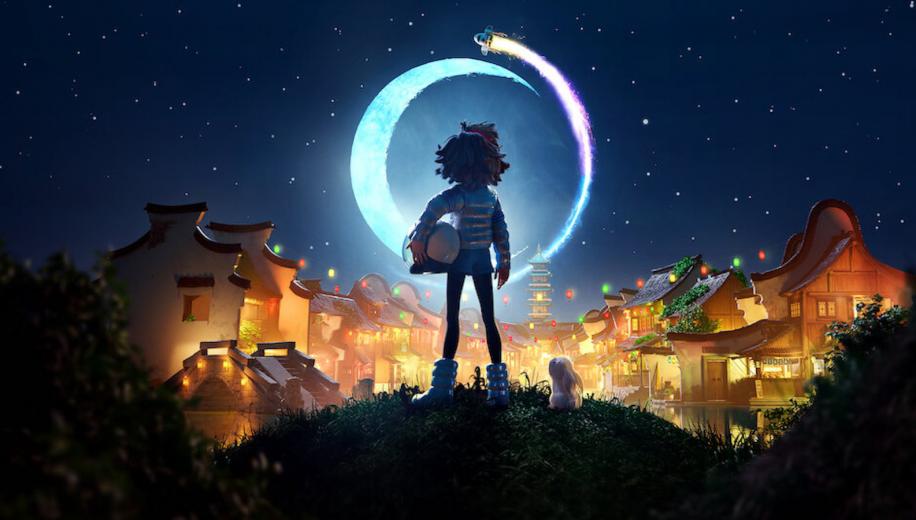
Over the Moon is a cute animated film about a young girl in China who believes in a traditional Chinese myth about a goddess who lives on the moon. When the girl’s father introduces her to her future stepmother, the girl builds a rocket to go to the moon goddess for help in breaking up the marriage. 

Over the Moon is best when it takes place on Earth, telling a tender story about grief and blended families. Once the characters get to the moon, the pacing becomes more frantic and the story more silly. Still, through it all, the animation is cartoonish but stylized, and the musical sequences are catchy. It’s the perfect choice for a family film, and I think will be entertaining for older viewers as well. 

Ma Rainey’s Black Bottom

Ma Rainey’s Black Bottom is a lot like 2016’s Fences,beyond both being adaptations of August Wilson plays. Both star Viola Davis in mesmerizing performances. Fences was directed by and starred Denzel Washington, and Ma Rainey is produced by him. Both films never utilize the film medium enough to ever feel like anything other than a play, yet both are so incredibly acted and written it doesn’t really matter. Like Fences, Ma Rainey’s Black Bottom delves deeply into the specifics of the Black American experience while still exploring universal emotions, even in a period piece. Here, it depicts the struggle of trailblazing Black musicians like Ma Rainey to gain respect and maintain power. The film is worth watching on multiple accounts, but it is especially resonant as Chadwick Boseman’s last film, and he doesn’t disappoint in his intense, soulful performance. 

The Prom

The Prom is based on the 2018 Tony-nominated musical about Broadway actors going to a small town in Indiana to advocate on behalf of a young lesbian, Emma, who is denied the ability to go to prom with her date. While the actors, played in the film by Meryl Streep, Nicole Kidman, James Corden, and Andrew Rannells, go for selfish reasons, over the course of their stay they become less self-absorbed and genuinely helpful in bringing about change in town. 

This Ryan Murphy-directed musical has received blowback for James Corden’s performance (I didn’t find it horrendous, but at best, it’s grating and tired), the lack of development for most of the characters, and leaning less into the satire of famous people and more into just focusing on famous people. The film has also been criticized for certain adaptational changes, which is what I find most revealing. One of the key adaptational changes is that Barry (Corden’s character) ends up reuniting with his mother, who kicked him out of the house as a teen. The film also has Kerry Washington’s character redeemed, accepting her gay daughter at the end of the film.

Neither of these story beats are in the musical and seem to me strange choices by Murphy. The LGBTQ+ community has a strong tradition of found families, yet The Prom prioritizes reunion with biological families, even families that treat their children terribly. The Prom is preaching to the choir but doesn’t really represent the diversity and core values of the LGBTQ+ community. In trying to be super palatable for straight people, it ends up feeling mushy and shapeless, like an overly-long musical number.

– Madeleine D.

Soul

*Spoilers

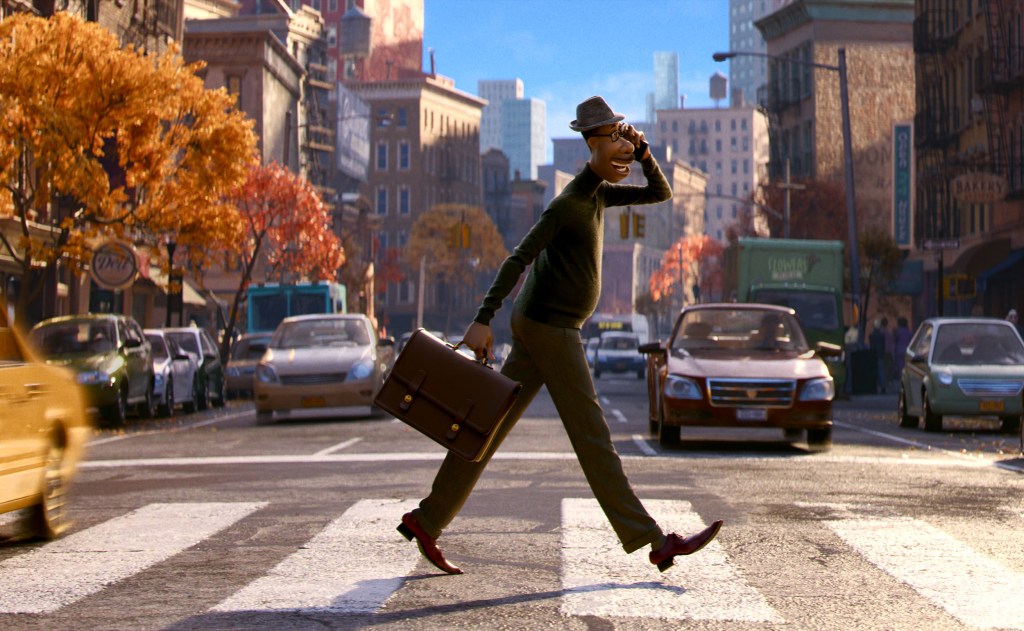
Soul, Pixar’s newest animated feature, now on Disney+, tells the story of Joe Gardner (Jamie Foxx), an aspiring musician who, on the day of his big break, nearly dies. His soul is transported into The Great Beyond, where he must pair up with another soul, Number 22 (Tina Fey), and try to get back to his body. 

Since this is a Pixar movie, it goes without saying that the animation is stunning and the music, character design, and voice work is excellent. Soul is beautiful to look at and enjoyable for all ages. 

Yet Soul, to me, is far from the studio’s strongest efforts, for a few reasons. 

At this point, I am sick of depicting the afterlife as a bureaucracy, a place of lines and procedures and paperwork. This has, disappointingly, become a default-characterization. Soul desperately avoids being religious, but choosing to depict the afterlife in this way is disappointing and speaks volumes of the lack of imagination we as a culture have that we can’t picture an afterlife as being any greater than our own workplaces. We hesitate to imagine what divine, beyond-Earth splendor- or horror- could actually be. 

2013’s Inside Out, the clear predecessor to Soul (both are directed by Pete Doctor) has a similar depiction. Inside Out shows the inside of the human mind as also being a place of rules and regulations. This depiction wasn’t as annoying in Inside Out, not only because it was the first film to do it but also because Inside Out was clearly a metaphor for what could be going on in someone’s brain, and, to an extent, what a person imagines their own mind to be like. It makes sense that a character like 12-year old Riley could only imagine her head as a workplace because that’s what she’s exposed to. It was an interior look, while Soul aims to explore something spiritual, something beyond us, yet can’t imagine it as anything beyond us. 

Granted, there are moments of visual imagination when it comes to the afterlife. One of my favorite sequences is the climax, where Joe goes to find 22 and discovers that she has become a “lost soul.” The visuals of this sequence are gripping and shows just how good Pixar can be when they lean into the darkness. Joe is able to rescue 22 by speaking to her compassionately, following a new (and welcomed) trend where the protagonist and antagonist do not fight, but the protagonist extends grace to the antagonist and coaxes them out of their actions (see also Moana, A Wrinkle in Time, Over the Moon, and Wonder Woman 1984).

The lost souls are depicted as people who have just lost their love of life; their “lostness” is not tied to their actions or sin or consequences. If you don’t love life enough, you are a lost soul. It’s not bad, per se. But it does feel a little flimsy, especially considering the stronger choices Soul promises but pulls back on. In this same sequence, the movie sets up Joe to be making a great sacrifice to give 22 life. But then he is immediately granted another chance at life, meaning there is no sacrifice, cutting short the possibility of real consequences and emotional stakes. The lack of strong emotional stakes tie into Soul’s likewise muted moral, which boils down to: don’t forget to stop and smell the roses, and, you’re a human be-ing, not a human do-ing. These are good messages, and there are several lovely moments of the film that call attention to everyday beauty. But these morals are not new, nor do they completely fit in with a movie that still spends more time on Joe’s musical ambitions than they do any other part of his life. Soul argues that Joe needs to care about more than his music, yet that is all that the movie fleshes out about Joe. 

This is not the only way Joe is held at a distance from the audience. Throughout the movie, his soul jumps into several different forms. As reviewer Andrew Tejahda writes for Tor.com: “it’s hard to ignore that [Soul’s] main plot can’t work unless a black man is left stranded outside his body and robbed of his identity. His drastic transformations kept creating distance between us and his true self. This left the impression that this beautiful looking Pixar film wasn’t fully connected to its main character’s…well, soul.” 

Soul is fun to watch and is certainly one of the best animated films of 2020, but it is hard to shake the feeling that it’s a missed opportunity, or could have been better with a little more direction. 

– Madeleine D.

Wonder Woman 1984

*Spoilers

“Be careful what you wish for.” 

This is one of the lessons we learn in Wonder Woman 1984, and unfortunately, may hold meaning for audiences as well. After the success of the DC heroine’s origin movie, 2017’s Wonder Woman, director Patty Jenkins and star Gal Gadot return here for the sequel, which on the surface seems to be a striking departure. The first Wonder Woman was a muted, gritty war-themed movie. Wonder Woman 1984 has neon colors, a 1980’s setting, action scenes that play out like a comic-book panel, and whimsical homages to the Lynda Carter Wonder Woman television series. Reviewer and comic book writer Grace Randolph notes in her review of the film that Wonder Woman has two distinct personas that often divides her fanbase. She’s either the more aggressive, no-holds-barred, fierce Amazonian warrior, or she plays defense, never starting a fight and always trying to stop her enemies with words of compassion. The first film shows more of the first side, and WW84 emphasizes the second, leaning into Wonder Woman/Diana’s gentleness and flaws. 

This tonal shift for the character and franchise is just one of the risks Jenkins takes. Other risks in WW84 include not setting up any future franchise movies, having few action sequences, and a final climax that isn’t Diana fighting Maxwell Lord, but simply talking to him. And while the 80’s setting is fun, Jenkins shows restraint in not making it a nostalgia-fest of “oh look I recognize that!” and instead ties the decade’s consumerism and paranoia into the main plot. 

I also admire the choice to depict Diana as being miserable. Throughout the film, Diana is lonely and embittered. She does good deeds but never gets what she wants in return, which makes her similar to Maxwell Lord and susceptible to the same temptations as he is. In most sequels, we see the heroes at the top of their game, and over the course of the movie are humbled and then regain their strength. Starting Diana in a place of personal weakness, and then physically weakening her throughout the film, and ending her in an ambivalent place again, is a strong choice and one that I like, because it humanizes an otherwise god-like character. 

While I appreciate many of these choices and Jenkin’s confidence as a filmmaker, not all the choices work. Wonder Woman 1984 is stuffed to the brim with characters and ideas, which shortchanges everyone. Kristen Wiig is a promising Barbara Minerva/Cheetah but is pushed aside for more Maxwell Lord (Pedro Pascal). In the comics, Barbara and Diana are friends, making Barbara’s turn into Cheetah a personal betrayal to Diana. In WW84 though, their relationship is barely above acquaintances, making the stakes less personal and Barbara less compelling than if their relationship had been given more time to develop. 

Much has also been made out of the way Steve Trevor comes back. Chris Pine is one of the best parts of the film to be sure, and his Steve Trevor continues to be the perfect partner to Diana. But he comes back in a random man’s body, and Diana… has sex with that body? She lets Steve use the body and bring him into violent situations? This man doesn’t even get a name, he’s just credited as “Handsome Man” (Kristoffer Polaha). The cartoonish tone of WW84 means this Get Out scenario isn’t dwelt on, but it’s a strange, almost reprehensible choice that is easy to latch onto as a symbol for all of the weaknesses of the film. 

Wonder Woman 1984 is admirably experimental, but always pulls back with just enough convention to never be either truly weird or easily palatable. There’s a lot to like, but it gets mixed up in the long-running time and some sequences that seem to go nowhere. I want to see Patty Jenkins get to finish her trilogy with Wonder Woman 3 and see if she can balance the approaches of both Wonder Woman films. But, I suppose I should be careful what I wish for. 

– Madeleine D.