Streaming Triple Feature: Godmothered, Run, and Time

Godmothered – Disney+

Godmothered is the spiritual sequel to 2007’s Enchanted. Remember Enchanted? Starring Amy Adams, it told the story of Giselle, a Disney animated princess who was thrown into real-world Manhattan. Similarly, Godmothered sees Jillian Bell’s Eleanor, a fairy-godmother-in-training, go to the real world to help adult single-mother Mackenzie (Isla Fisher) figure out what she needs to change her sad, cynical life. Enchanted marked the beginning of Disney’s self-referential style that can be seen prominently in films like Frozen and Wreck-It Ralph 2, which explicitly critique the Disney tropes like love at first sight and damsels in distress. Self-awareness and irony have proven to be popular for Disney, and it’s understandable why- consumers are (or, at least, we imagine ourselves to be) savvier to the Disney formula, so it seems good for the company to be in on the joke as well.

Yet these movies, especially the live-action remakes, which have followed Enchanted, tend to slap a coat of girlboss paint and incredibly shallow “wokeness” on the story in order to make their movies seem more modern and grown-up. At best, these efforts can be genuine attempts to correct the sins of the past for younger audiences. At worse, this self-deprecation/irony is a lazy attempt to match our current sensibilities towards female empowerment, but only in the ways that are most profitable and the least disruptive. And also, make no mistake, these efforts are making a point, the point being: you, adult woman, still need Disney in your life! We realize that you don’t believe in Prince Charming and talking animals anymore, which is why we’ll make fun of those things, but you still need our inspiration, our joy, our product.*  Of course there’s nothing wrong with loving Disney as an adult. But it’s difficult to reconcile the Disney magic with the way Disney is able to wield its own nostalgia- and critiques of it- for its own benefit.

Enchanted, while it started this trend, is a genuinely charming, clever, and well-made film. Is Godmothered just as good? Godmothered has its moments but replays the classic fish-out-of-water story without much variance. Bell and Fisher do a nice job, but both could play these roles in their sleep. The first twenty minutes setting up the premise is nothing short of excruciating, which makes the rest of the film much better in comparison. However, after the first twenty minutes, it is harmless fun that a family can enjoy, so if you need a holiday movie (the story takes place at Christmas) to pass the time, it’s not a bad option.

Run – Hulu
*Mild spoiler

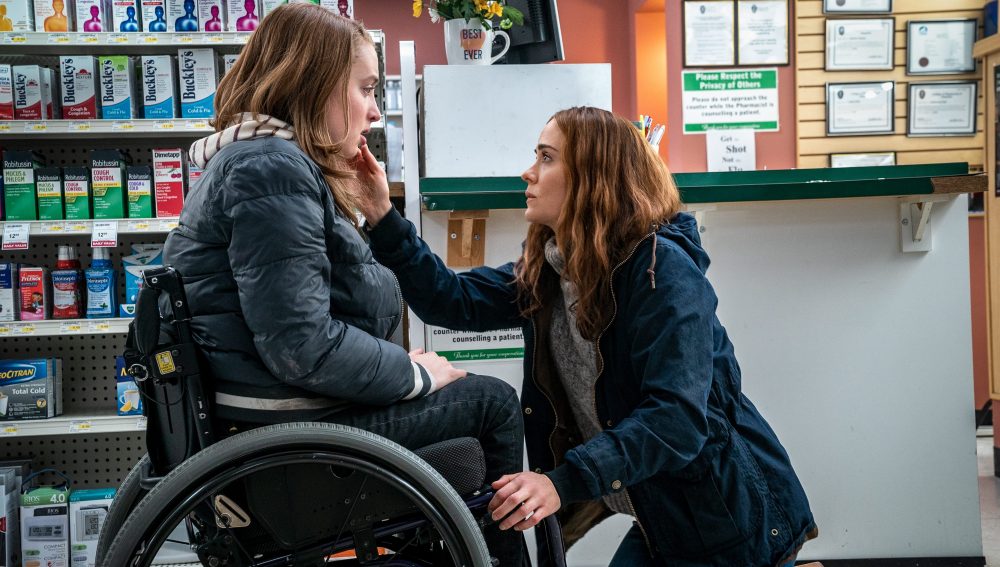
Hulu’s Run, starring Sarah Paulson and newcomer Kiera Allen, mines some of the best tropes of horror- isolation, illness, perversion of motherhood, and actors with good “scare face”- to make an enjoyable thriller about a mother with Munchausen syndrome by proxy and her wheel-chair bound daughter who will do anything to escape. Allen is particularly excellent, especially with her daunting action sequences. Run isn’t particularly original, but it’s well-executed and very enjoyable. Especially for people like me, who are squeamish with horror films, this is a tense but not-too-scary movie to enjoy. 

Time – Amazon Prime

Time is a documentary about Sibil Fox Rich, a woman who works tirelessly to shorten the sentence of her husband Rob, who was sentenced to 60 years of prison without parole after the two of them attempted to commit armed robbery. By using traditional documentary techniques with home videos made by Sibil herself, the film paints a rich portrait of a family’s inner life. 

What’s striking about Time is that it is not interested in the typical narratives or rhetoric that go along with stories about incarceration. The specifics of the robbery are barely addressed. There is really no time spent discussing whether Sibil and Rob deserved jail time or how much of it as a consequence for their actions. And that’s off-putting at first, especially if your natural inclination is to support harsher sentencing and “if you do the crime, you do the time.” But Time is telling the story of the emotions of being separated from your husband for twenty years. It’s telling the story of a father not seeing his children grow up except through occasional visits and phone calls. It’s telling the story of a woman who hits one bureaucratic roadblock after another, who must fight tooth and nail for any opportunity to get her husband a chance. It’s a story of growing up fatherless, of trying to keep a separated family together, of realizing you’ll never get back missing time, and of trying to have hope after a hundred let-downs. It’s a film that has no *time* for the narratives we typically employ in order to separate ourselves from the incarcerated and their loved ones. If you surrender yourself to Sibil’s story, you can’t help but find yourself replacing her with yourself, and your loved ones with Rob, and feeling the frustrations, anger, and sorrow at the situation. It’s an exercise in empathy, one that I think anyone would benefit from undergoing. 

-Madeleine D.

*For more on the trend of self-examination in Disney movies, check out “Woke Disney,” a video essay by Lindsay Ellis
Hillbilly Elegy

From its initial reviews to its Thanksgiving-week release on Netflix, Hillbilly Elegy, the film adaptation of the 2016 memoir Hillbilly Elegy: A Memoir of a Family and Culture in Crisis by J.D Vance, has been a polarizing film. Critics widely panned it- some of them from Appalachia, many not. The film has been received better by audiences, but still remains divisive. The movie and memoir tell the story of Vance’s upbringing in Middletown, Ohio, his family’s struggles with alcoholism, abuse, and drug use, and his escape to go on to be a Yale graduate and successful venture capitalist. The memoir (which I haven’t read) goes into Vance’s thoughts on the strengths and failures of Appalachia culture and of poor working-class white Americans. 

Director Ron Howard’s movie strips away much of Vance’s commentary to focus on just the family drama. Since the backlash to the film, he and the rest of the cast have emphasized this point, that it’s not a political story, but a personal one (and how can you argue with the authenticity of one person’s life experiences?). Yet it’s hard to view the film as only a singular family’s drama, as the book was quickly lauded as a way to “understand Trump voters” and as a broader sociological study. The movie’s focus on Vance and him “pulling himself up by his bootstraps” means that it doesn’t quite do enough to divorce from that political narrative either.  

I can’t testify to whether the book and movie are “authentic” depictions or not. But I do know this: it is impossible to give a sympathetic or humane portrait of someone or a group of people if you only show their suffering. I know this movie is depicting a family in crisis, but there are no scenes of normalcy or relative peace that serves as a contrast to when there is a crisis. Instead, the constantly traumatic events of the movie feel to me, as a viewer, like I’m continually being pummeled, and I can’t get any sense of the characters outside of their worst moments and their worst mistakes. From my understanding, the book tries to paint Appalachia as a place still worth saving. But despite platitudes about the importance of family, hard work, and tradition, Hillbilly Elegy barely presents anything worth celebrating, because it’s always about the drama and horribleness, never about the potential, promise, or beauty in the rough. 

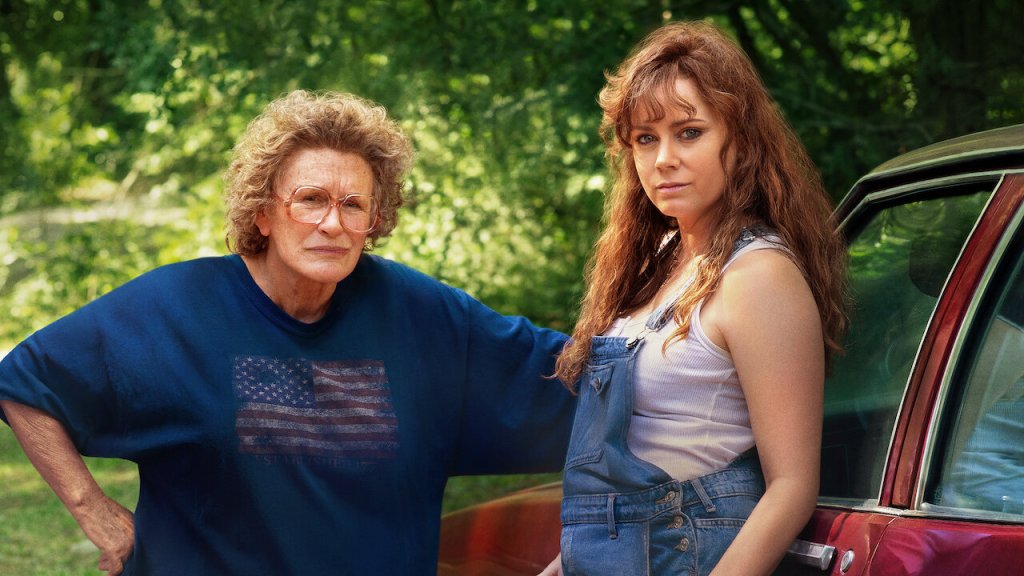
That is probably because screenwriter Vanesa Taylor and Howard are not interested in critiquing anything about J.D Vance or how he presents his narrative of how he got out and surpassed his relatives because of his hard work. It doesn’t help that Vance is unlikeable, not only in some of his politics but, mainly, because there is an infuriating lack of curiosity on his part about the women in his life. Sure, the movie focuses on his mother Bev (Amy Adams) and Mamaw (Glenn Close). But except for a few vague references to the trauma they’ve suffered, the film doesn’t actually dig into examining their pain, their choices, their generational traumas, and into the specific, systematic ways women suffer in this community. This is all wrapped up in the character of JD’s sister Lindsay (Haley Bennett), who remains in Middleton. She’s doing the brunt of the care-taking for Bev. She didn’t “get out” like J.D. All signs show that she’s headed to become just like Bev and Mawmaw- embittered, miserable older women. But she barely gets any sizable screen time, except to be plot exposition and to assure J.D that she’s fine, she’ll continue to sacrifice herself to take care of their destructive, needy mother, because he needs to live his dream! 

While watching, I kept thinking of 2017’s Three Billboards Outside of Ebbing, Missouri, as a solid comparison. This is a movie that, I… how do I put this delicately… really hated. Both Three Billboards and Hillbilly Elegy rely on characters screaming in every single scene to constitute Drama™. Of Frances McDormand’s performance in Three Billboards, I said “I never had to read [her] face to figure out what she was feeling, she was either saying it or destroying something.” The same can be said about Adam’s “look, I tried to look ugly because my character is real,” performance as well. (To be clear, this is not a knock to either actress, but instead to the writing, direction, and Oscar-bait-yness of the production). 

The Florida Project (2017) comes to mind as a much better example of a film that is able to depict poverty in a way that is 1) not primarily concerned with getting Oscars (and because of that humility, it didn’t) and 2) is not a non-stop pity party, but instead shows the humanity of its subject by having scenes that contrast difficulty with scenes of them finding joy, even in their circumstances. The Florida Project strikes a balance between recognizing that both personal choices and systemic failings have worked together to create the situation the characters are in, but that they aren’t to be looked at like bugs under a microscope or as New York Times profiles elites can read about to feel educated by, but instead as people who are as real and familiar as our family and friends. 

Hillbilly Elegy is not a terrible watch by any means, but it had the potential to be so much more. Instead of leaning into the convictions of the memoir, it has been neutered into something shapeless, and while becoming more personal, it does so without fully realizing the humanity of its subjects.

-Madeleine D.