This live-action remake of the animated classic from 1998 follows the same formula of “reinvention” as the other live-action remakes (Beauty and the Beast, Aladdin, The Jungle Book, Cinderella, etc.). This includes making a poorer version of (or cutting out entirely) the musical numbers, a half-hearted attempt at retconning the things that were critiqued in the original while getting a whole host of new problems, making the female protagonists more “empowered” with a new Girl Boss paint job, and just overall becoming a duller film.
This new Mulan isn’t a complete waste of time, though. The movie infuses some classic wuxia/ fantasy martial arts styling here that not only pays tribute to Chinese cinema, but makes this Mulan retelling feel more like a myth, which gets back at the story’s roots as folklore. The sets and costumes are beautiful. Mulan is given a sister who, while extremely underdeveloped, chooses a more traditionally feminine route and isn’t shamed for it, driving home the message that just because Mulan bucked traditional roles doesn’t mean she or her path is better, it just means feminism is about widening women’s choices.
This live-action remake simply just does not use its new format to be the cool war movie we wanted (although Mulan herself does have a surprisingly high body count), and it’s hard to overcome that disappointment and not compare it to the original. But I do have to say this: I watched this with one of my best friends, who is Chinese-American (was born and raised in China until she immigrated to the US). While she had some problems with the depiction of China, she spoke to me at length about how good it made her feel to see a girl like her on-screen, in her home country, with such a powerful story. That’s not something I take lightly. Representation matters, even if there are some missteps or missed opportunities while striving for it.
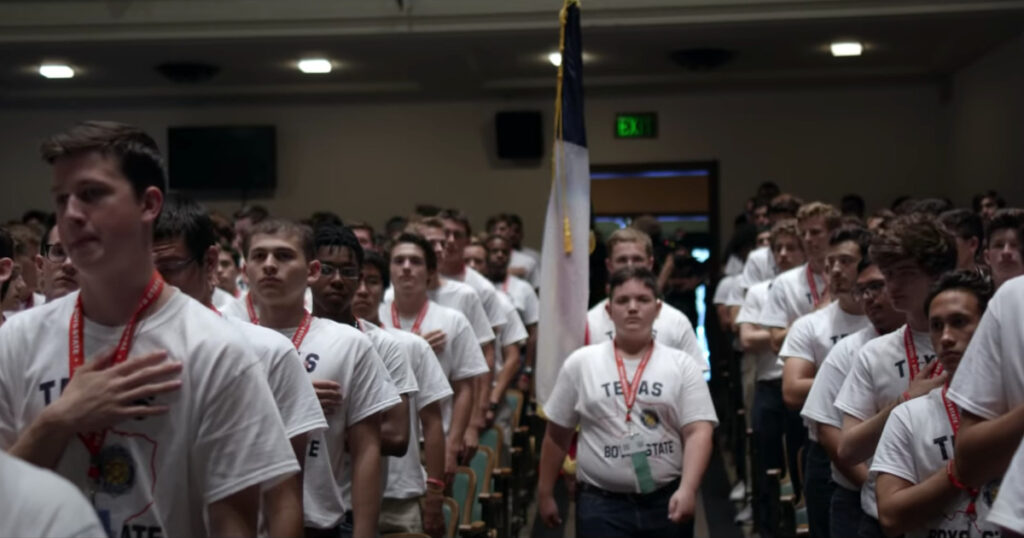
Boys State – Apple TV+
This documentary follows the 2019 Texas Boys State, an annual convention where boys (there’s a separate Girls State) from across the state are chosen to participate in an educational week where they form political parties and hold elections to learn about democracy.
Personally, this is one of the most stressful environments I could ever imagine being in, and the documentary is at its best when it is able to catch a glimpse of the true wariness and vulnerability of the subjects. Sometimes the self-awareness of the documentary is a little too noticeable, like you can tell when the filmmakers are thinking, “This is going to draw a parallel to the 2016 election! We’re telling an important story here that reveals the declining state of American politics!” But, despite the self-awareness sometimes getting in the way, it’s true- there are parallels to both the 2016 election but also to all sorts of political discourses we continue to have about tribalism, slander, fake news, the values of a trained politician vs. a non-politician “draining the swamp,” and the intersections of race, class, and gender.
So like the discourse around those topics, the film can feel just as tiring, emotional, cyclical, and repetitive, and, at least to me, discouraging. Yet it’s insightful, and there are kids to root for, and entertaining, so I certainly recommend watching it. But, Boys State also reminds you that nothing is new under the sun, and politics and policies are not the ultimate avenue for change we should put our hopes in.
The Devil All The Time – Netflix
The Devil All the Time, based on the book of the same name by Donald Ray Pollock (who narrates the film), has the midwest gothic aesthetic down to a T. Haunting landscape? Check. Evil religion and charismatic, wicked preachers? Check. Flat, midwest landscapes that grow more sinister as the sun goes down? Tortured women cast in a soft glow? Check and check.
Atmosphere and aesthetics can only go so far, though, and unfortunately The Devil All The Time doesn’t have anything deeper to offer. Everyone in the all-star cast is game, but there is only so much that nice cinematography, shocking plot twists, and star power can give a movie. It can’t sustain it. The whole film ends up feeling bloated, repetitive, and less serious and important than it thinks it is. I agree with Justin Chang for NPR when he writes, “I also found the movie ultimately repetitive in its grisliness, and simplistic in some of the ways that it accuses religion of being.” Now I am fascinated by movies about religion and the way it can be corrupted, and complicated ministers. But, The Devil All The Time’s depiction of small-town faith is so repetitive and cartoonish that it never tries to dig below the surface as to why religion can breed such vileness and destructive patterns. The movie is similarly uninterested in digging deeper into the depictions of generational trauma and violence. We get it- evil is mundane. But why? The Devil shrugs.
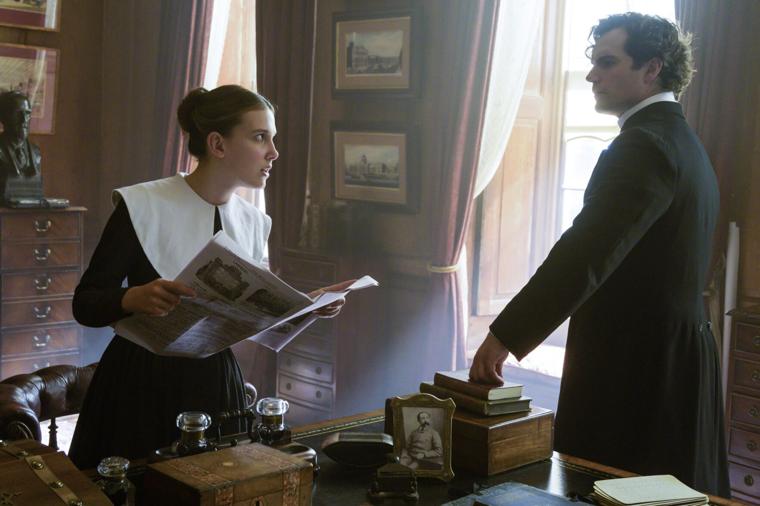
Enola Holmes – Netflix
Enola Holmes is mostly a star vehicle for Millie Bobby Brown (who also produces here), and it works- she’s truly a movie star. Charismatic, expressive, and immensely talented, she carries the movie effortlessly. She has some nice help from Louis Partridge, and some star power backup from the most uncharitable and unlikeable portrayals of Sherlock (a dull Henry Cavill) and Mycroft Holmes (Sam Claflin) I’ve ever seen- and I’ve watched Sherlock! So like Enola Holmes herself, Brown is mostly on her own as she goes from one unexpectedly brutal action scene to the next, offering a promising career in action for Brown if she wants to go down the Milla Jovovich or Charlize Theron route.
Enola Holmes reminded me, more than anything else, of an American Girl Doll movie. Remember those movies, with the likes of Kit Kittredge: An American Girl (a formative influence on me)? Unlike those movies, with sweet early-2000s optimism, this 2020 Enola Holmes has a little more bite, with rough action, some political commentary (don’t interrogate that too much), and a historical narrative jazzed up with modern features. But, while the film feels episodic (like a future Netflix streaming series???) it’s still charming and doesn’t feel like a television movie, but like big-screen fare, which we’re all a little desperate for.
During my city’s stay-at-home order in March and April, I finally got around to watching AMC’s iconicBreaking Badseries, and later, its prequel spinoffBetter Call Saul. I quickly fell in love with both shows, but especially Breaking Bad. I loved the writing and directing, the twists and turns, and the complicated characters. My favorite character, far and away, was Jesse Pinkman- junkie dealer turned tortured soul.
When I finished the show, I experienced post-show depression. Also, we were in a pandemic. To combat this sadness, I decided to chase the “high” of Breaking Bad by watching a few of the movies of Jesse Pinkman’s actor Aaron Paul.
And then I kept watching. Once I had watched a few movies, I decided I was too far in and committed fully to going through his filmography. Now, I have watched two full TV shows (BoJack Horseman, The Truth Be Told) and almost every single movie from Aaron Paul’s post-Breaking Bad career (the exceptions being Welcome Home, Central Intelligence, and Kingsglaive: Final Fantasy XV). As a newly certified Aaron Paul academic, I am compelled to share my findings with you.
This essay will examine Paul’s filmography after 2013. We will examine the trajectory of his career and the underlying themes of the roles he has played and how they have responded to Hollywood trends, and we’ll take a look at the good, the bad, and the ugly of his projects.
~
It is an infamous Hollywood sentiment that most actors cannot make the jump from television to film. Only a few have been able to do it successfully and reach movie star level. While the era of prestige television has brought many stars to the small screen, it is still difficult to do the reverse.
But if anyone would be able to do it, it should have been Aaron Paul. With the end of critically acclaimed Breaking Bad’s fifth and final season in September of 2013, Paul entered 2014 with five movies released in U.S theaters, all wildly different. The reactions to these five films set the course for the rest of his career.
Timeline
Breaking Bad ends in September 2013.
Hellion(dir. Kat Candler) premieres at Sundance on January 17th, 2014, and gets a wide release in June. It’s an indie that doesn’t make much money, but Paul gets good reviews for his performance as an alcoholic widower struggling to keep custody of his sons. The film receives mixed to positive reviews. Hellion doesn’t quite come together as a whole but has a lot of strong elements. The film observes its characters without moralizing, full of empathy for their plights, no matter how frustrating it is to watch them self-sabotage. It’s an emotionally wrenching portrait of grief ripping a family apart. (I give it 4 out of 5 stars).
Need for Speed (dir. Scott Waugh) comes out March 14th. This is obviously supposed to be Paul’s “leading man” action blockbuster debut. It’s panned by critics and makes decent box office, but not enough to get a sequel. The only thing about the film that lives in the cultural lexicon is this meme:
So it was all worth it in the end. Paul is completely miscast as the lead here, which is probably why he’ll never be trusted with a franchise again. Lead characters in action movies are usually proactive and initiate within the story to drive the plot. Paul is great at reacting, which makes him a poor fit with a movie like this, which asks him to mostly sit and glower in front of a wheel. As Michael Phillips of the Chicago Tribune put it, “Paul has talent, though the actor’s idea of simmering intensity in the context of Need for Speed comes off more like‘serial killer in the making.'” Yikes. (1/5 stars)
Decoding Annie Parker(dir. Steven Bernstein) has a U.S theatrical release on May 2nd. It is a small drama that doesn’t get much publicity or box office, and it receives mixed to negative reviews. Paul’s character here is- and I mean this as respectfully as possible- a himbo. A himbohusand, until halfway through the film when his character does a complete 180. He wears a delightful array of terrible wigs that do a lot of the heavy lifting. The movie never figures out what story it wants to tell about the real-life Annie Parker and her contributions to breast cancer research, botching what could have been a moving story. But Paul’s relatively small role is entertaining, and much more so if you track his character’s moral decay by the shortening of his hair. (2/5)
A Long Way Down(dir. Pascal Chaumeil) gets a long, windy European rollout but eventually hits the United States in limited release on June 5th. It’s also a small film that doesn’t get a lot of attention or box office returns. Those who see it give it negative reviews. Paul plays a depressed ex-musician who tries to commit suicide on News Years Eve, but, surprise! three other people (played by Pierce Brosnan, Toni Collet, and Imogene Poots) are on the roof as well. The four of them make a pact to stay alive until Valentine’s Day and in the process become a little family. The movie is a tonally uneven “dark comedy” that refuses to sit in any kind of grief or sorrow. It’s not well written, and, as Mike D’Angelo notes for the AV Club, “Brosnan and Poots clearly believe A Long Way Down is a comedy…while Collette and Paul are convinced it’s a deadly serious portrait of despair.” But, admittedly, this movie is my kind of trash. It has plenty of tropes I hate, like “Go on vacation to find meaning in life again.” But it also has tropes I do like, such as “on the nose power ballad,” and “angstily swims in the ocean as a form of spiritual baptism” and “Aaron Paul crying,” which, in this case, are all the same scene. (3/5)
The 66th Primetime Emmys are on August 25th. Breaking Bad wins big, and Paul takes home his third Emmy win for best-supporting actor.
Exodus: Gods and Kings (dir. Ridley Scott) is released on December 12th. The movie is a box office failure and gets slammed with terrible reviews, as it deserves.(1/5)
Here is, apparently, what Aaron Paul learned from this appetizer-year of roles:
I will never do a big blockbuster again, and my only leading man roles will be in B-level action flicks. (Whether this was a decision Paul came to on his own or was just what Hollywood decided post-Need for Speed, we’ll never know).
I can continue to play boyfriends & husbands in supporting roles for mid-budget movies (Fathers and Daughters, American Woman, Decoding Annie Parker).
I will never ever do a period piece ala Exodus again, but I WILL work with a Scott again (he works with Ridley Scott for Exodus, works with Ridley Scott’s son Jake Scott in his 2019 film American Woman).
I will continue to play Troubled Fathers™ in indie movies (The Parts You Lose, Hellion, The 9th Life of Louis Drax)
TV is my real home (BoJack Horseman, The Path, The Truth Be Told, Westworld)
So what did Aaron Paul’s career look like after 2014? Let’s go through each movie and see. The following movies are in chronological order by U.S theatrical release date.
Eye in the Sky (2016) 4/5 – This well-crafted drama explores drone warfare in a way that presents probably a more idealized version of how modern war is conducted than an accurate one. Putting realism aside, however, the film does what it set out to accomplish, which is to make the audience think about the ethics of this new frontier of combat. Paul spends most of the film sitting in front of a computer and being distraught, but he pulls it off perfectly. Helen Mirren and Alan Rickman (this was his last role) co-star and are both characteristically excellent.
Fathers and Daughters (2016) 1/5 – This movie is incredibly forgettable, and so is Paul’s role as Bland Supportive Boyfriend. Russell Crowe and Amanda Seyfried turn in nice performances in this not-particularly-insightful drama about… well, the relationship between a father and daughter.
Triple 9 (2016) 0/5 – This is a brutal, violent film that offers no redemption in the story nor interesting filmmaking on any level. Its great cast is wasted. Paul plays a sensitive criminal whose most interesting trait is his half-shaved head, half mohawk comb-over. Absolutely nothing worth recommending here.
The 9th Life of Louis Drax (2016) 3/5 – This movie is bonkers! It’s absolutely nuts! It barely makes sense! Yet that makes it so much better than many of these other films. Paul plays the father of young Louis Drax, who falls off a cliff and into a coma on his ninth birthday. Paul also plays a sea monster. I… really can’t explain it, it has to be seen to be believed. This whimsical, dark children’s-but-is-really-for-adults-movie has a distinct vision. Is it a good vision? Debatable. But it is a wild ride nonetheless.
Come and Find Me (2016) 0/5 – I despise how boring this movie is! Paul is again miscast playing a boyfriend trying to find his missing girlfriend in this action thriller that has neither good action nor is thrilling. You’ve seen a better version of this movie before.
American Woman (2019) 4/5 – This haunting drama follows the life of Debra (Sienna Miller), a down-on-her-luck working-class woman from a small town whose daughter goes missing. Paul plays her love interest, and while his role is small, gets to do some nice dramatic work. It’s Miller’s movie though, and although the film is a non-stop train to Sad-ville, it’s worth the ride.
The Parts You Lose (2019)5/5 – Paul plays a nameless fugitive who is hidden and nursed back to health by a deaf child. Paul has a natural chemistry with child actors and he gets to use that here with promising newcomer Danny Murphy. Like in El Camino, he excels at expressing feral energy through a mostly silent role. It’s a perfect use of his talents, while also challenging him, and the whole movie is definitely a worthwhile watch.
This should have won the Emmy this year for Outstanding Television Movie! Vince and Aaron were robbed!
Paul delivers an outstanding performance that stands apart from his previous work as Jesse Pinkman. This Jesse is stripped of all of the things that made him more of a meme than a character (“yeah, science!”) and instead reminds us of the complex path towards salvation the character has been on, and the depth of his desperation when on the cusp of grasping it.
Strangely Specific Tropes in Aaron Paul’s Work
*I’m including here what I saw of his roles in TV shows BoJack Horseman, The Truth Be Told, the first two episodes of The Path, and a shoutout to the movie Smashed, which came out in 2012, which puts it before this scope of this essay.
His character is enslaved and gets tortured in the desert- Breaking Bad/El Camino, Exodus: Gods and Kings
Scene where his wife follows him in her car because she suspects he’s cheating on her and he goes to a shady motel to meet a mysterious woman: The Path, American Woman
Modification: Plays a husband who cheats and leaves his wife because he just can’t cope with the trauma she is undergoing: American Woman, Decoding Annie Parker
His character was in a band (but no musical abilities demonstrated) – Breaking Bad, American Woman, A Long Way Down, Decoding Annie Parker
Is a construction worker in the South with a spotty accent- American Woman, Hellion
Only southern accent: Triple 9 and The Truth Be Told
Wears a Beanie- The Parts You Lose, A Long Way Down, Breaking Bad/El Camino, BoJack Horseman, Triple 9. (All these costume designers were like, “his forehead is bigger than our budget, we gotta cover it up!”
Interacts with Nazis/White Supremacists or the Mafia: Breaking Bad/El Camino, BoJack Horseman, Come and Find Me, Triple 9, The Truth Be Told
Is a junkie or alcoholic- Breaking Bad, BoJack Horseman, Hellion, Triple 9, The Truth Be Told, Smashed
I’m a criminal, yo: Breaking Bad, The Parts You Lose, Central Intelligence, Triple 9, Westworld, Need for Speed, The Truth Be Told
Does some guttural crying- Breaking Bad/El Camino, A Long Way Down, The Path, Hellion, Come and Find Me, Need for Speed, The Truth Be Told
Closeup as he sheds one single tear- El Camino, Need for Speed
So what’s the verdict? Aaron Paul’s filmography is uneven, to say the least, but it has some bright spots, especially as of late. If I were his manager, I would advise him to continue acting (and producing) small indie dramas that play to his strengths, stop doing mid-budget action movies, and try to befriend some prestigious directors (I could see a fit with the likes of Christopher Nolan, Kathryn Bigelow, Gina Prince-Bythewood, even Bong Joon Ho) and start edging back into big films, but not as the lead. He should also continue with prestige television, but use this as an opportunity to try different genres and be more experimental. I think with the right role he could get into better movies (and even win an Oscar one day?) but he needs to choose better projects and filmmakers need to take a chance on him.






 madeleinelovesmoviesdotcom