El Camino: A Breaking Bad Movie

AAAABTYD-SCYoagq9Sb6nEZqvmHE-CeWndT9Mk2Z1poBirWgiObFrVKONEp6WBIPmD-WR8cNHNt_gih4tcbUqnqfDs36vKYM*Spoilers for El Camino, Breaking Bad, and Old Yeller

Imagine a new world with me for a moment: I’m Vince Gilligan. I’ve spent the last six years being asked by fans what happened to Jesse Pinkman at the end of Breaking Bad. I can’t sleep well at night knowing that the fate of this beloved character that I tortured for years is still up in the air. I convince Netflix to give me a couple million dollars, and I write El Camino. I set it five years in the future, and tell a lovely and painless story of how Jesse Pinkman moved to Alaska, became an artisan carpenter, adopted a dog, bonded with his neighbors, is crushing it in therapy, and is now a big-brother mentor at the local elementary school. Aaron Paul wins five Oscars for it. How is that even possible? It just is. 

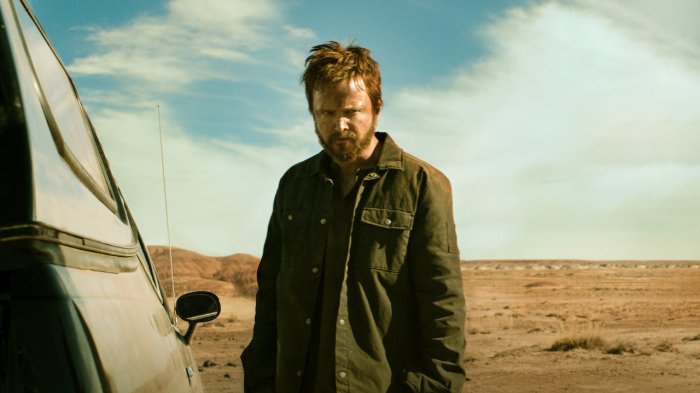
But alas, I am not Vince Gilligan, and instead, El Camino starts mere seconds after where Breaking Bad left off, with Jesse driving into the night after escaping the Brotherhood’s compound. The movie covers roughly the three days afterward as Jesse gets the money he needs to start his new life in Alaska. 

The largest criticism leveled against El Camino were accusations that it is superfluous. Jesse ends Breaking Bad driving to an unknown future, and that’s exactly how El Camino ends, too. Nothing in El Camino changes or informs us of anything new about Breaking Bad. So the accusation that it is superfluous is true- if you’re thinking purely in terms of plot. But plot and story are different things. The plot of The Lord of the Rings is getting the ring to Mordor, and everything after is technically superfluous. But the story of The Lord of the Rings is that of Frodo Baggins (and company) leaving the Shire to do an extraordinary task and the personal sacrifice it takes, which makes it impossible for Frodo to return to things the way they were. It’s that story that makes the long ending of Return of the King necessary. 

The plot of Breaking Bad may be over, but the story of Jesse Pinkman is not. Jesse’s ending in “Felina” completes the plot, but it doesn’t complete Jesse’s arc, because “Felina” ends with Walt freeing him from the Nazis, and that’s Walt taking action, not Jesse. Instead, Jesse’s arc has to be about him taking action to free himself, which is exactly what El Camino does.

The vice of Jesse Pinkman throughout Breaking Bad, more than his addictions or recklessness, is his malleability. He’s a sponge to outside influences, always looking to others to help him find a sense of direction and identity. His loyalty to these influences- Jane, Mike, Gus, and of course, Walt, form mental imprisonments that lead to his physical imprisonment. El Camino is about liberating Jesse from both.

Part of the way the film explores Jesse’s liberation and reclamation of personal agency is by building upon a connection that formed in the latter half of season 5, which is the comparison of Jesse to a dog. The title of episode 12, “Rabid Dog,” is in reference to Jesse and is when the connection is made explicit. Jesse has become a loose cannon to Walt’s operation, and Saul Goodman suggests to Walt that he should see this as “an Old Yeller type situationwhere he might need to put Jesse down, like a rabid dog. Walt stalls, but eventually hires Jack’s gang to do the deed.

The connection isn’t random; Jesse has always been a bit like Walt’s dog, tragically loyal and always there to be kicked around whenever Walt is angry. In El Camino, this connection is taken to its extreme, particularly in the flashback scenes of captivity with Jesse’s interactions with his primary captor Todd (a fantastically creepy Jesse Plemons). Now literally in a cage and on a chain leash on a dog cable run, Jesse has been dehumanized more than ever. Little actions from Todd- licking his hands and smoothing down Jesse’s hair, spraying Jesse with a water hose to clean him off, patting Jesse on the head as he sits crouched over in the car, his condescending words of positive reinforcement- all go to show that, as Plemons says in The Road to El Camino: Behind the Scenes of El Camino: A Breaking Bad Movie, “I think Jesse’s part [Todd’s] pet, and [Todd] thinks that what he’s doing is best for [Jesse], even if Jesse doesn’t realize it.” This is a sentiment similar to what Breaking Bad writer Gennifer Hutchison says of Walt, that “Walt does care about Jesse. The great thing about Walt is he kind of believes his own lies. He really does think he’s doing what’s best for Jesse.” In El Camino we finally see Jesse breaking free of these captors and regaining his humanity. Finally, it’s Jesse who is doing what is best for Jesse. 

All of this is conveyed through a truly captivating performance by Aaron Paul, whose work here is certainly cut out for him. He’s returning to a beloved character six years later, which alone brings plenty of skepticism. He has to play Jesse in five different time periods, and he has to overcome the sizable age difference between him and the character (Paul’s age works towards conveying that Jesse has been aged by his experiences, but can be distracting in flashbacks.) He has to track Jesse’s constant ups and downs, progresses and regresses, put well by Donna Bowman for the AV Club, “Gilligan’s camera won’t let us look away from [Jesse]: painfully infantilized by Todd in flashback, flinching and broken at Badger’s house, desperate in Todd’s apartment, regressing to petty defiance at the vacuum shop, and wearily dominant at Kandy Welding.”

Most impressively, Paul portrays Jesse as he is processing this deluge trauma in real-time, while also trying to fight it off, knowing that, as Brian Tallerico says for RogerEbert.com, “he does not have the luxury of time to grieve or heal [yet]… capturing the push-and-pull of trauma and need within Jesse.” Jesse has been in survival mode for so long that he can barely remember who he is outside of those basic instincts, making the moments where we see glimpses of “old Jesse,” precious glimmers of hope. Through the extensive flashbacks, Paul is able to weave together the different versions of Jesse to remind us of the person who is still there beneath the feral survivor. 

The only thing about El Camino that gives me pause is the climactic shoot-out. So much of Jesse’s character has been about his guilt over the violence he’s caused, and his quest to leave this violence behind him. To have the climax of the movie require Jesse to kill two men feels… wrong?

On the one hand, Breaking Bad has always been a western, and El Camino leans heavily into the genre’s tropes and aesthetics. I think incorporating the genre conventions are fun, and a shootout is classic Western. Also, Jesse doesn’t go into the situation with the intention of violence, and the duel is mutually agreed upon. It’s an “honorable” killing, as moral an act of violence ever gets in the world of Breaking Bad. And, as a cherry on top, the man Jesse duels is the man who built the rig-system that kept Jesse captive, so there’s a sense of righteous retribution. 

But. On the other hand, the rule of threes means that this shoot-out scene is thematically connected to two previous scenes in El Camino. The first is a flashback with Todd, when Jesse gets his hands on a gun while he and Todd are out in the desert burying the housekeeper. The second is when Jesse hands himself over to the fake cops, rather than kill them. As James Poniewozik says for the New York Times, Jesse “gets a ‘Coward of the County’ Western arc, twice surrendering his gun to bad men who break his will, then finally winning his freedom in a shootout. The beaten cur gets his mojo back by pulling the trigger. Walt would be proud.” The progression of these scenes, of Jesse suffering greatly twice before for not pulling the trigger, and gaining his freedom in the third, sends the message that Jesse had to enact violence. Pulling the trigger is part of his liberation. It was necessary, part of his character growth. In a way, it also implies that Jesse surrendering the gun twice earlier was a sign of weakness.

I hate this implication. What has always been most powerful about Jesse is his aversion to violence and his conscience. In the Breaking Bad ending, Jesse doesn’t kill Walt because Jesse has always been better than Walt. He doesn’t run from the consequences of his actions. He accepts them and endures them. Jesse isn’t like Walt, that’s why we love him, and his final actions in El Camino shouldn’t be about becoming more like Walt or doing something that Walt would approve of. 

So.. sorry Vince, the climax doesn’t do it for me. But that’s hardly enough for me to disregard the rest of the movie, which otherwise is the perfect mix of soul-crushing sadness and hopefulness that we’ve come to expect from the Gilligan-verse, and is a fitting ending for Jesse. But if, say, we’re looking at an El Camino Dos: A Breaking Bad Movie Sequel, Vince, I have the perfect pitch for you. 

-Madeleine D.
The Elder Brothers of Breaking Bad and Better Call Saul

Screen Shot 2020-05-21 at 10.52.22 AM

*Spoilers for Breaking Bad, Better Call Saul, and El Camino below

For the past 9 weeks, my heart has been in Vince Gilligan’s Land of Enchantment. I have watched, for the first time, Breaking Bad, El Camino: A Breaking Bad Movie, and Better Call Saul. I’m 12 years late to the party, but I’m here! Therefore, this is not a review about how amazing these shows and movie are, because by now that’s a pretty well-established fact. Instead, I want to examine an overarching theme of the Gilligan-verse.

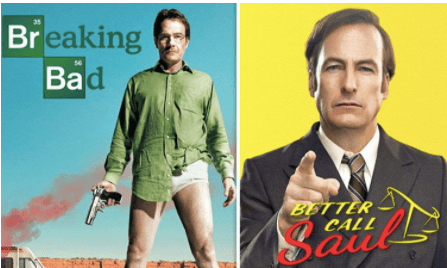
In both TV shows, we see a reenactment of the biblical parable of the prodigal son, with a special emphasis placed on understanding the Elder Brother character. Walter White of Breaking Bad and Chuck McGill of Better Call Saul are archetypal elder brothers to Jesse Pinkman and Jimmy McGill/Saul Goodman, respectively. These characters become case studies of the unique failings of both Elder Brothers and Younger Brothers, as depicted in the prodigal son parable. These allegorical connections are part of what makes Breaking Bad and Better Call Saul such rich examinations of morality.  

The Parable

The Prodigal Son narrative appears in Luke 15:11-32 when Jesus tells a series of parables to a group of Pharisees. In the story, there is a rich man with two sons. The younger son asks his father for his share of the inheritance (an extremely disrespectful action). The father gives it to him, and the son runs off. He squanders the money “in reckless living” (v. 13, ESV). When he runs out of money, there is a famine in the country he is in. The only work he can find is feeding pigs (which, when considering Jewish dietary laws, symbolizes a great spiritual deprivation). The son decides to go back to his father and to offer himself up as a hired servant in order to pay back his debt. He knows his father is a kind man, and he will be treated better as a servant for him than he is now.  But when the younger son returns home, his father runs to meet him and immediately embraces him back as his son and puts on a celebration, declaring that the son “was dead, and is alive again; he was lost, and is found’” (v. 22). The son, despite his failings, has been forgiven and fully reconciled with the father. 

Meanwhile, when the elder brother, who has remained faithful to his father, hears about this, he becomes angry and refuses to join the celebration. His father comes out to try to bring him in, but the brother argues that it is unfair that while he has always served the father, it is his younger brother, who acted so shamefully, who is now being celebrated. The elder son has served his father out of duty and a desire to be recognized, not out of love. The father responds that “‘Son, you are always with me, and all that is mine is yours” (v. 31). The parable ends without any reconciliation between the brothers or between the older brother and the father. 

Better Call Saul 

Better Call Saul is a more straightforward telling of the prodigal son story with the literal brothers of Chuck and Jimmy McGill. Chuck (Michael McKean) is the older brother who is a brilliant, respected, accomplished lawyer, and is nearly impossible to please. He casts a long shadow over his younger brother Jimmy (Bob Odenkirk), who has a messy past and is more than willing to take a few shortcuts to get his way. Chuck operates in a completely black-and-white worldview. He is a staunch legalist who puts all of his trust in the law. He shows little capacity for mercy or grace. Because he sees Jimmy cut corners and get things without working as hard for them as he did, Chuck is full of self-righteous anger. 

Pastor Timothy Keller writes in his book The Prodigal God that “Elder brothers base their self-images on being hardworking, or moral, or members of an elite clan, or extremely smart and savvy” (61). Chuck does all of these things, and because he defines himself as being diametrically opposed to Jimmy, he refuses to recognize any of these characteristics in his brother. This means Jimmy, even at his best, can never earn Chuck’s love and approval. This is part of the reason he gives up on being good altogether and embraces the Saul Goodman moniker. 

Chuck’s resentment towards Jimmy is best reflected in the words of the older son to the father in the parable after he hears of the celebration for his brother:

“‘Look, these many years I have served you, and I never disobeyed your command, yet you never gave me a young goat, that I might celebrate with my friends. But when this son of yours came, who has devoured your property with prostitutes, you killed the fattened calf for him!’ [The father responds:] ‘Son, you are always with me, and all that is mine is yours. It was fitting to celebrate and be glad, for this your brother was dead, and is alive; he was lost, and is found’” (v. 29-32). 

The joy of the father’s inheritance has always been available to the older son. Being with the father is itself a gift. Likewise, a joyful relationship with his brother and personal satisfaction in his own accomplishments has always been possible for Chuck. But he self-sabotages both because he’s too preoccupied with the perceived unfairness of how he’s been treated compared to Jimmy. He sees any grace extended towards Jimmy as unfair, and isn’t unfairness the antithesis of the law? It is for a legalist who hasn’t experienced mercy. 

The tragedy of Chuck is that he is too focused on what he deems “fair” to see what is loving and kind. Even when Jimmy is at his humblest, Chuck continues to cut him down. Chuck did all the “right” things, but without the right heart, it leads to nothing. Chuck dies alone in his house, with nothing of value to show for himself. His story ends with alienation from joy and from his brother, just like the elder brother in the parable.

Amill Santiago writes in “Better Call Saul and the Ache for Approval” that, “The two broken brothers are trying to get essentially the same thing through very different ways: immorality and moralism… [But] In Christ we can be received and approved despite our moral failures (cf. 1 Tim. 1:15) and independently from our moral performance (cf. Eph. 2:8-9).” Chuck and Jimmy, like the Elder and Younger brother, are both trying to fill holes in their hearts for affirmation and reward, but simply in different ways. In this sense, Better Call Saul invites viewers to examine the ways in which they lean towards the younger brother or elder brother mindset, and the follies of both. The show understands, like the parable, that neither approach to life- duty and joyless obligation like Chuck, or self-centered rebelliousness like Jimmy, are satisfactory ways to have relationships with God or others. 

But, unfortunately for the McGill brothers, Better Call Saul is also a show about how seemingly minute choices put people on a path towards destruction from which they eventually find themselves unable to escape. There is no father/God figure in Better Call Saul who disrupts the road to destruction and redeems his wayward children, who stops Jimmy McGill from becoming the Saul Goodman we know in Breaking Bad. In this regard, Better Call Saul’s fatalism is at odds with the Prodigal Son parable. But despite this, there is still great value in the way the show prompts audience introspection, and how Better Call Saul shows other characters land in the middle of the extreme older brother-younger brother spectrum. Kim, Howard, Mike, Nacho, and others move around from one end of the spectrum to another, and this fleshes out how anyone can “break bad,” and the many incarnations this can take. This variation is what makes the show so compelling. 

Breaking Bad

In Better Call Saul, the older and younger brother dynamic is more straightforward because it plays out in the central sibling relationship between Chuck and Jimmy. But in Breaking Bad, Walt and Jesse are not brothers, nor is their relationship dynamic that of brothers. Instead, Walt and Jesse have a twisted father and son relationship (one of forced co-dependency). This means that the older/younger brother dynamic doesn’t play out so much in their interpersonal relationship as much as it does through their symbolic standings in society.

Walter White (Bryan Cranston) is a quintessential elder brother in his world. When we meet him in the pilot, he’s a mild-mannered high school chemistry teacher who keeps his head down and is a steady father and husband. He is seen as the beta male to his DEA brother-in-law, Hank’s, alpha machismo. Walt feels emasculated by his wife Skyler. He feels underappreciated and underestimated. He is full of unrecognized genius, and therefore full of bitterness to those around him who do not recognize this genius. When he is diagnosed with lung cancer, he’s been dealt an undeniably crappy deal. But he chooses to let this be the reason why he indulges in self-pity and becomes unbelievably cruel. This is because, “The first sign [of] an elder-brother spirit is that when your life doesn’t go as you want, you aren’t just sorrowful but deeply angry and bitter. Elder brothers believe that if they live a good life they should get a good life” (Keller, 56). In El Camino, Walt tells Jesse in a flashback, “You’re lucky, you know that? You didn’t have to wait your whole life to do something special.” Walt wants the same thing as Jesse, but has spent his life trying to get it in a different way. Elder brothers try to gain what they want through loveless obedience, and become disillusioned when their efforts don’t pay off.  

Walt’s cancer diagnosis puts him in contrast to Hank when Hank is shot by the twins and loses his ability to walk. While Walt’s pain reveals pride, anger, bitterness, and entitlement, in the end, Hank uses his pain as a catalyst to become a better man, husband, and DEA agent. For Walt, “The good life is lived not for delight in good deeds themselves, but as calculated ways to control their environment” (Keller, 58). When he loses control of his environment, the Heisenberg that was always inside him does everything necessary to regain control, which means becoming a menace to everyone, especially to those in his own home. Walt feels that he’s earned the right to play Heisenberg, to live out this childish power fantasy because he has acted good and has been repressed for so long. He helps justify this with his mantra of doing it all “for his family,” a lie he holds onto until the very end, when he finally admits to Skyler in the episode “Felina” that he did it all for himself. In Walt, we see that the elder brother mindset is a ticking time bomb. When the elder brother feels cheated, or that his “good life” hasn’t paid off in the way he expected, he lashes out in self-righteous pride and anger. He is unable to relate to others with grace and mercy because he refuses to accept it himself, and nothing will ever be good enough for him. 

On the flip side, you have Jesse Pinkman (Aaron Paul), who (despite actually being an older brother in his biological family) is a classic younger brother. In the parable, “The [younger brother] humiliates his family and lives a self-indulgent, dissolute life. He is totally out of control” (Keller, 39). This is how we meet Jesse at the beginning of the show. He’s considered by his family and respectable society to be an embarrassment; a wayward junkie, too dumb and unruly to ever do anything of value. He’s seemingly squandered all potential and resources he has for a life of easy living and drugs. Literally the third sentence Walt says to Jesse in the pilot is, “Honestly, I never expected you to amount to much.” 

Throughout the series, Jesse has quite a few “eating with the pigs” moments, from S02E04 “Down” when he’s kicked out of his house and spends the night on the floor of the Krystal Ship, covered in portapotty sludge and wearing a facemask, to being a meth-cook slave to neo-nazis by the end of the series. And that’s just the physical desolation; Jesse is constantly haunted by guilt and remorse and keeps being pulled further and further in over his head into the life of crime he was never cut out for. Jesse, unlike Walt, is brought low enough to see his need for forgiveness and redemption. It’s easy to imagine him saying the words of the younger brother at his lowest points- “I have sinned against heaven and before you. I am no longer worthy to be called your son” (v. 21). But because there is no God/father figure in Breaking Bad either, Jesse turns to all sorts of self-flagellation to try and replicate this forgiveness, from rehab and its philosophy of unconditional self-acceptance, to mind-numbing partying, to helping the DEA, to going through a personal hell in captivity. We see here that the younger brother’s life of gluttony and self-fulfillment leads to great personal consequences. If the younger brother doesn’t come to see the error of his ways, this self-destructiveness is a never-ending spiral. If the younger brother does see the error of his ways, then he needs forgiveness and reconciliation to be able to move past his failings. 

In El Camino, Jesse gets his happy ending (as happy as one can be in Breaking Bad), and the older brother/younger brother’s differences are further parsed out. When Jesse escapes captivity, he is able to rely on his friendships and connections to help get him to Alaska. He doesn’t have Walt’s pride and is able to use his relationships with Skinny Pete, Badger, Old Joe the junkyard guy, his parents, Ed, and the memories of Mike and Jane to guide him. In the end, Jesse is, in part, saved by his reliance on others and their prodigal mercy towards him, while Walt dies utterly alone, having severed all relationships because he saw them primarily as transactional. Jesse as the younger brother experiences a restoration. Walt refuses every chance given to him of restoration with himself, his family, and moral society. 

While Better Call Saul invites viewers to consider themselves and whether they are an older or younger brother and how such mindsets lead down equally dangerous roads, Breaking Bad is focused more on the ending of the parable. Better Call Saul’s lack of a father/God figure means neither Chuck nor Jimmy get redemption. Breaking Bad gives Jesse as the younger brother a reconciliation, but leaves the elder brother Walt’s ending as unresolved, just like the parable. This zeros-in on a key point of understanding the parable. Jesus was talking to a group of Pharisees, hyper-religious men who loved the law over God and enforcing the law over loving others. By leaving the elder brother unreconciled, Jesus sends a clear message to the Pharisees- you look down on the younger brother sinners of the word, but your fates will be much worse if you do not see the hatred in your own hearts.

Breaking Bad, too, seems to think that being an elder brother can be potentially worse than being a younger brother, conveying this through both the respective endings for Walt and Jesse and also through the show’s tight-rope balance of pushing the audience to align themselves with Walt, only to then remind you of Walt’s monstrosity. By doing this, the show puts up a mirror and makes you realize how easily you too are swayed into his self-serving, self-righteous, entitled mindset. Perhaps it is easier in our current society to be elder brothers- and much more dangerous as well. These shows focused on morality come to similar conclusions to that of Jesus’ parables- that bitterness, anger, resentment, a lack of mercy, and entitlement are all key roots of evil.

-Madeleine D.

Living In The Curse: Miss Americana

Taylor_Swift_-_Miss_Americana

Miss Americana is a 2020 Netflix documentary by Lana Wilson about superstar Taylor Swift. It gives an overview of Swift’s career through the years but focuses primarily on 2016 through the release of her newest album Lover from late last year. The movie depicts the 2016 election and a series of Swift’s personal and professional struggles as the catalyst for her newfound political voice, which she showcased during the 2018 midterm elections (coming out in support of a Tenessee Democratic candidate), the pro-LGBTQ+ song “You Need To Calm Down” from Lover, and her sexual assault trial that she won in 2017 against a radio DJ who groped her during a meet-and-greet. 

None of the events depicted in the documentary are particularly new, even for casual fans but especially for dedicated ones. Most of these events were highly publicized and Swift has already spoken or sung about them. The most interesting new stuff comes from discussions between Swift and her team about her political statements and genuinely thrilling footage of Swift at work recording. For the filmmaking itself, there is nothing groundbreaking here in the art of making documentaries about stars. But while the parts of Miss Americana may not be new, it is the most concise expression that I’ve seen of what all other pop-documentaries have been trying to say:

Fame is a curse. 

The first sequence after the opening scene shows Swift preparing for a show on her Reputation tour. She stands in the wings and puts on a glittery hoodie. She looks like a boxer. Then she comes out on stage, with all the showmanship of today’s WWE shows, and suddenly you realize that even for a woman who is at the height of her powers and is, arguably, the biggest titan in the music industry right now, she is still fighting every day. And that’s terribly sad. 

Swift and the film touch on a number of reasons why fame is a curse. The profound loneliness while being extremely visible, particularly when it comes to personal relationships. The pressure to always top yourself and to keep evolving and changing your image. The fact that once you’re famous,  you are not an individual, but a cultural archetype that can be used as a character to cast in myths and allegories of politics, identity, history, and explorations of greater systems than ourselves, as is well-explored in this Vox article, “How the Taylor Swift-Kanye West VMAs scandal became a perfect American morality tale”. 

Along with these general observations on fame, the film also explores Swift’s unique experience of fame, which is shaped by the brand she established for herself when she started at age 14. Swift has a distinct brand of vulnerable authenticity. Her songs are extremely personal and are most frequently compared to that of a diary. It’s distinct because Swift was one of the pioneers of the pop-star-as-your-friend movement, on top of seemingly every trend and perfectly suited to the social media age. If nothing else, she has carried this brand with the most consistency out of her contemporaries. 

Now is she really authentic? Hard to say. I’m of the mind that no one is truly authentic, and certainly not when they are commodifying themselves, as we all do online and in our work. Swift’s biggest critics disdain what they see as an overly-polished relatability. Making a documentary adds to Swift’s brand of vulnerability and openness, but it doesn’t reassure me that she isn’t fully in control of how she’s being portrayed all the time. 

But while we can question how authentic her personal image and actions are, I don’t think there is any question about the sincerity of her motives. You may wonder how much of a victim Swift was in, say, one of her breakups, but what Swift really wants you to see is that she is always truthful about what she feels, which is what comes across in her songs. Those feelings, if not the truth of the situation, are authentic. 

That comes across very clearly in Miss Americana and is one of the most compelling aspects of it. In the opening monologue, Swift talks succinctly about how she has always wanted to be good, and the documentary goes on to chart how what she has defined as “good” has changed over the years. She’s always acted out of a desire to be on the right side of things, for better or worse. As someone who is similarly motivated by the same desire to “be good” (unite, enneagram ones!), albeit defined differently than Swift, this is incredibly relatable and therefore feels authentic. It goes back to the theme of the authenticity of her motivations, which is why I think she remains such a big star and has an intimate parasocial connection with her fans.

Miss Americana is not a particularly revealing look at Swift, and can feel pretty milquetoast at times. But it is a good look at fame, and if you were already interested in the film or Swift, then it delivers on its promise to craft the bildungsroman of Taylor Swift, 30, coming of age by finding her political voice. 

-Madeleine D.