
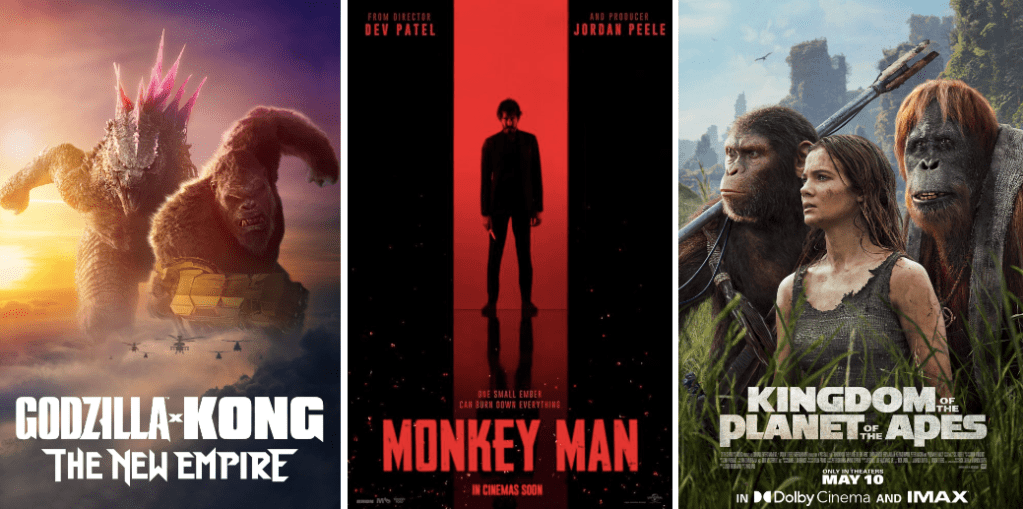
Within the past two months, we have gotten three high-profile films featuring monkeys. In Godzilla X Kong: The New Empire, we see King Kong, the giant ape kaiju, fight/occasionally team up with the equally giant lizard kaiju Godzilla. In Monkey Man, Dev Patel plays not a literal monkey, but a fighter who uses a monkey mask that resembles Hanuman, a half-monkey, half-human Hindu deity. And in Kingdom of the Planet of the Apes, we get a whole lot of apes– a kingdom full, in fact– rising up as they continue to take over the Earth from the disappearing human race.
To help us navigate this Monkey Movie Spring, I’ll be going through each movie to share my thoughts and analysis, as well as give each movie a number on a scale of one to ten regarding how monkey-centric it is. We’ll answer questions like, Is Monkey Man Dev Patel’s big breakthrough? Does Kingdom of the Planet of the Apes live up to its predecessor trilogy? Is Godzilla x Kong a new peak for monster cinema? Are these films worth your time? Or are they just… monkeying around?
Godzilla x Kong: The New Empire
There is no reason to see this film if you do not already have interest in it. You are not missing out on anything. If you want to see a good kaiju movie, watch Godzilla Minus One, and if you want a goofy monster movie, watch Venom. However, if you have any affinity for these movies already, I do think this makes improvements upon the last film in this franchise, Godzilla vs Kong. For one, the human cast is paired down significantly to focus on Rebecca Hall and Kaylee Hottle (whose adopted mother-daughter subplot feels directly torn from the Jurassic World films), with a big assist from Brian Tyree Henry, and the addition of a very-game Dan Stevens. Godzilla x Kong keeps the plot more simple: Kong and his home are in trouble, Godzilla must help. And, it leans more into the absurdity of the fights, turning Godzilla and Kong’s tussles into something akin to an extravagant MMA fight with a sprinkling of Marvel superhero action. It does exactly what it aims to do, and succeeds at being a silly, fun time.
Monkey Movie Rating: 4/10 – While Kong is the primary character, and we do get several additional monkey characters, ultimately, this is not a rich exploration of the monkey experience.
Monkey Man
Dev Patel is one of our best working actors today, yet he rarely has gotten material that is on his level. With Monkey Man, he creates his own opportunity through co-writing, producing, directing, and starring in this revenge story about an unnamed protagonist (simply called “Kid”) who seeks revenge on the man who killed his mother and massacred his village.
The film has been compared by many to John Wick, which I have not seen. So while I can’t speak to that, I can say the action here is inventive, brutal, and compelling- at least, the 50% of it I saw between covering my eyes with my hands because of said brutality.
The story is admirably ambitious, weaving together references to political corruption, religious violence, personal trauma, poverty, and oppression. The movie clearly condemns the Indian caste system, and centers marginalized people as the heroes of the story. There is a righteous anger pulsing through the film, and often used to great effect in the action sequences.
Another thing that sets it apart is the use of the Hanuman mythology. Not only is Hanuman the deity that Kid draws inspiration from in his fighting, but the story beats, very loosely, play out aspects of the Hanuman lore. I saw the film with an Indian friend, who loved the story of Hanuman growing up and was delighted with how the film used the character. Her insight into the film, telling me things I either didn’t catch or didn’t know, was incredibly helpful in making me appreciate the movie more. However, because the movie itself doesn’t explain all of this to the audience, and its use of the Hanuman lore is somewhat abstract, I think most Western viewers won’t catch the deeper layers of the story, meaning that the film’s most accessible aspects are its most basic.
In the end, I ultimately agree with the New York Times review of the film by Manohla Dargis, who writes, “Patel gestures at the real world and folds in some mythology, but these elements only create expectations for a complex story that never emerges.” I don’t think the story is able to fully elevate those references into something subversive to this genre, which results in a movie that has a very distinct setting and feel, but only leaves you with a very straightforward revenge tale with overly-familiar story beats. What Monkey Man is best at is its visceral fights, the stunning cinematography, and Patel’s acting. If he doesn’t immediately get better work off of this, I might just pick up a Hanuman mask and head to some Hollywood offices myself.
Monkey Movie Rating: 6/10 – While it does not actually depict monkeys, Monkey Man does a lot for prestige monkey representation. Along with the title and references to Hanuman, this movie has an anarchist, feral spirit that honors its titular animal.
Kingdom of the Planet of the Apes
The Rise, Dawn, and War for the Planet of the Apes films are some of the greatest science fiction films of the recent past, powerfully led by Andy Serkis as Caesar. But even though those films are excellent, I was wary of this new installment in the franchise. I imagined the premise would be something trite, like, “Here’s a new ape who is Caesar’s grandson or something, struggling under the weight of his family’s legacy.” Thankfully though, Kingdom does something much more interesting.
Set generations after Caesar’s death, when apes are continuing to rapidly evolve and the few remaining humans on Earth have either gone underground or have become animalistic, we follow a young ape named Noa (a very impressive Owen Teagues) who is a part of a small clan of apes who practice falconry. An ape named Proximus attacks and captures his clan in order to build his own kingdom, set on destroying the remaining humans and gaining their knowledge. With the help of a human girl named Mae (Freya Allan), a devout disciple of Caesar named Raka (Peter Macon, also excellent), and some other allies, Noa faces Proximus to free his clan.
The Caesar trilogy was memorable for the way it leaned into allusion and allegory (Caesar is Moses! Caesar is Christ! We’re referencing the Civil Rights Movement! We’re referencing the Holocaust! We’re referencing Vietnam! We’re referring to the border wall and immigration!). Kingdom does not do this. Instead, it focuses on being a more intimate, small-scale character drama, giving Noa a very classic Jungian character arc. But within this subtler framework, it continues the franchise’s questions about the blurry line between humanity and the apes. Can they coexist? Should they? This franchise continues to hold my interest in these questions and how it explores them.
The only real criticism I have for Kingdom is that I found it to be poorly paced. In a two and a half hour long film, it takes us about an hour and a half to meet our main villain. The introduction and inciting incident of the village raid could, in my estimation, have been about fifteen minutes shorter and have been just as effective. Likewise, the next rambling hour of road-tripping with Raka and Mae could have been significantly cut down, especially since there isn’t a lot of character building for Mae in this section. The final act is dramatic and interesting, but is now far too short after all of this build-up. A tighter run time with a few cuts could have kept the momentum of the story going, and made the ending a little more impactful.
In the final moments of the film, we get hints that we’re getting close to the timeline of the 1968 film. There’s enough ambiguity, however, for us to have another film or two in between if we want to keep this story going. So, should we?
I say yes, with a bit of hesitation. It’ll be a tricky act to pull off, to continue this story without redoing beats from the original trilogy, turning Noa into a second Caesar. There’s a lot of ground to cover in getting to the ape society we see depicted in the 1968 film, but that sociological aspect may be harder to do in a blockbuster film. But if the franchise can continue to introduce compelling new characters, as they do here, I’ll continue to be invested. For example, based on the advertising, I thought Mae (Freya Allen) was going to be another silent young girl, a passive plot device meant to represent the redeemable side of humanity. To my surprise, she not only can speak, but ends up being a sly inversion of that trope, and her actions in the final third of the movie are bold and complex. If these movies can keep pulling out tricks like these, they’ll remain something special.
Monkey Movie Score: 10/10 – This is a movie about monkeys: their experiences, their psychology, their culture, history, politics, and hopes and dreams. It has a diverse array of monkey characters. This is the crown jewel of Monkey Movie Spring.
-Madeleine D.
 madeleinelovesmoviesdotcom