
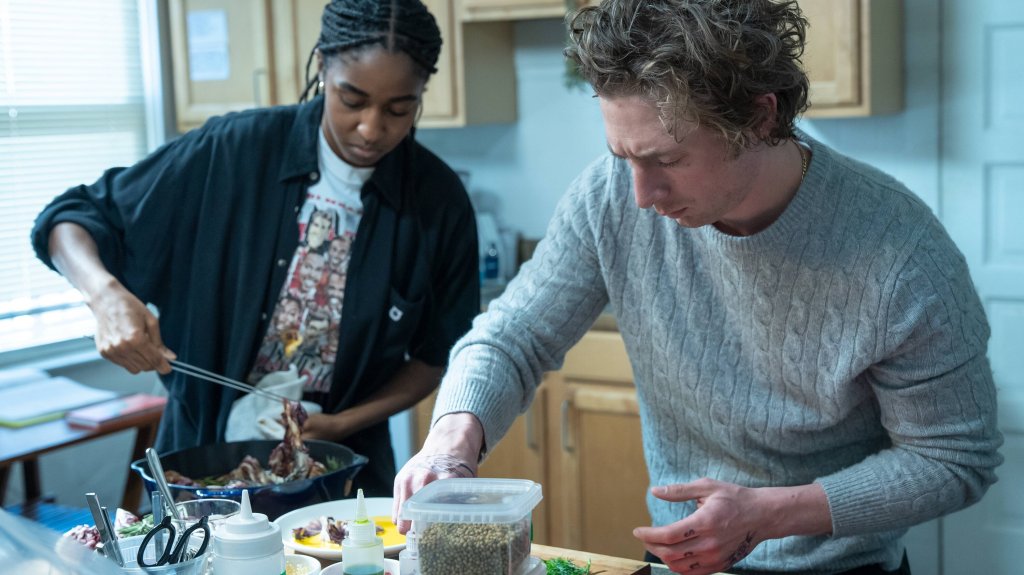
FX and Hulu’s The Bear recently dropped its second season. The show, which came out in relative obscurity last summer but then exploded in popularity, has become a phenomenon and is being hailed as one of the summer’s best shows. The first season followed Carmen “Carmy” Berzatto (Jeremy Allen White), a fine dining chef, as he returned to his hometown of Chicago to take over his deceased brother’s floundering sandwich shop. Season 2 finds Carmy and the staff shutting down the sandwich shop and opening a fine dining restaurant, The Bear, in its place. The real heart of the show is its ensemble of the rough-around-the-edges kitchen staff, and season two finds many of them embarking on journeys of professional and personal growth. The show has many themes- the ruthlessness of the culinary world and the toll it takes, family trauma, found family, the sacrifices it takes to become the best, and cooking as hospitality.
Woven in with all of those themes is a beautiful ode to vocation, and an honest one. And as I watched, I saw in some of the character’s stories illustrations of some of the core Christian doctrines around vocation. The Bear is not an explicitly religious show, but that doesn’t mean it can’t be deeply insightful, even biblical, about the nature of work. So that is what I want to explore here: how The Bear, particularly in this season, gives us insight into how a Christian can think about vocation.

In Tim Keller’s book, Every Good Endeavor, he starts off by analyzing a short story by J.R.R Tolkien, called Leaf by Niggle. In the story, a painter named Niggle tries to paint a gorgeous tree. He spends his life on this painting, yet due to circumstances and his perfectionism, he is only able to paint one really good leaf on the whole tree. Then Niggle dies, feeling like a failure. In the afterlife, Niggle is invited to a heavenly country, where he sees the tree he had always imagined in his mind and tried to paint. The tree is real. The tree is real and beautiful and will be enjoyed forever in this heavenly place. In retrospect, we see that Niggle’s life on earth was about reflecting and imitating and making known to others this real, beautiful thing- even though his efforts were small and clumsy. Because the tree is real, Niggle’s painting, no matter how incomplete, had meaning.
In this, we see a vision for Christian vocation that is both realistic and beautiful. As Christians, we believe that God is in the business of restoration, and he is truly making all things new (Revelation 21:5). He has not abandoned Earth; he is restoring it and will bring it to perfection in the fullness of time. And in the meanwhile, he delights in using our human work to bring about that restoration. That restoration comes because we know and believe in a deeper truth, which is that of the work and love of Jesus. What the world sees as lost causes, the Christian can see as a yet-to-be-used canvas of God’s mercy. That is, in essence, Niggle’s Tree, the truth that a Christian can work from and find hope and inspiration in. Our efforts– artistic or otherwise– are best when they are reflections of God’s truth and his plan for the world.
Yet at the same time, we live in a broken world, and are sinful, imperfect vessels. Therefore, none of the good work we do will be complete in this world. Like Niggle, circumstances, and our own selves, get in the way of good work. Most of the time, our work will not look fruitful at all; it will look like failure, or an incomplete mess. This is the result of the curse given to Adam and Eve in Genesis 3 after they sin. God tells them work will no longer be always pleasurable or easy. It is now cursed, characterized with “thorns and thistles”, and only “by the sweat of your face” (3:18-19). Both of these realities hold comfort. When our work is frustrating, we find comfort in the truth that it is that way because of sin, and we can’t expect our work to always be good. This protects us from the bitterness and resentment that comes with unrealistic expectations. But at the same time, our work is always inherently valuable when it is done to please God, because it is like the leaf- it is connected to something that is real and perfect, even if our efforts are not.

In The Bear, various characters get glimpses of “the tree.” They get a glimpse into what a beautiful, perfected version of their work is, and it is what pushes them to strive harder to better their own craft and, more importantly, value the human relationships their work gives them. This is best illustrated in episode 7, “Forks,” which follows Richie as he interns as a stage at a high-end restaurant. He arrives at the restaurant angry at the position and bitter about his life; he lacks purpose and fears he will soon be driven out of Carmy’s restaurant, a restaurant he’s not even sure he wants to work in but is the only place he’s ever fit in.
But as his work goes along, he gains an appreciation for the staff who work there. He sees the pride the employees take in their work, and how they are able to link all of their work to the relational interactions they have with guests. The hospitality of the restaurant is not ultimately about the quality of the food, it’s about the way food and presentation can be used to make someone feel seen, and therefore cared about. When Richie serves a special deep-dish-pizza-inspired plate to some guests visiting Chicago, he is connecting with them through service, and the delight both he and the guests experience is transcendent. That is the tree, that is the vision of what fine dining can be that Richie takes back with him when he goes back to The Bear. And even though his time at The Bear won’t necessarily be made up of transcendent moments (the opposite, actually), the newfound respect for himself and his vocation fuels him and makes the way he does his work more beautiful and purposeful, no matter the actual impact of the work itself.

Meanwhile, Tina, Ebra, and Marcus are also all sent off to nurture their talent, with the first two going to culinary school and Marcus taking an apprenticeship in Copenhagen to study under a dessert chef. After butting heads with Sydney in the first season, Tina has now softened and become more open to change and focused on sharpening her craft. This openness earns her the rightful role as Sydney’s sous chef and this season she flourishes. Ebra is hesitant and intimidated by culinary school, but eventually finds the courage to continue. And Marcus is finally given the space for his interests to be nurtured, and is reminded of something important by the other chef, Luca, which is that there is freedom in realizing you can’t, or won’t be the very best, and that humility actually allows you the chance to learn. And, Luca adds, that you have to spend time out in the world to be any good in the kitchen. Which is to say, we can’t be solely defined by our work.

One of the best moments of the show happens in the penultimate episode, when Natalie admits to Sydney she hasn’t eaten that day, so Sydney makes her an omelet. Sydney later tells Carmy that that was the best thing she did that day. Sydney is being reminded of the tree– that this job is about serving and loving someone else with the gifts she’s been given. That is what the restaurant is ultimately for.
Tina lays down her pride to become better than she ever thought she could be. Marcus and Ebra take the leap to invest in their gifts and embrace the humility it takes to get better. Richie learns how to work with a purpose that is outside of himself. Sydney is reminded of the true heart of her work.
But Carmy, tragically, is the one who doesn’t learn any of this. During the opening night of the restaurant, Carmy gets locked into the walk-in fridge. Despite his setback, the staff is able to handle the rest of the night without him, successfully finishing the night. But Carmy can’t handle it. Instead of being proud of the fact that his staff was strong enough to handle things without him, he spirals, even ending up (accidentally) telling his girlfriend Claire that their relationship was a waste of time and focus.
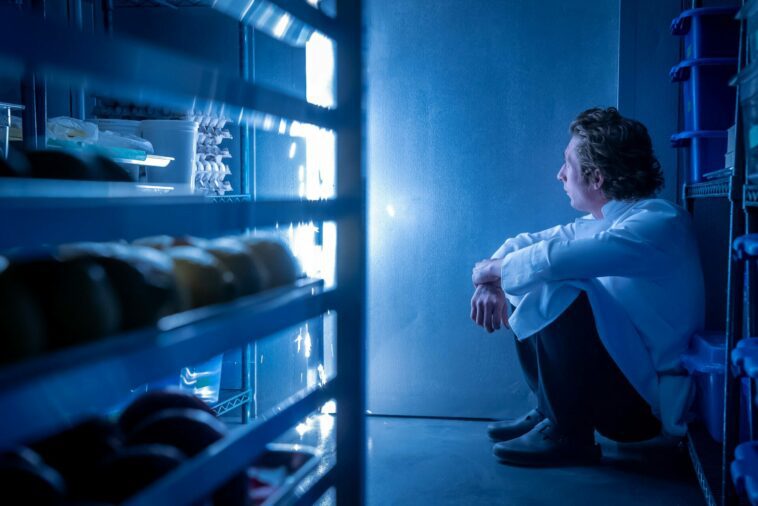
Richie then calls him out, comparing Carmy to his mother Donna (played by Jamie Lee Curtis), who we are introduced to in a flashback episode. In that episode, Donna, on the brink of a meltdown, makes the family an extravagant holiday meal, but no one can enjoy it because she’s martyring herself over it. She complains that she’s overwhelmed, then won’t take any help offered to her, and when the meal is done, she won’t accept or believe any amount of compliments about it. She desires to cook for her family as an act of love and sacrifice, but she is so consumed with herself that it isn’t anything but a narcissistic act of attention.
Carmy might not be so far gone, but in that moment, that’s what he’s doing. He is not enjoying the restaurant for what it is and for the satisfaction of using his gifts and blessing others with it; or seeing his staff step up and do their jobs beautifully. Instead, he’s mourning that, by being stuck in the fridge, he is not being able to prove himself and justify all he’s sacrificed. And that is what makes it impossible for him to believe in the chance at a romantic relationship, or any life outside of the kitchen. As long as he finds all his worth in his job, he can never imagine a life outside of it. A Christian view of vocation counteracts this, because Christians don’t find their worth and identity in themselves or their skills, they find it outside of themselves in Christ. Carmy has chased his dreams and given it everything he has, but it hasn’t made him happy, because the perfect “tree” will always be beyond himself and his own abilities.
The season ends with uncertainty: the staff has experienced some triumphs, and the restaurant’s first night was a success, but various relationships are in a precarious place, and Carmy is once again his own worst enemy. Most of the characters, through their experiences this season, have seen the tree. They have seen the deeper reality underneath their work, and it has resulted in more humility, teamwork, and respect for one another. But will they be able to hold on to that vision and mindset against hardship?
I can only imagine what will be cooking (sorry not sorry!) for season three.
– Madeleine D.
 madeleinelovesmoviesdotcom
Thank you for such a great insight on this show. I saw how one can help others to see their own purposes yet ignore it in themselves.
LikeLike